Ch. 4 - Inverse, Exponential, and Logarithmic Functions
Lial - College Algebra 13th Edition
Lial13th EditionCollege AlgebraISBN: 9780136881063Not the one you use?Change textbook
Chapter 5, Problem 6

Fill in the blank(s) to correctly complete each sentence. The graph of ƒ(x) = -(1/3)x+4-5 is that of ƒ(x) = (1/3)x reflected across the ______ -axis, translated to the left ______ units and down _______ units.

Verified step by step guidance
1
Identify the base function given: ƒ(x) = (1/3)^x. This is an exponential decay function because the base (1/3) is between 0 and 1.
Look at the transformed function: ƒ(x) = - (1/3)^{x+4} - 5. Notice the negative sign in front of the exponential term, which indicates a reflection.
Determine the axis of reflection: Since the negative sign is multiplying the entire exponential expression, the graph is reflected across the x-axis.
Analyze the horizontal translation: The exponent is (x + 4), which means the graph is shifted to the left by 4 units (because adding inside the exponent shifts the graph left).
Analyze the vertical translation: The '-5' outside the exponential function means the graph is shifted down by 5 units.

Verified video answer for a similar problem:

This video solution was recommended by our tutors as helpful for the problem above.
Video duration:
3m
Was this helpful?

Key Concepts

Here are the essential concepts you must grasp in order to answer the question correctly.

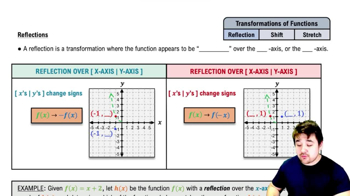
Reflections of Functions

A reflection of a function across an axis flips its graph over that axis. For example, multiplying a function by -1 reflects it across the x-axis, changing the sign of all output values while keeping input values the same.
Recommended video:
5:00
Reflections of Functions

Horizontal Translations

Horizontal translations shift the graph left or right. Replacing x with (x + h) moves the graph h units to the left if h is positive, and h units to the right if h is negative, affecting the input values before the function is applied.
Recommended video:
5:28
Horizontal Parabolas

Vertical Translations

Vertical translations move the graph up or down. Adding or subtracting a constant outside the function shifts the graph vertically; adding k moves it up k units, while subtracting k moves it down k units, changing the output values directly.
Recommended video:
5:30
Foci and Vertices of an Ellipse