Ch. 3 - Polynomial and Rational Functions
Lial - College Algebra 13th Edition
Lial13th EditionCollege AlgebraISBN: 9780136881063Not the one you use?Change textbook
Chapter 4, Problem 50d

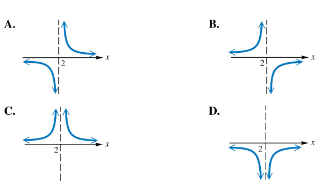
Work each problem. Choices A–D below show the four ways in which the graph of a rational function can approach the vertical line x=2 as an asymptote. Identify the graph of each rational function defined in parts (a) – (d). ƒ(x)=1/(x2)2ƒ(x)=-1/(x-2)^2

Verified step by step guidance
1
Identify the vertical asymptote by setting the denominator equal to zero: solve \( (x - 2)^2 = 0 \) which gives \( x = 2 \). This means the vertical asymptote is the line \( x = 2 \).
Analyze the behavior of the function near the vertical asymptote. Since the denominator is squared, \( (x - 2)^2 \), it is always positive except at \( x = 2 \) where it is zero, causing the function to be undefined there.
Consider the sign of the function on either side of \( x = 2 \). Because the numerator is \( -1 \), which is negative, and the denominator is always positive (except at \( x=2 \)), the function \( f(x) = \frac{-1}{(x-2)^2} \) will always be negative for values of \( x \) near but not equal to 2.
Determine the behavior of \( f(x) \) as \( x \) approaches 2 from the left and right. Since the denominator approaches zero and is squared, the function values will tend toward negative infinity on both sides of the asymptote.
Summarize the graph behavior near \( x=2 \): the graph approaches the vertical line \( x=2 \) with the function values decreasing without bound (going to negative infinity) on both sides, indicating the graph is below the \( x \)-axis near the asymptote.

Verified video answer for a similar problem:

This video solution was recommended by our tutors as helpful for the problem above.
Video duration:
3m
Was this helpful?

Key Concepts

Here are the essential concepts you must grasp in order to answer the question correctly.

Vertical Asymptotes of Rational Functions

Vertical asymptotes occur where the denominator of a rational function equals zero and the numerator is nonzero, causing the function to approach infinity or negative infinity. For ƒ(x) = -1/(x-2)^2, the vertical asymptote is at x = 2 because the denominator becomes zero there.
Recommended video:
3:12
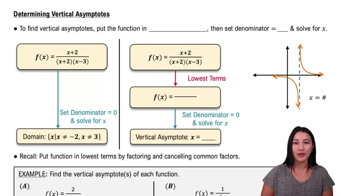
Determining Vertical Asymptotes

Behavior Near Vertical Asymptotes

The behavior of a function near a vertical asymptote depends on the power of the factor in the denominator. When the denominator is squared, as in (x-2)^2, the function approaches the same infinity (positive or negative) on both sides of the asymptote, resulting in a 'U'-shaped graph near x=2.
Recommended video:
3:12
Determining Vertical Asymptotes

Sign and Shape of the Graph Near the Asymptote

The negative sign in ƒ(x) = -1/(x-2)^2 flips the graph below the x-axis. Since the denominator is squared and always positive (except at x=2), the function values are always negative and approach negative infinity on both sides of x=2, creating a downward 'U' shape near the vertical asymptote.
Recommended video:
6:24
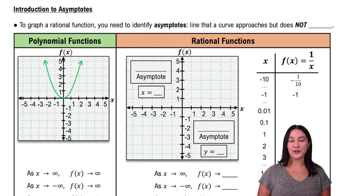
Introduction to Asymptotes