Use the intermediate value theorem to show that each polynomial function has a real zero between the numbers given. ƒ(x)=x4-4x3-x+3; 0.5 and 1
Ch. 3 - Polynomial and Rational Functions

Chapter 4, Problem 51
For each polynomial function, find all zeros and their multiplicities.
Verified step by step guidance1
Start by identifying the factors of the polynomial function: \(f(x) = (x^2 + x - 2)^5 (x - 1 + \sqrt{3})^2\).
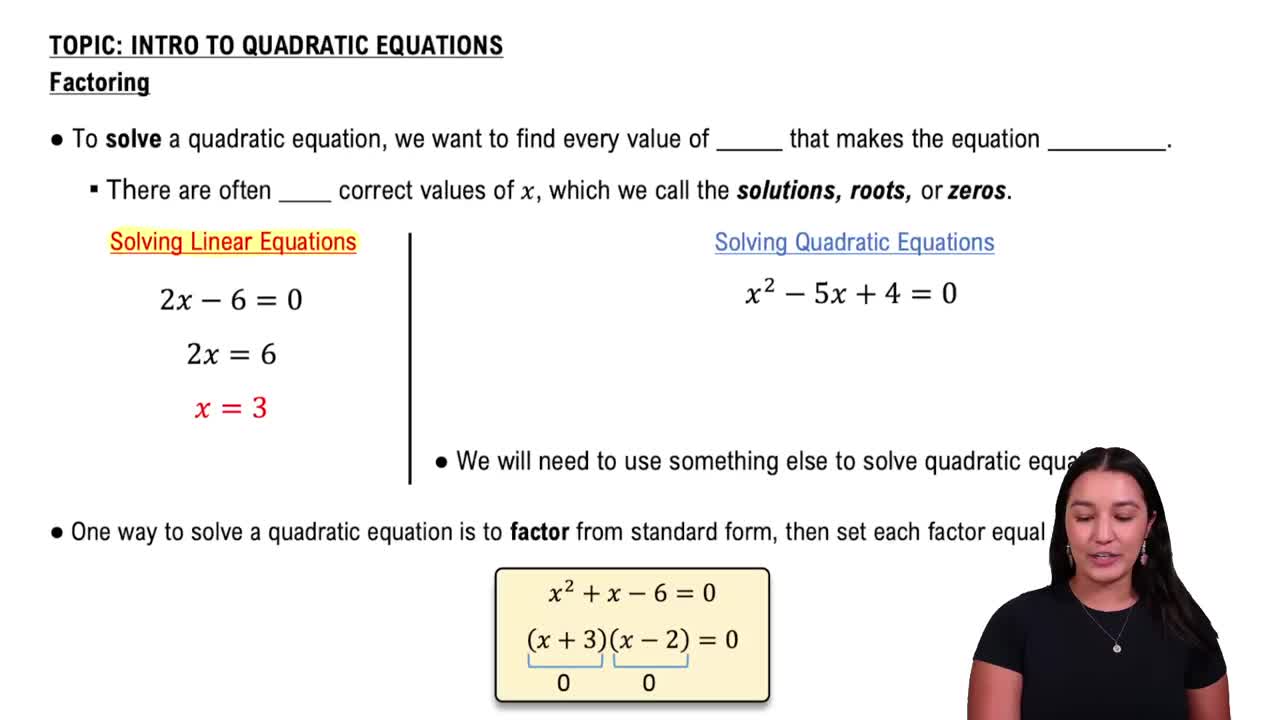
Find the zeros of the first factor \(x^2 + x - 2\) by solving the quadratic equation \(x^2 + x - 2 = 0\). Use factoring, completing the square, or the quadratic formula.
Once you find the roots of \(x^2 + x - 2 = 0\), note that each root has a multiplicity of 5 because the entire quadratic factor is raised to the 5th power.
Next, find the zero of the second factor \(x - 1 + \sqrt{3} = 0\) by isolating \(x\), which gives \(x = 1 - \sqrt{3}\). This zero has a multiplicity of 2 since the factor is squared.
List all zeros found along with their multiplicities: the roots from the quadratic factor each with multiplicity 5, and the root from the linear factor with multiplicity 2.

Verified video answer for a similar problem:
This video solution was recommended by our tutors as helpful for the problem above.
Video duration:
5mKey Concepts
Here are the essential concepts you must grasp in order to answer the question correctly.
Polynomial Zeros
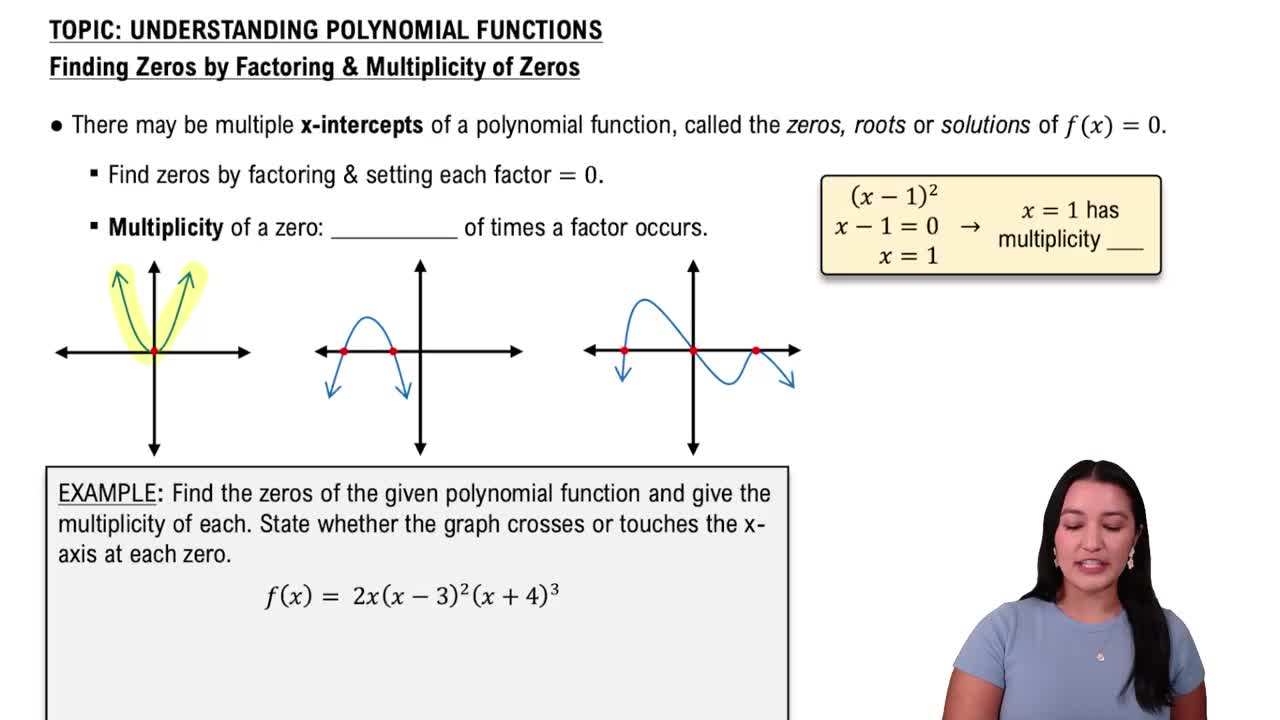
Zeros of a polynomial are the values of x that make the polynomial equal to zero. Finding zeros involves solving the equation f(x) = 0, which can be done by factoring or using other algebraic methods. Each zero corresponds to a root of the polynomial.
Recommended video:
Finding Zeros & Their Multiplicity
Multiplicity of Zeros
Multiplicity refers to how many times a particular zero appears as a factor in the polynomial. If a factor is raised to a power n, the zero associated with that factor has multiplicity n. Multiplicity affects the graph's behavior at the zero.
Recommended video:
Finding Zeros & Their Multiplicity
Factoring and Solving Quadratic Expressions
Factoring quadratic expressions like x^2 + x - 2 helps find zeros by rewriting the polynomial as a product of linear factors. Solving these factors set to zero gives the roots. Recognizing and factoring quadratics is essential for breaking down complex polynomials.
Recommended video:
Solving Quadratic Equations by Factoring
Related Practice
Textbook Question
Textbook Question
Use synthetic division to determine whether the given number k is a zero of the polynomial function. If it is not, give the value of ƒ(k). ƒ(x) = 2x3 - 6x2 -9x + 4; k=1
4
views
Textbook Question
Work each problem. Which function has a graph that does not have a vertical asymptote?
A. ƒ(x)=1/(x2+2)
B. ƒ(x)=1/(x2-2)
C. ƒ(x)=3/x2
D. ƒ(x)=(2x+1)/(x-8)
Textbook Question
Connecting Graphs with Equations Find a quadratic function f having the graph shown. (Hint: See the Note following Example 3.)
Textbook Question
For each polynomial function, find all zeros and their multiplicities.
Textbook Question
Work each problem. Which function has a graph that does not have a horizontal asymptote?
A. ƒ(x)=(2x-7)/(x+3)
B. ƒ(x)=3x/(x2-9)
C. ƒ(x)=(x2-9)/(x+3)
D. ƒ(x)=(x+5)/(x+2)(x-3)