Ch. 3 - Polynomial and Rational Functions
Lial - College Algebra 13th Edition
Lial13th EditionCollege AlgebraISBN: 9780136881063Not the one you use?Change textbook
Chapter 4, Problem 50b

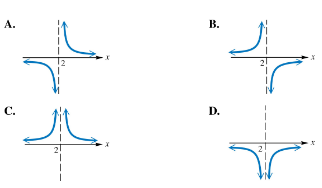
Work each problem. Choices A–D below show the four ways in which the graph of a rational function can approach the vertical line x=2 as an asymptote. Identify the graph of each rational function defined in parts (a) – (d). ƒ(x)=1/(x2)ƒ(x)=1/(x-2)

Verified step by step guidance
1
Identify the vertical asymptote by setting the denominator equal to zero: solve \(x - 2 = 0\) to find \(x = 2\). This means the graph has a vertical asymptote at \(x = 2\).
Analyze the behavior of the function \(ƒ(x) = \frac{1}{x-2}\) as \(x\) approaches 2 from the left side (\(x \to 2^-\)). Since the denominator approaches zero from the negative side, the function values will tend toward negative or positive infinity depending on the sign.
Analyze the behavior of the function as \(x\) approaches 2 from the right side (\(x \to 2^+\)). Since the denominator approaches zero from the positive side, the function values will tend toward positive or negative infinity accordingly.
Compare the behavior near the vertical asymptote with the four given graph choices (A–D). Look for which graph shows the function going to opposite infinities on either side of \(x=2\), consistent with \(\frac{1}{x-2}\).
Confirm that the function does not cross the vertical asymptote and that the graph matches the expected shape of \(ƒ(x) = \frac{1}{x-2}\), which typically has two branches, one in the second quadrant and one in the fourth quadrant relative to \(x=2\).

Verified video answer for a similar problem:

This video solution was recommended by our tutors as helpful for the problem above.
Video duration:
4m
Was this helpful?

Key Concepts

Here are the essential concepts you must grasp in order to answer the question correctly.

Vertical Asymptotes

A vertical asymptote occurs in the graph of a function where the function approaches infinity or negative infinity as the input approaches a specific value. For rational functions, vertical asymptotes happen at values of x that make the denominator zero, provided the numerator is not zero at those points.
Recommended video:
3:12
Determining Vertical Asymptotes

Behavior Near Vertical Asymptotes

The graph of a rational function near a vertical asymptote can approach positive or negative infinity from either side. Understanding whether the function values go to +∞ or -∞ on each side helps identify the correct graph and distinguish between different rational functions with the same vertical asymptote.
Recommended video:
3:12
Determining Vertical Asymptotes

Rational Functions and Their Graphs

A rational function is the ratio of two polynomials. Its graph can have vertical asymptotes, horizontal or oblique asymptotes, and intercepts. Analyzing the function's formula, especially the denominator and numerator, helps predict the shape and key features of its graph.
Recommended video:
8:19
How to Graph Rational Functions
Related Practice
Textbook Question

Work each problem. Choices A–D below show the four ways in which the graph of a rational function can approach the vertical line x=2 as an asymptote. Identify the graph of each rational function defined in parts (a) – (d). ƒ(x)=1/(x2)ƒ(x)=-1/(x-2)

2
views
Textbook Question

For each polynomial function, find all zeros and their multiplicities. ƒ(x)=5x2(x2-16)(x+5)

Textbook Question

Work each problem. Choices A–D below show the four ways in which the graph of a rational function can approach the vertical line x=2 as an asymptote. Identify the graph of each rational function defined in parts (a) – (d). ƒ(x)=1/(x2)2ƒ(x)=-1/(x-2)^2

Textbook Question

Work each problem. Choices A–D below show the four ways in which the graph of a rational function can approach the vertical line x=2 as an asymptote. Identify the graph of each rational function defined in parts (a) – (d). ƒ(x)=1/(x-2)^2

Textbook Question

Nuclear Bomb Detonation Suppose the effects of detonating a nuclear bomb will be felt over a distance from the point of detonation that is directly proportional to the cube root of the yield of the bomb. Suppose a 100-kiloton bomb has certain effects to a radius of 3 km from the point of detonation. Find, to the nearest tenth, the distance over which the effects would be felt for a 1500-kiloton bomb.

Textbook Question

Use the intermediate value theorem to show that each polynomial function has a real zero between the numbers given. ƒ(x)=2x4-4x2+4x-8; 1 and 2