Resistance of a Wire The resistance in ohms of a platinum wire temperature sensor varies directly as the temperature in kelvins (K). If the resistance is 646 ohms at a temperature of 190 K, find the resistance at a temperature of 250 K.
Ch. 3 - Polynomial and Rational Functions

Chapter 4, Problem 28
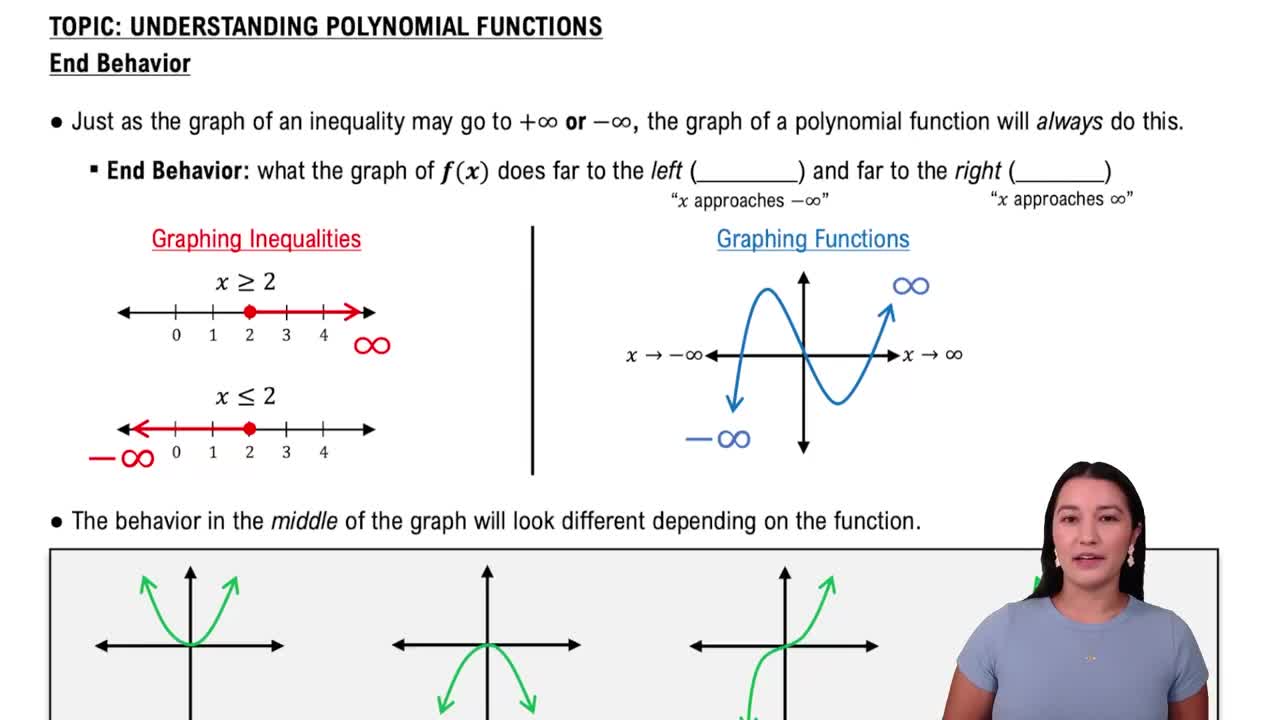
Use an end behavior diagram, as shown below, to describe the end behavior of the graph of each polynomial function. ƒ(x)=7+2x-5x2-10x4


Verified step by step guidance1
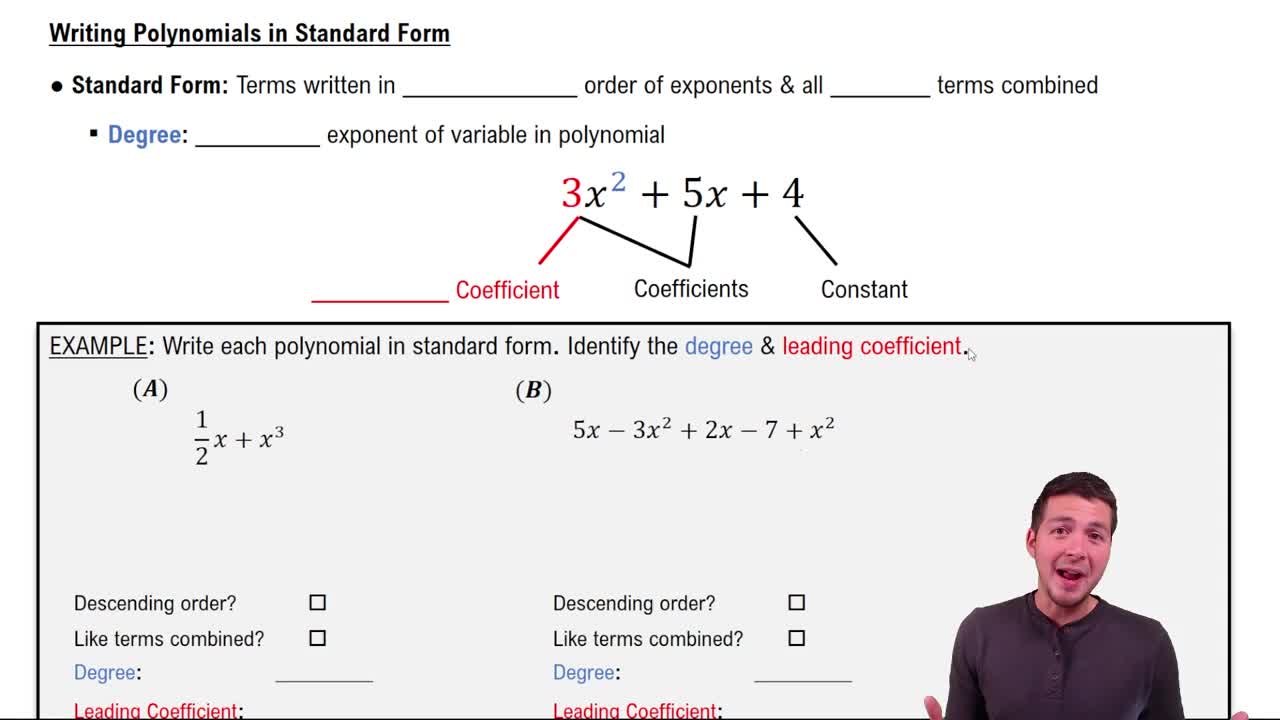
Identify the degree of the polynomial function. The given function is \(f(x) = 7 + 2x - 5x^2 - 10x^4\). The degree is the highest power of \(x\), which is 4 in this case.
Determine the leading term of the polynomial, which is the term with the highest degree. Here, the leading term is \(-10x^4\).
Analyze the leading coefficient and the degree to understand the end behavior. The leading coefficient is \(-10\), which is negative, and the degree 4 is even.
Recall the end behavior rules for polynomials: For even degree and negative leading coefficient, as \(x \to \infty\), \(f(x) \to -\infty\), and as \(x \to -\infty\), \(f(x) \to -\infty\).
Use this information to draw or describe the end behavior diagram, showing both ends of the graph going downwards toward negative infinity.

Verified video answer for a similar problem:
This video solution was recommended by our tutors as helpful for the problem above.
Video duration:
2mWas this helpful?
Key Concepts
Here are the essential concepts you must grasp in order to answer the question correctly.
Polynomial Degree and Leading Term
The degree of a polynomial is the highest power of the variable in the expression, and the leading term is the term with this highest power. The degree and leading coefficient determine the general shape and end behavior of the polynomial's graph.
Recommended video:
Guided course
Standard Form of Polynomials
End Behavior of Polynomial Functions
End behavior describes how the values of a polynomial function behave as x approaches positive or negative infinity. It depends primarily on the degree and leading coefficient: even-degree polynomials with positive leading coefficients rise on both ends, while odd-degree polynomials have opposite end behaviors.
Recommended video:
End Behavior of Polynomial Functions
Using End Behavior Diagrams
End behavior diagrams visually represent the direction of the graph's ends, typically using arrows pointing up or down on the left and right sides. These diagrams help quickly identify how the polynomial behaves for large positive and negative x-values.
Recommended video:
End Behavior of Polynomial Functions
Related Practice
Textbook Question
6
views
Textbook Question
Match the rational function in Column I with the appropriate description in Column II. Choices in Column II can be used only once.
1
views
Textbook Question
Use an end behavior diagram, as shown below, to describe the end behavior of the graph of each polynomial function. ƒ(x)=3+2x-4x2-5x10
Textbook Question
Circumference of a Circle The circumference of a circle varies directly as the radius. A circle with radius 7 in. has circumference 43.96 in. Find the circumference of the circle if the radius changes to 11 in.
Textbook Question
Graph each quadratic function. Give the (a) vertex, (b) axis, (c) domain, and (d) range. ƒ(x) = -(1/2)(x + 1)2 - 3
Textbook Question
Graph each quadratic function. Give the (a) vertex, (b) axis, (c) domain, and (d) range. ƒ(x) = -3 (x - 2)2 +1
