Use an end behavior diagram, as shown below, to describe the end behavior of the graph of each polynomial function. ƒ(x)=7+2x-5x2-10x4
Ch. 3 - Polynomial and Rational Functions

Chapter 4, Problem 29
Resistance of a Wire The resistance in ohms of a platinum wire temperature sensor varies directly as the temperature in kelvins (K). If the resistance is 646 ohms at a temperature of 190 K, find the resistance at a temperature of 250 K.
Verified step by step guidance1
Identify the direct variation relationship: resistance \(R\) varies directly as temperature \(T\), which can be written as \(R = k \times T\), where \(k\) is the constant of proportionality.
Use the given values to find \(k\): substitute \(R = 646\) ohms and \(T = 190\) K into the equation \(646 = k \times 190\).
Solve for \(k\) by dividing both sides of the equation by 190: \(k = \frac{646}{190}\).
Write the general formula for resistance using the found \(k\): \(R = \left( \frac{646}{190} \right) \times T\).
Find the resistance at \(T = 250\) K by substituting into the formula: \(R = \left( \frac{646}{190} \right) \times 250\).

Verified video answer for a similar problem:
This video solution was recommended by our tutors as helpful for the problem above.
Video duration:
4mWas this helpful?
Key Concepts
Here are the essential concepts you must grasp in order to answer the question correctly.
Direct Variation
Direct variation describes a relationship where one quantity changes proportionally with another. If resistance varies directly with temperature, then resistance = k × temperature, where k is a constant. Understanding this helps set up the equation to find unknown values.
Recommended video:
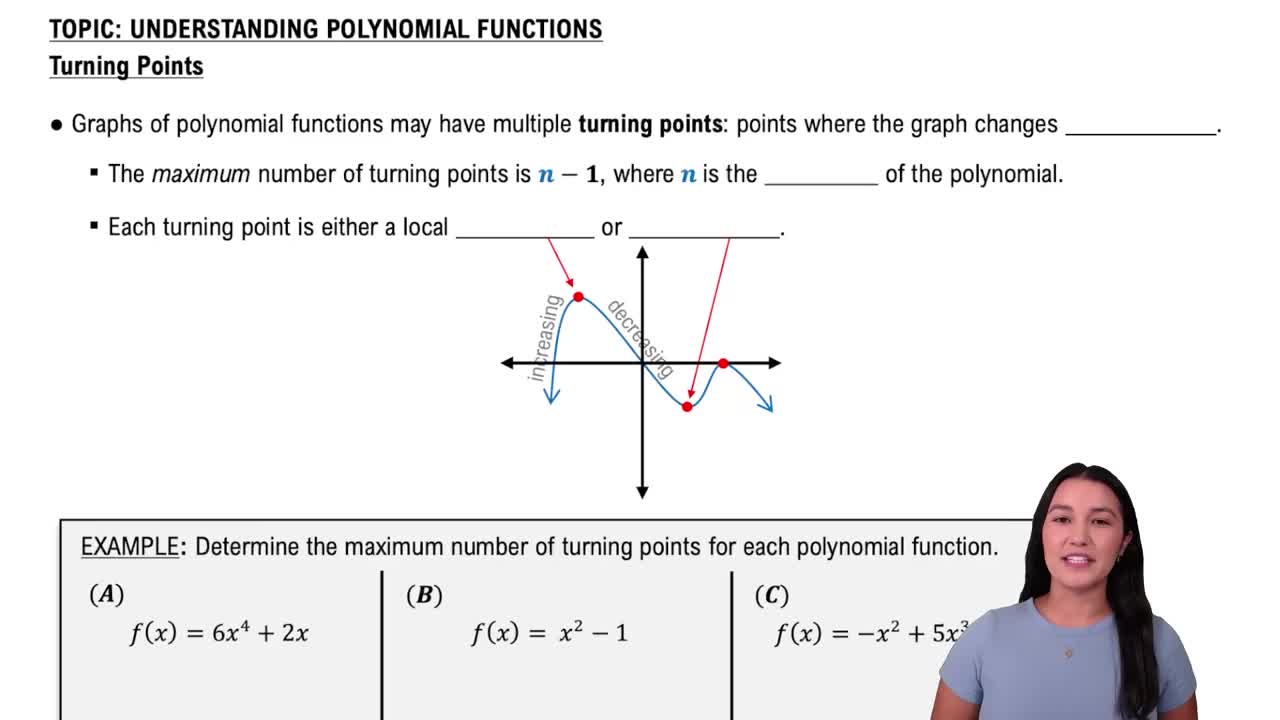
Maximum Turning Points of a Polynomial Function
Finding the Constant of Variation
To solve direct variation problems, first find the constant k by using given values. Substitute the known resistance and temperature into the formula resistance = k × temperature, then solve for k. This constant allows calculation of resistance at any temperature.
Recommended video:
Finding the Domain of an Equation
Solving Linear Equations
Once the constant k is found, substitute the new temperature into the equation and solve for resistance. This involves basic algebraic manipulation to isolate the variable and compute the desired value, reinforcing skills in solving linear equations.
Recommended video:
Solving Linear Equations with Fractions
Related Practice
Textbook Question
Textbook Question
Match the rational function in Column I with the appropriate description in Column II. Choices in Column II can be used only once.
1
views
Textbook Question
Solve each polynomial inequality. Give the solution set in interval notation. (x - 3)(x - 4)(x - 5)2 ≤ 0
Textbook Question
Graph each quadratic function. Give the (a) vertex, (b) axis, (c) domain, and (d) range. ƒ(x) = x2 + 6x + 5
Textbook Question
Circumference of a Circle The circumference of a circle varies directly as the radius. A circle with radius 7 in. has circumference 43.96 in. Find the circumference of the circle if the radius changes to 11 in.
Textbook Question
Graph each quadratic function. Give the (a) vertex, (b) axis, (c) domain, and (d) range. ƒ(x) = -3 (x - 2)2 +1