Ch. 2 - Graphs and Functions
Lial - College Algebra 13th Edition
Lial13th EditionCollege AlgebraISBN: 9780136881063Not the one you use?Change textbook
Chapter 3, Problem 21d

For the pair of functions defined, find (ƒ/g)(x). Give the domain of each. See Example 2.
ƒ(x)=2x^2-3x, g(x)=x^2-x+3

Verified step by step guidance
1
First, recall that the operation (ƒ/g)(x) means the quotient of the two functions, which is given by the formula: \[(\frac{ƒ}{g})(x) = \frac{ƒ(x)}{g(x)}\]
Substitute the given functions into the quotient: \[(\frac{ƒ}{g})(x) = \frac{2x^2 - 3x}{x^2 - x + 3}\]
Next, simplify the expression if possible by factoring the numerator and denominator and canceling any common factors. For the numerator, factor out the common term: \[2x^2 - 3x = x(2x - 3)\]. Check if the denominator can be factored as well.
Determine the domain of each function separately. For \(ƒ(x) = 2x^2 - 3x\), since it is a polynomial, its domain is all real numbers: \[(-\infty, \infty)\].
For \(g(x) = x^2 - x + 3\), also a polynomial, the domain is all real numbers. However, for the quotient \((ƒ/g)(x)\), the domain excludes values where \(g(x) = 0\) because division by zero is undefined. Solve the equation \[x^2 - x + 3 = 0\] to find any such values and exclude them from the domain.

Verified video answer for a similar problem:

This video solution was recommended by our tutors as helpful for the problem above.
Video duration:
4m
Was this helpful?

Key Concepts

Here are the essential concepts you must grasp in order to answer the question correctly.

Function Operations (Division of Functions)

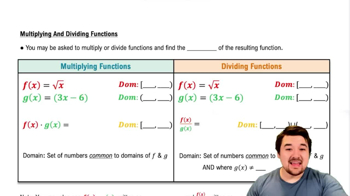
Dividing two functions ƒ and g, denoted (ƒ/g)(x), means creating a new function by dividing the output of ƒ(x) by g(x). This operation is defined as (ƒ/g)(x) = ƒ(x) / g(x), where g(x) ≠ 0 to avoid division by zero.
Recommended video:
7:24
Multiplying & Dividing Functions

Domain of a Function

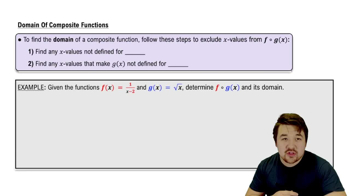
The domain of a function is the set of all input values (x) for which the function is defined. For (ƒ/g)(x), the domain includes all x-values in the domains of ƒ and g, except where g(x) = 0, since division by zero is undefined.
Recommended video:
3:51
Domain Restrictions of Composed Functions

Polynomial Functions and Their Domains

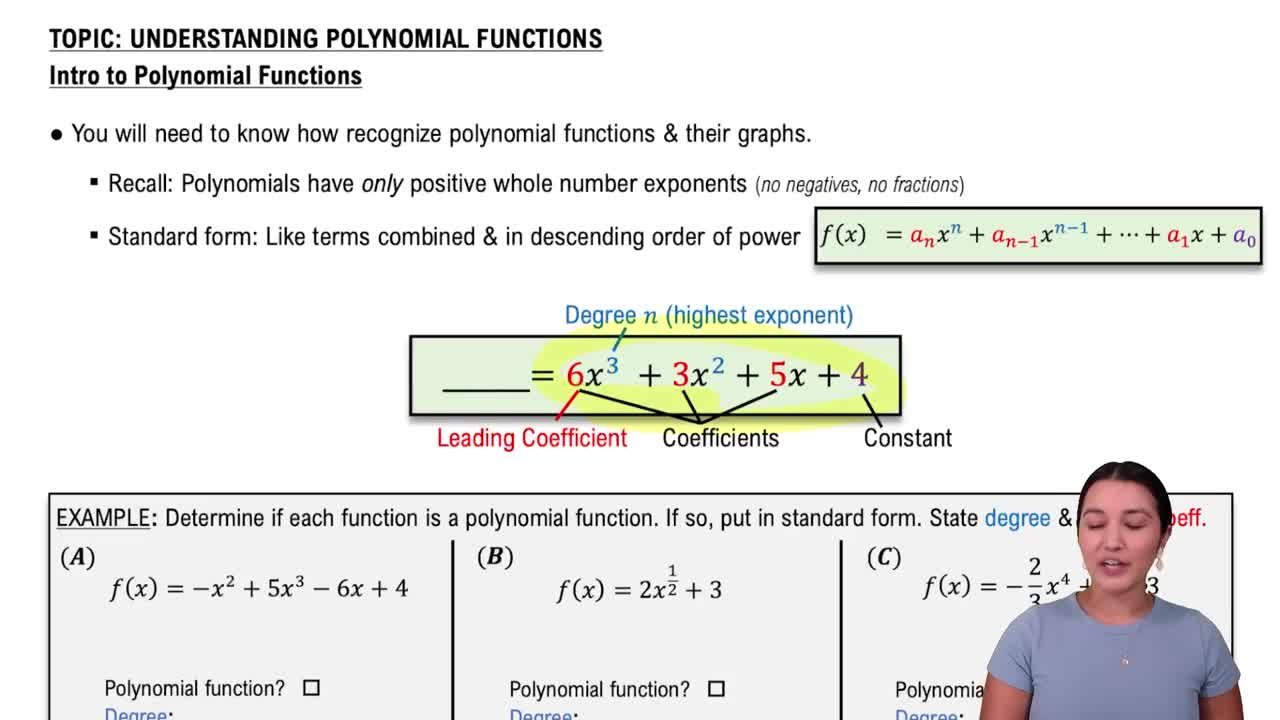
Both ƒ(x) = 2x² - 3x and g(x) = x² - x + 3 are polynomial functions, which are defined for all real numbers. However, when dividing, the domain excludes values that make the denominator zero, so identifying zeros of g(x) is essential.
Recommended video:
06:04
Introduction to Polynomial Functions