Ch. 2 - Graphs and Functions
Lial - College Algebra 13th Edition
Lial13th EditionCollege AlgebraISBN: 9780136881063Not the one you use?Change textbook
Chapter 3, Problem 22

For the pair of functions defined, find (ƒ+g)(x), (ƒ-g)(x), (ƒg)(x), and (f/g)(x).Give the domain of each. ƒ(x)=4x2+2x, g(x)=x2-3x+2

Verified step by step guidance
1
First, write down the given functions: \(f(x) = 4x^2 + 2x\) and \(g(x) = x^2 - 3x + 2\).
To find \((f+g)(x)\), add the two functions: \((f+g)(x) = f(x) + g(x) = (4x^2 + 2x) + (x^2 - 3x + 2)\). Combine like terms to simplify.
To find \((f-g)(x)\), subtract \(g(x)\) from \(f(x)\): \((f-g)(x) = f(x) - g(x) = (4x^2 + 2x) - (x^2 - 3x + 2)\). Be careful to distribute the minus sign and then combine like terms.
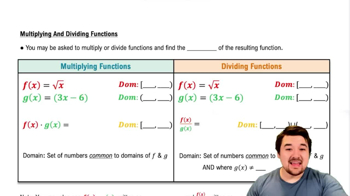
To find the product \((fg)(x)\), multiply the two functions: \((fg)(x) = f(x) imes g(x) = (4x^2 + 2x)(x^2 - 3x + 2)\). Use the distributive property (FOIL) to expand the product.
To find the quotient \((f/g)(x)\), divide \(f(x)\) by \(g(x)\): \((f/g)(x) = \frac{f(x)}{g(x)} = \frac{4x^2 + 2x}{x^2 - 3x + 2}\). The domain excludes values where \(g(x) = 0\), so solve \(x^2 - 3x + 2 = 0\) to find these excluded values.

Verified video answer for a similar problem:

This video solution was recommended by our tutors as helpful for the problem above.
Video duration:
2m
Was this helpful?

Key Concepts

Here are the essential concepts you must grasp in order to answer the question correctly.

Function Operations

Function operations involve combining two functions through addition, subtraction, multiplication, or division. For example, (ƒ+g)(x) means adding the outputs of ƒ(x) and g(x) for each x. Understanding how to perform these operations is essential to manipulate and analyze combined functions.
Recommended video:
7:24
Multiplying & Dividing Functions

Domain of a Function

The domain of a function is the set of all input values (x) for which the function is defined. When combining functions, the domain is restricted to values common to both functions and, in the case of division, excludes values that make the denominator zero.
Recommended video:
3:51
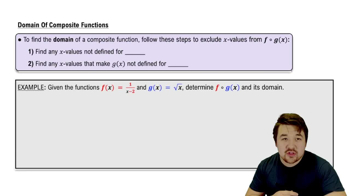
Domain Restrictions of Composed Functions

Polynomial Functions

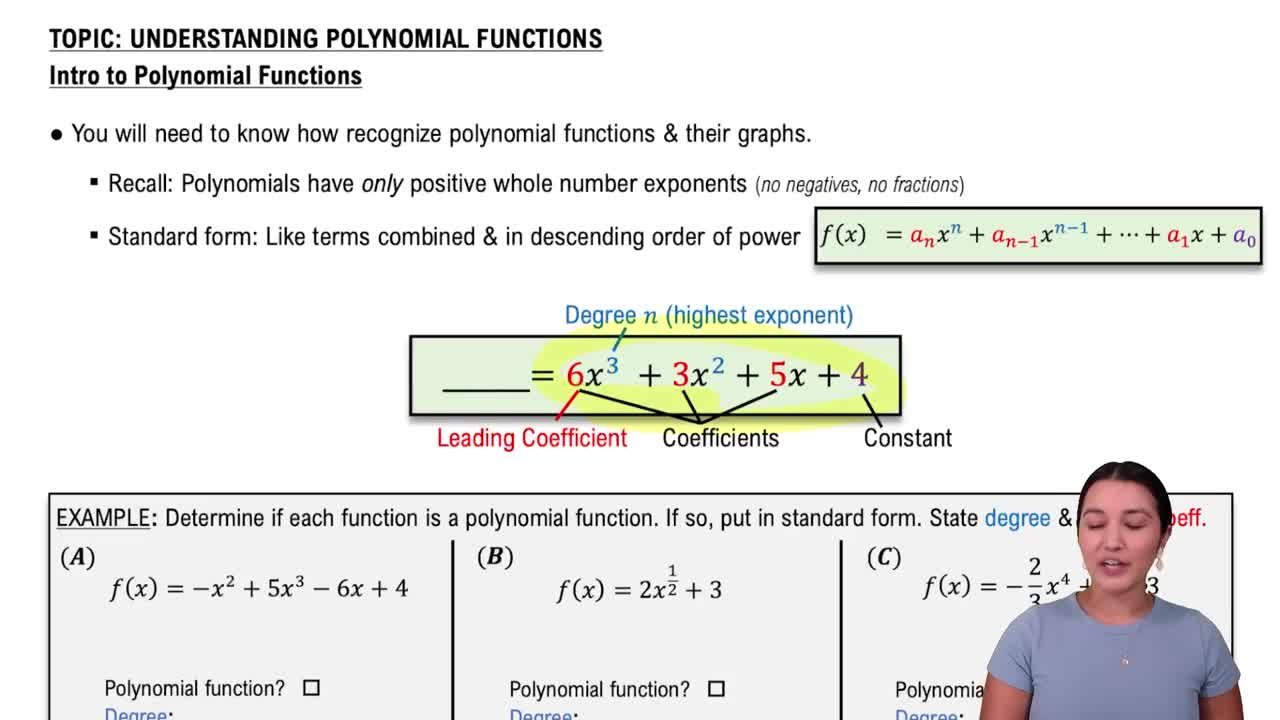
Polynomial functions are expressions involving variables raised to whole-number exponents with coefficients. Both ƒ(x) and g(x) are polynomials, which are defined for all real numbers, simplifying domain considerations except when division is involved.
Recommended video:
06:04
Introduction to Polynomial Functions