For each graph, determine whether y is a function of x. Give the domain and range of each relation.
Ch. 2 - Graphs and Functions

Chapter 3, Problem 21b
For the pair of functions defined, find (ƒ-g)(x). Give the domain of each. See Example 2.
ƒ(x)=2x^2-3x, g(x)=x^2-x+3
Verified step by step guidance1
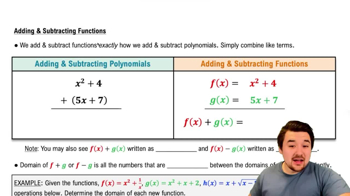
First, understand that (ƒ - g)(x) means you subtract the function g(x) from ƒ(x). So, write the expression as (ƒ - g)(x) = ƒ(x) - g(x).
Substitute the given functions into the expression: (ƒ - g)(x) = (2x^2 - 3x) - (x^2 - x + 3).
Distribute the negative sign across the terms in g(x): (ƒ - g)(x) = 2x^2 - 3x - x^2 + x - 3.
Combine like terms by grouping the x^2 terms, the x terms, and the constants: (2x^2 - x^2) + (-3x + x) - 3.
Determine the domain of each function. Since both ƒ(x) = 2x^2 - 3x and g(x) = x^2 - x + 3 are polynomials, their domains are all real numbers, which can be written as \((-\infty, \infty)\). The domain of (ƒ - g)(x) is also all real numbers.

Verified video answer for a similar problem:
This video solution was recommended by our tutors as helpful for the problem above.
Video duration:
3mWas this helpful?
Key Concepts
Here are the essential concepts you must grasp in order to answer the question correctly.
Function Operations (Addition and Subtraction)
Function operations involve combining two functions by adding or subtracting their outputs for each input x. For (ƒ - g)(x), subtract g(x) from ƒ(x) to create a new function. This process helps analyze how functions interact and transform.
Recommended video:
Adding & Subtracting Functions
Domain of a Function
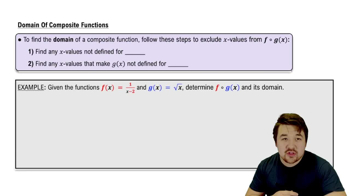
The domain is the set of all input values (x) for which a function is defined. When combining functions, the domain of the resulting function is the intersection of the individual domains. Understanding domain restrictions ensures valid inputs for the combined function.
Recommended video:
Domain Restrictions of Composed Functions
Polynomial Functions
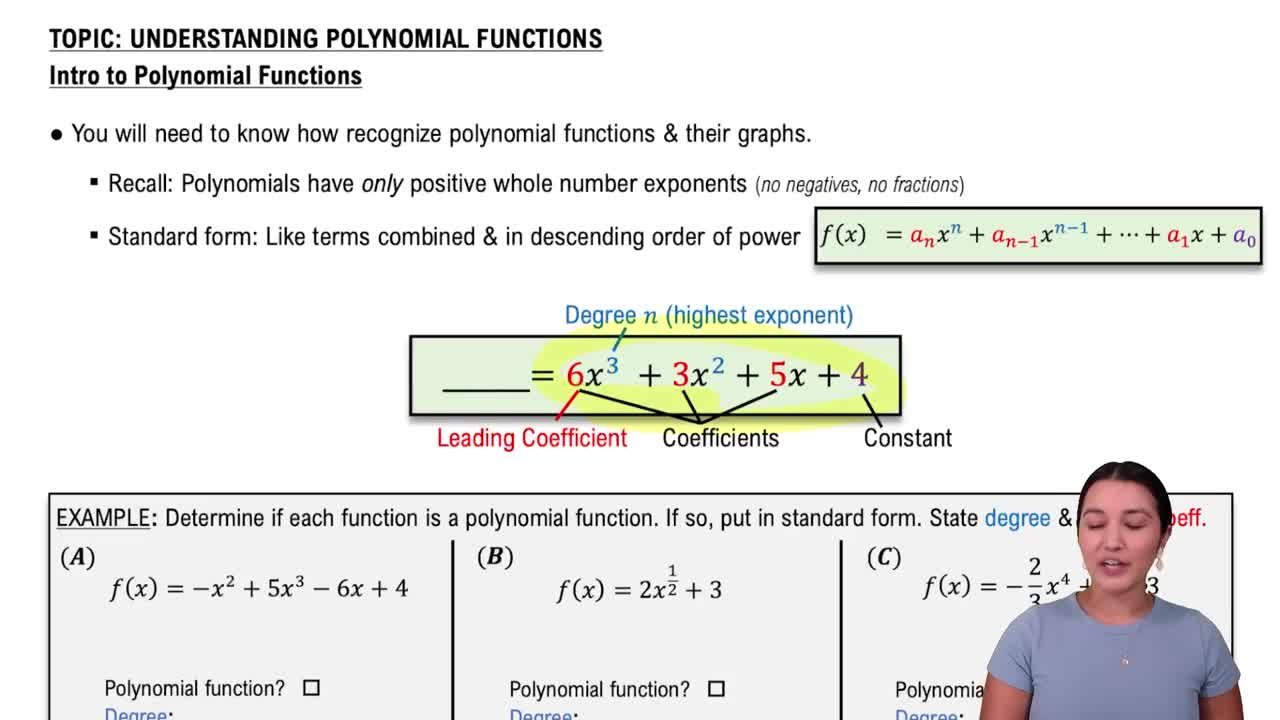
Polynomial functions are expressions involving variables raised to whole-number exponents with coefficients. Both ƒ(x) and g(x) are polynomials, which are defined for all real numbers, simplifying domain considerations. Recognizing polynomial structure aids in function operations.
Recommended video:
Introduction to Polynomial Functions
Related Practice
Textbook Question
11
views
Textbook Question
Write an equation for each line described. Give answers in standard form for Exercises 11–20 and in slope-intercept form (if possible) for Exercises 21–32.
x-intercept (3,0), y-intercept (0,-2)
Textbook Question
For the pair of functions defined, find (ƒ/g)(x). Give the domain of each. See Example 2.
ƒ(x)=2x^2-3x, g(x)=x^2-x+3
1
views
Textbook Question
For the pair of functions defined, find (ƒ+g)(x).Give the domain of each. See Example 2.
ƒ(x)=2x^2-3x, g(x)=x^2-x+3
3
views
Textbook Question
For the pair of functions defined, find (ƒg)(x). Give the domain of each. See Example 2.
ƒ(x)=2x^2-3x, g(x)=x^2-x+3
Textbook Question
In the following exercises, (a) find the center-radius form of the equation of each circle described, and (b) graph it. center (√2, √2), radius √2
1
views