Ch. 1 - Equations and Inequalities
Lial - College Algebra 13th Edition
Lial13th EditionCollege AlgebraISBN: 9780136881063Not the one you use?Change textbook
Chapter 2, Problem 7

Solve each problem. If x represents the number of pennies in a jar in an applied problem, which of the following equations cannot be a correct equation for finding x? (Hint:Solve the equations and consider the solutions.)
A. 5x+3 =11
B.12x+6 =-4
C.100x =50(x+3)
D. 6(x+4) =x+24

Verified step by step guidance
1
Step 1: Understand the context of the problem. Since \( x \) represents the number of pennies in a jar, \( x \) must be a non-negative integer (\( x \geq 0 \)) because you cannot have a negative number of pennies.
Step 2: Solve each equation for \( x \) to find its solution.
For equation A: \( 5x + 3 = 11 \), subtract 3 from both sides to get \( 5x = 8 \), then divide both sides by 5 to find \( x = \frac{8}{5} \).
For equation B: \( 12x + 6 = -4 \), subtract 6 from both sides to get \( 12x = -10 \), then divide both sides by 12 to find \( x = -\frac{10}{12} = -\frac{5}{6} \).
For equation C: \( 100x = 50(x + 3) \), expand the right side to get \( 100x = 50x + 150 \), subtract \( 50x \) from both sides to get \( 50x = 150 \), then divide both sides by 50 to find \( x = 3 \).
For equation D: \( 6(x + 4) = x + 24 \), expand the left side to get \( 6x + 24 = x + 24 \), subtract \( x \) and 24 from both sides to get \( 5x = 0 \), then divide both sides by 5 to find \( x = 0 \).
Step 3: Analyze the solutions in the context of the problem. Since \( x \) must be non-negative, any negative solution is not valid for the number of pennies.
Step 4: Identify which equation(s) yield invalid solutions. Equation B gives \( x = -\frac{5}{6} \), which is negative and therefore cannot represent the number of pennies.
Step 5: Conclude that equation B cannot be a correct equation for finding \( x \) in this applied problem.

Verified video answer for a similar problem:

This video solution was recommended by our tutors as helpful for the problem above.
Video duration:
4m
Was this helpful?

Key Concepts

Here are the essential concepts you must grasp in order to answer the question correctly.

Solving Linear Equations

Linear equations are algebraic expressions where the variable is to the first power. Solving them involves isolating the variable on one side to find its value. Understanding how to manipulate equations using addition, subtraction, multiplication, and division is essential to find solutions.
Recommended video:
04:02
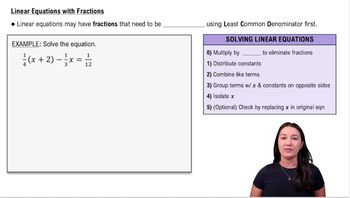
Solving Linear Equations with Fractions

Interpreting Solutions in Context

When variables represent real-world quantities, like the number of pennies, solutions must make sense in that context. For example, negative or non-integer solutions may be invalid if the quantity cannot be negative or fractional. Evaluating solutions against the problem's scenario ensures meaningful answers.
Recommended video:
2:57
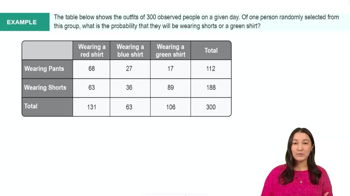
Probability of Non-Mutually Exclusive Events Example

Checking for Extraneous or Invalid Solutions

Some equations may yield solutions that do not fit the problem's conditions or are mathematically impossible. Identifying such solutions requires substituting back or analyzing the equation's structure. This helps determine which equations cannot correctly represent the situation.
Recommended video:
05:21
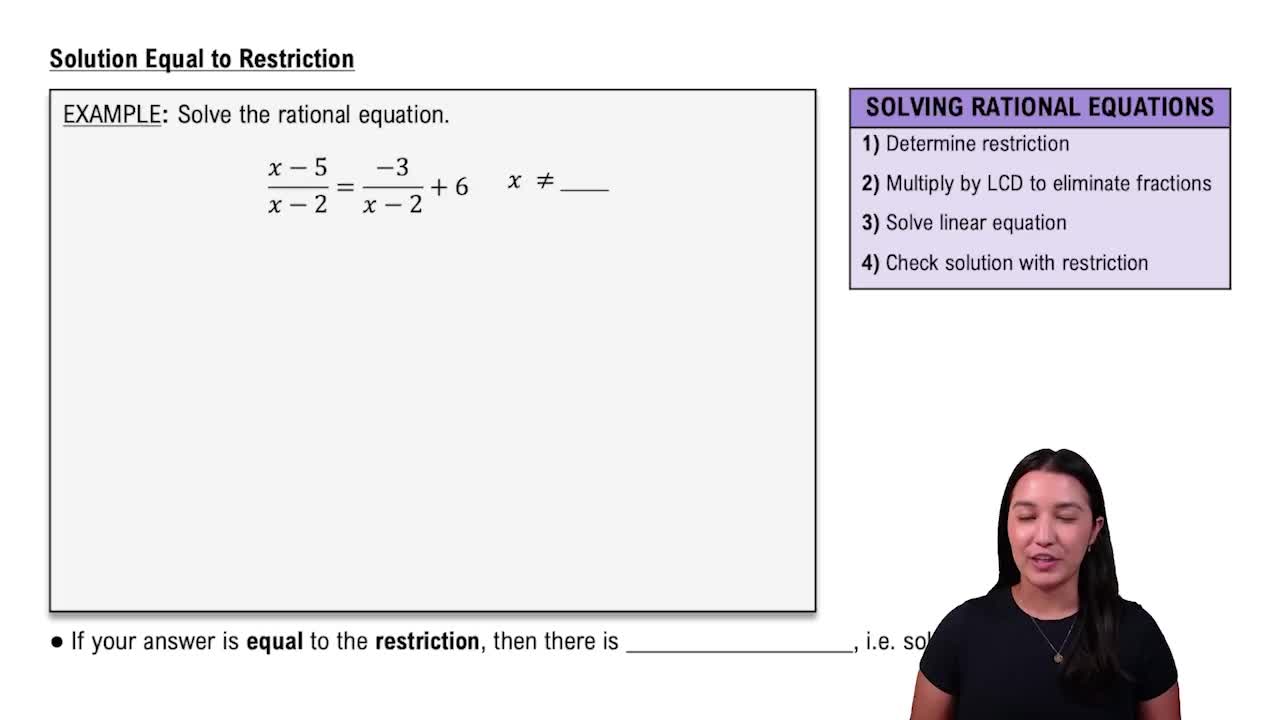
Restrictions on Rational Equations