Ch. 8 - Sequences, Induction, and Probability
Blitzer - College Algebra 8th Edition
Blitzer8th EditionCollege AlgebraISBN: 9780136970514Not the one you use?Change textbook
Chapter 9, Problem 35

Find the indicated sum. Use the formula for the sum of the first n terms of a geometric sequence.i=16(12)i+1\(\sum\)_{i=1}^{6} \(\left\)(\(\frac{1}{2}\]\right\))^{i+1}

Verified step by step guidance
1
Identify the geometric sequence and the number of terms. Here, the sequence is given by the general term \(a_i = \left(\frac{1}{2}\right)^{i+1}\), and the number of terms is \(n = 6\).
Rewrite the general term to express it in the form \(a r^{i-1}\), where \(a\) is the first term and \(r\) is the common ratio. For \(i=1\), the first term is \(a = \left(\frac{1}{2}\right)^{1+1} = \left(\frac{1}{2}\right)^2\).
Determine the common ratio \(r\) by comparing consecutive terms. Since the exponent increases by 1 each time, \(r = \frac{1}{2}\).
Use the formula for the sum of the first \(n\) terms of a geometric sequence: \(S_n = a \frac{1 - r^n}{1 - r}\)
Substitute the values of \(a\), \(r\), and \(n\) into the formula: \(S_6 = \left(\frac{1}{2}\right)^2 \frac{1 - \left(\frac{1}{2}\right)^6}{1 - \frac{1}{2}}\) This expression represents the sum you need to calculate.

Verified video answer for a similar problem:

This video solution was recommended by our tutors as helpful for the problem above.
Video duration:
5m
Was this helpful?

Key Concepts

Here are the essential concepts you must grasp in order to answer the question correctly.

Geometric Sequence

A geometric sequence is a list of numbers where each term after the first is found by multiplying the previous term by a constant ratio. For example, in the sequence 1, 1/2, 1/4, 1/8, ..., each term is multiplied by 1/2. Understanding the structure of geometric sequences is essential to identify the terms and apply the sum formula correctly.
Recommended video:
Guided course
4:18
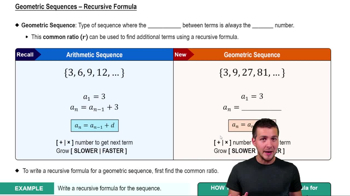
Geometric Sequences - Recursive Formula

Sum of the First n Terms of a Geometric Sequence

The sum of the first n terms of a geometric sequence can be calculated using the formula S_n = a(1 - r^n) / (1 - r), where a is the first term and r is the common ratio. This formula simplifies the process of adding multiple terms without computing each individually, which is crucial for efficiently solving the given sum.
Recommended video:
Guided course
4:18
Geometric Sequences - Recursive Formula

Index Manipulation and Term Identification

Correctly interpreting the index in the summation, especially when the exponent involves (i + 1), is important to identify the first term and the common ratio. Adjusting the index helps to rewrite the sum in a standard geometric form, ensuring the sum formula is applied accurately.
Recommended video: