Use the formula for the general term (the nth term) of a geometric sequence to find the indicated term of the sequence. Find a7 when a1 = 2, r = 3
Ch. 8 - Sequences, Induction, and Probability

Chapter 9, Problem 35
Find each indicated sum.
Verified step by step guidance1
Identify the sum notation: you need to find the sum of the terms from \( i = 1 \) to \( i = 4 \) of the expression \( \left(-\frac{1}{2}\right)^i \). This means you will add \( \left(-\frac{1}{2}\right)^1 + \left(-\frac{1}{2}\right)^2 + \left(-\frac{1}{2}\right)^3 + \left(-\frac{1}{2}\right)^4 \).
Recognize that this is a geometric series where the first term \( a = \left(-\frac{1}{2}\right)^1 = -\frac{1}{2} \) and the common ratio \( r = -\frac{1}{2} \).
Recall the formula for the sum of the first \( n \) terms of a geometric series: \[ S_n = a \cdot \frac{1 - r^n}{1 - r} \]. Here, \( n = 4 \).
Substitute the values into the formula: \[ S_4 = \left(-\frac{1}{2}\right) \cdot \frac{1 - \left(-\frac{1}{2}\right)^4}{1 - \left(-\frac{1}{2}\right)} \].
Simplify the numerator and denominator separately, then multiply by the first term to find the sum. Remember not to calculate the final numeric value, just set up the expression.

Verified video answer for a similar problem:
This video solution was recommended by our tutors as helpful for the problem above.
Video duration:
6mWas this helpful?
Key Concepts
Here are the essential concepts you must grasp in order to answer the question correctly.
Summation Notation (Sigma Notation)
Summation notation uses the Greek letter sigma (Σ) to represent the sum of a sequence of terms. It specifies the index of summation, the starting and ending values, and the general term to be added. Understanding this notation is essential to correctly interpret and compute the sum.
Recommended video:
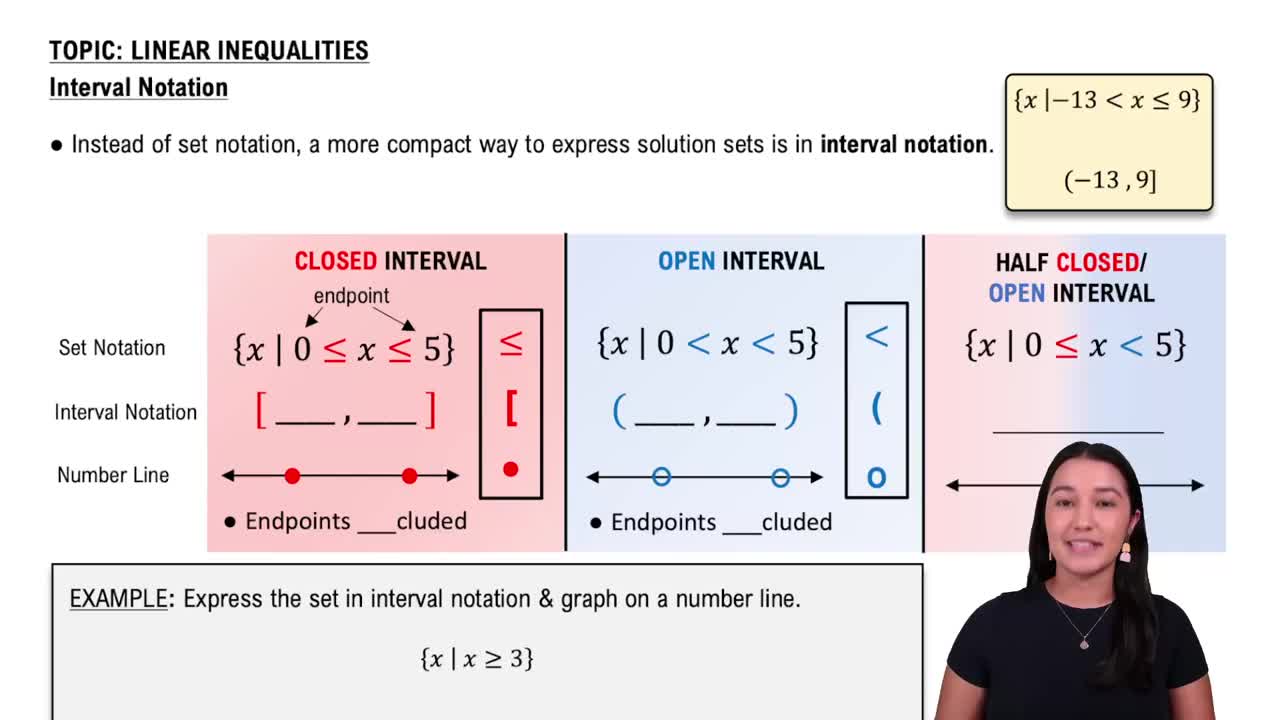
Interval Notation
Geometric Series
A geometric series is a sum of terms where each term is found by multiplying the previous term by a constant ratio. Recognizing the series as geometric allows the use of formulas to find the sum efficiently, especially when the number of terms is finite.
Recommended video:
Guided course
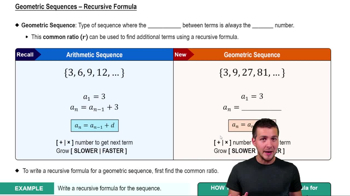
Geometric Sequences - Recursive Formula
Formula for the Sum of a Finite Geometric Series
The sum of the first n terms of a geometric series with initial term a and common ratio r (r ≠ 1) is given by S_n = a(1 - r^n) / (1 - r). This formula simplifies the calculation of sums without adding each term individually.
Recommended video:
Guided course
Geometric Sequences - Recursive Formula
Related Practice
Textbook Question
Textbook Question
Write the first three terms in each binomial expansion, expressing the result in simplified form. (y3 − 1)20
2
views
Textbook Question
Find the indicated sum. Use the formula for the sum of the first n terms of a geometric sequence.
1
views
Textbook Question
Use the formula for the general term (the nth term) of a geometric sequence to find the indicated term of the sequence. Find a(sub 6) when a(sub 1) = 16, r = 1/2
2
views
Textbook Question
Use the formula for the general term (the nth term) of a geometric sequence to find the indicated term of the sequence. Find a5 when a1 = -3, r = 2
Textbook Question
Write the first three terms in each binomial expansion, expressing the result in simplified form. (x2 + 1)16