Write the first three terms in each binomial expansion, expressing the result in simplified form. (x - 2y)10
Ch. 8 - Sequences, Induction, and Probability

Chapter 9, Problem 35
Find the sum of the first 20 terms of the arithmetic sequence: 4, 10, 16, 22,……….
Verified step by step guidance1
Identify the first term \( a_1 \) of the arithmetic sequence. Here, \( a_1 = 4 \).
Determine the common difference \( d \) by subtracting the first term from the second term: \( d = 10 - 4 = 6 \).
Use the formula for the \( n \)-th term of an arithmetic sequence: \( a_n = a_1 + (n - 1)d \). For the 20th term, write \( a_{20} = 4 + (20 - 1) \times 6 \).
Apply the formula for the sum of the first \( n \) terms of an arithmetic sequence: \( S_n = \frac{n}{2} (a_1 + a_n) \). Substitute \( n = 20 \), \( a_1 = 4 \), and the expression for \( a_{20} \) from the previous step.
Simplify the expression to find the sum \( S_{20} \) without calculating the final numeric value.

Verified video answer for a similar problem:
This video solution was recommended by our tutors as helpful for the problem above.
Video duration:
4mWas this helpful?
Key Concepts
Here are the essential concepts you must grasp in order to answer the question correctly.
Arithmetic Sequence
An arithmetic sequence is a list of numbers where each term after the first is found by adding a constant difference to the previous term. In this sequence, the difference between consecutive terms is fixed, which helps in identifying the pattern and calculating any term.
Recommended video:
Guided course
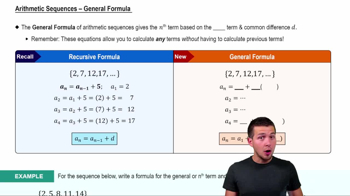
Arithmetic Sequences - General Formula
Common Difference
The common difference is the constant amount added to each term to get the next term in an arithmetic sequence. It is found by subtracting any term from the following term, and it is essential for determining the nth term and the sum of terms.
Recommended video:
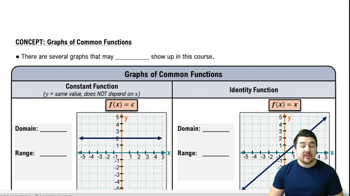
Graphs of Common Functions
Sum of an Arithmetic Sequence
The sum of the first n terms of an arithmetic sequence can be calculated using the formula S_n = n/2 * (first term + last term). This formula simplifies adding many terms by using the number of terms and the values of the first and last terms.
Recommended video:
Guided course
Arithmetic Sequences - General Formula
Related Practice
Textbook Question
Textbook Question
Use the formula for the general term (the nth term) of a geometric sequence to find the indicated term of the sequence. Find a7 when a1 = 2, r = 3
Textbook Question
Write a formula for the general term (the nth term) of each arithmetic sequence. Do not use a recursion formula. Then use the formula for an to find a20, the 20th term of the sequence. an= an-1 -10, a1 = 30
Textbook Question
Find the indicated sum. Use the formula for the sum of the first n terms of a geometric sequence.
1
views
Textbook Question
Find the indicated sum. Use the formula for the sum of the first n terms of a geometric sequence.
3
views
Textbook Question
Write the first three terms in each binomial expansion, expressing the result in simplified form. (x2 + 1)16