Ch. 8 - Sequences, Induction, and Probability
Blitzer - College Algebra 8th Edition
Blitzer8th EditionCollege AlgebraISBN: 9780136970514Not the one you use?Change textbook
Chapter 9, Problem 33

Find the indicated sum. Use the formula for the sum of the first n terms of a geometric sequence. i=11052i\(\sum\)_{i=1}^{10} 5 \(\cdot\) 2^i

Verified step by step guidance
1
Identify the terms of the geometric sequence. Here, the general term is given by \(a_i = 5 \cdot 2^i\), where \(i\) goes from 1 to 10.
Recognize that this is a geometric sequence with the first term \(a_1 = 5 \cdot 2^1 = 10\) and common ratio \(r = 2\) because each term is multiplied by 2 to get the next term.
Recall the formula for the sum of the first \(n\) terms of a geometric sequence: \(S_n = a_1 \cdot \frac{r^n - 1}{r - 1}\).
Substitute the known values into the formula: \(n = 10\), \(a_1 = 10\), and \(r = 2\), so the sum is \(S_{10} = 10 \cdot \frac{2^{10} - 1}{2 - 1}\).
Simplify the denominator and prepare to calculate the numerator \(2^{10} - 1\) to find the sum \(S_{10}\).

Verified video answer for a similar problem:

This video solution was recommended by our tutors as helpful for the problem above.
Video duration:
5m
Was this helpful?

Key Concepts

Here are the essential concepts you must grasp in order to answer the question correctly.

Geometric Sequence

A geometric sequence is a list of numbers where each term after the first is found by multiplying the previous term by a constant called the common ratio. For example, in the sequence 5, 10, 20, 40, the common ratio is 2. Understanding this helps identify the pattern in the given sum.
Recommended video:
Guided course
4:18
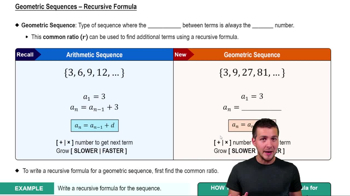
Geometric Sequences - Recursive Formula

Sum of the First n Terms of a Geometric Sequence

The sum of the first n terms of a geometric sequence can be calculated using the formula S_n = a(1 - r^n) / (1 - r), where a is the first term and r is the common ratio. This formula simplifies adding many terms without computing each individually.
Recommended video:
Guided course
4:18
Geometric Sequences - Recursive Formula

Index and Exponent in Summation Notation

Summation notation (Σ) represents the sum of terms indexed by i from a starting value to an ending value. In this problem, the exponent i in 2^i changes with each term, affecting the value of each term in the sum. Understanding how the index affects each term is crucial for applying the sum formula correctly.
Recommended video:
Guided course
04:06
Rational Exponents