Ch. 8 - Sequences, Induction, and Probability
Blitzer - College Algebra 8th Edition
Blitzer8th EditionCollege AlgebraISBN: 9780136970514Not the one you use?Change textbook
Chapter 9, Problem 33

Find each indicated sum. k=15k(k+4)\(\sum\)_{k=1}^{5} k(k+4)

Verified step by step guidance
1
Identify the sum notation: you need to find the sum of the expression \(k(k+4)\) as \(k\) goes from 1 to 5, which is written as \(\sum_{k=1}^{5} k(k+4)\).
Expand the expression inside the summation: \(k(k+4) = k^2 + 4k\).
Rewrite the sum as the sum of two separate sums: \(\sum_{k=1}^{5} (k^2 + 4k) = \sum_{k=1}^{5} k^2 + \sum_{k=1}^{5} 4k\).
Use the properties of summation to factor out constants: \(\sum_{k=1}^{5} 4k = 4 \sum_{k=1}^{5} k\).
Calculate each sum separately using formulas: \(\sum_{k=1}^{n} k = \frac{n(n+1)}{2}\) and \(\sum_{k=1}^{n} k^2 = \frac{n(n+1)(2n+1)}{6}\), then substitute \(n=5\) and add the results.

Verified video answer for a similar problem:

This video solution was recommended by our tutors as helpful for the problem above.
Video duration:
4m
Was this helpful?

Key Concepts

Here are the essential concepts you must grasp in order to answer the question correctly.

Summation Notation (Sigma Notation)

Summation notation uses the Greek letter sigma (Σ) to represent the sum of a sequence of terms. The expression 5Σk=1 means to sum the terms as k goes from 1 to 5. Understanding this notation is essential to correctly evaluate the sum.
Recommended video:
05:18
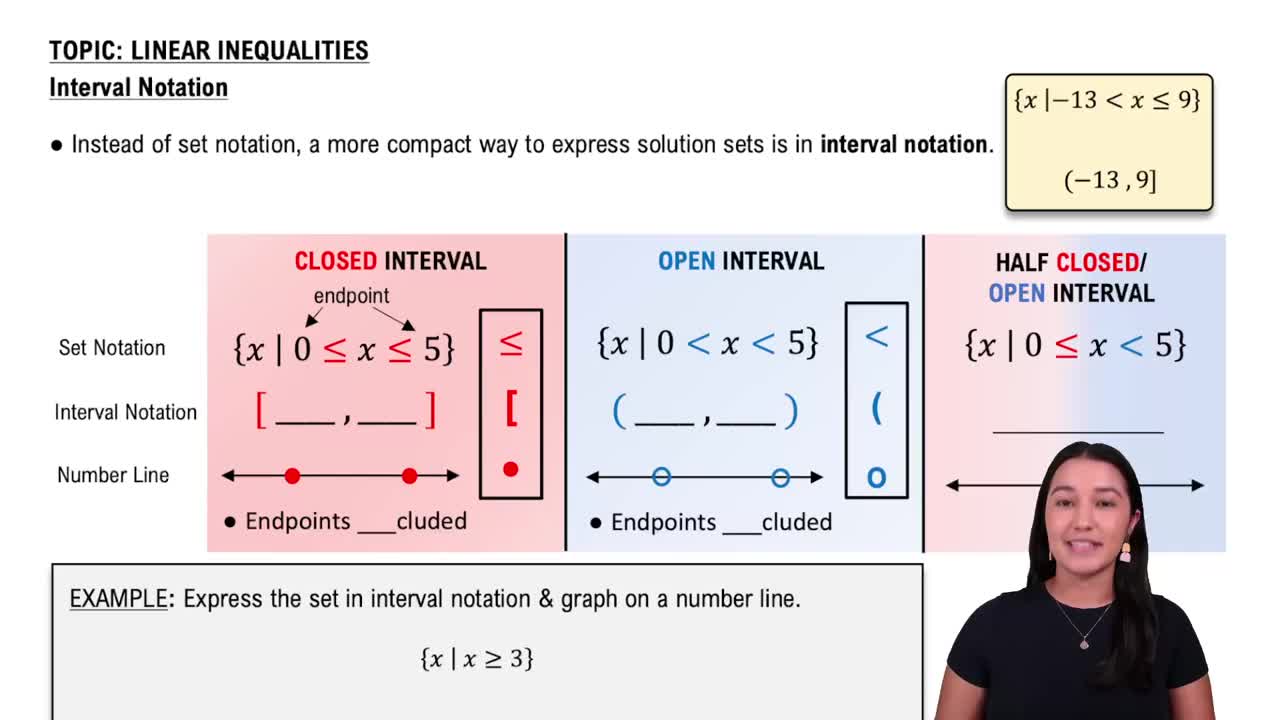
Interval Notation

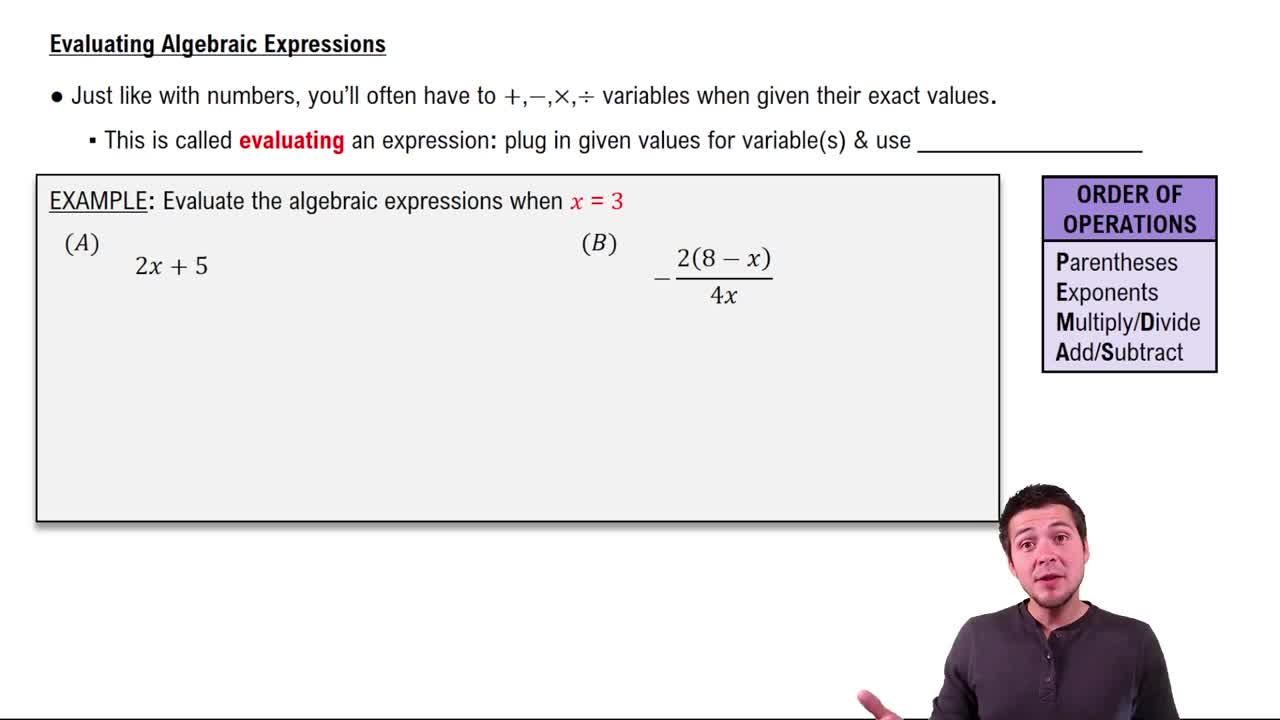
Evaluating Polynomial Expressions

Each term in the sum involves evaluating the polynomial k(k+4) for each integer k from 1 to 5. This requires substituting values of k into the expression and simplifying before summing the results.
Recommended video:
Guided course
03:11
Evaluating Algebraic Expressions

Properties of Finite Sums

Finite sums can be broken down into sums of simpler expressions, such as sums of k and sums of constants. Using properties like linearity of summation helps simplify calculations by separating and summing individual parts.
Recommended video:
5:36
Change of Base Property