Use the Fundamental Counting Principle to solve Exercises 29–40. A popular brand of pen is available in three colors (red, green, or blue) and four writing tips (bold, medium, fine, or micro). How many different choices of pens do you have with this brand?
Ch. 8 - Sequences, Induction, and Probability

Chapter 9, Problem 31
Use mathematical induction to prove that each statement is true for every positive integer n. n + 2 > n
Verified step by step guidance1
Identify the statement to prove using mathematical induction: For every positive integer \(n\), the inequality \(n + 2 > n\) holds.
Base Case: Verify the statement for \(n = 1\). Substitute \(n = 1\) into the inequality to check if \(1 + 2 > 1\) is true.
Inductive Hypothesis: Assume the statement is true for some positive integer \(k\), that is, assume \(k + 2 > k\) holds.
Inductive Step: Using the inductive hypothesis, prove the statement for \(k + 1\). Show that \((k + 1) + 2 > k + 1\) is true.
Conclude that since the base case is true and the inductive step holds, by mathematical induction, the inequality \(n + 2 > n\) is true for every positive integer \(n\).

Verified video answer for a similar problem:
This video solution was recommended by our tutors as helpful for the problem above.
Video duration:
1mWas this helpful?
Key Concepts
Here are the essential concepts you must grasp in order to answer the question correctly.
Mathematical Induction
Mathematical induction is a proof technique used to establish that a statement holds for all positive integers. It involves two steps: proving the base case (usually for n=1) and then proving the inductive step, where assuming the statement is true for n=k leads to it being true for n=k+1.
Recommended video:
Guided course
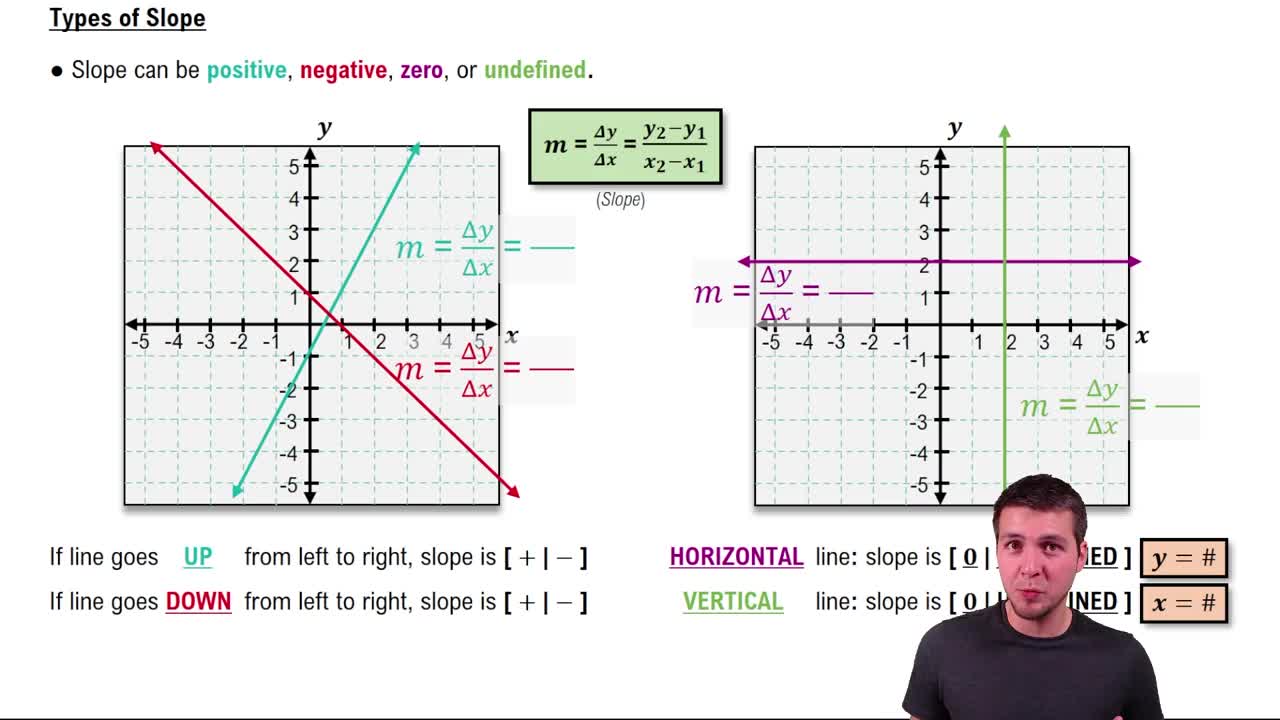
Types of Slope
Base Case Verification
The base case is the initial step in induction where the statement is verified for the smallest positive integer, often n=1. This step confirms the statement holds at the starting point, providing a foundation for the inductive step.
Recommended video:
Change of Base Property
Inductive Step
The inductive step requires assuming the statement is true for an arbitrary positive integer n=k (inductive hypothesis) and then proving it is true for n=k+1. This step shows the property holds for the next integer, completing the induction process.
Recommended video:
Solving Linear Equations with Fractions
Related Practice
Textbook Question
4
views
Textbook Question
Use the formula for the sum of the first n terms of a geometric sequence to solve Exercises 25–30. Find the sum of the first 14 terms of the geometric sequence: - 3/2, 3, - 6, 12, ...
Textbook Question
Write the first three terms in each binomial expansion, expressing the result in simplified form. (x+2)8
Textbook Question
Use the Fundamental Counting Principle to solve Exercises 29–40. The model of the car you are thinking of buying is available in nine different colors and three different styles (hatchback, sedan, or sport). In how many ways can you order the car?
Textbook Question
Write the first five terms of each geometric sequence. a1 = 3, r = 2
2
views
Textbook Question
Find the indicated sum. Use the formula for the sum of the first n terms of a geometric sequence.
2
views
