Ch. 8 - Sequences, Induction, and Probability
Blitzer - College Algebra 8th Edition
Blitzer8th EditionCollege AlgebraISBN: 9780136970514Not the one you use?Change textbook
Chapter 9, Problem 29

Use the Fundamental Counting Principle to solve Exercises 29–40. The model of the car you are thinking of buying is available in nine different colors and three different styles (hatchback, sedan, or sport). In how many ways can you order the car?

Verified step by step guidance
1
Identify the number of choices for each category. Here, there are 9 different colors and 3 different styles (hatchback, sedan, sport).
Recall the Fundamental Counting Principle, which states that if one event can occur in \( m \) ways and a second independent event can occur in \( n \) ways, then the total number of ways both events can occur is \( m \times n \).
Apply the principle by multiplying the number of color options by the number of style options: \( 9 \times 3 \).
Set up the expression for the total number of ways to order the car as \( \text{Total ways} = 9 \times 3 \).
Interpret the result as the total number of unique car orders possible, combining each color with each style.

Verified video answer for a similar problem:

This video solution was recommended by our tutors as helpful for the problem above.
Video duration:
1m
Was this helpful?

Key Concepts

Here are the essential concepts you must grasp in order to answer the question correctly.

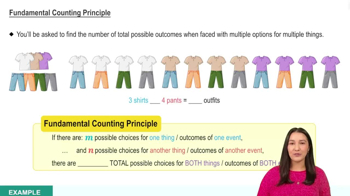
Fundamental Counting Principle

The Fundamental Counting Principle states that if one event can occur in m ways and a second independent event can occur in n ways, then the two events together can occur in m × n ways. This principle helps calculate the total number of possible outcomes when multiple choices or events are combined.
Recommended video:
4:04
Fundamental Counting Principle

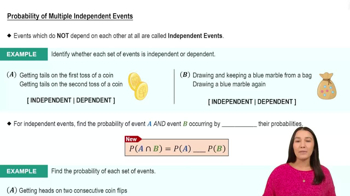
Independent Choices

Independent choices mean that the selection of one option does not affect the selection of another. In this problem, choosing a car color does not influence the choice of style, so the total number of combinations is the product of the number of color options and style options.
Recommended video:
5:54
Probability of Multiple Independent Events

Multiplication of Options

When multiple categories of options are available, the total number of unique combinations is found by multiplying the number of choices in each category. Here, multiplying 9 colors by 3 styles gives the total ways to order the car.
Recommended video:
03:42
Finding Zeros & Their Multiplicity