Use the Fundamental Counting Principle to solve Exercises 29–40. An ice cream store sells two drinks (sodas or milk shakes) in four sizes (small, medium, large, or jumbo) and five flavors (vanilla, strawberry, chocolate, coffee, or pistachio). In how many ways can a customer order a drink?
Ch. 8 - Sequences, Induction, and Probability

Chapter 9, Problem 31
Find the indicated sum. Use the formula for the sum of the first n terms of a geometric sequence.
Verified step by step guidance1
Identify the type of sequence given. Since the terms are of the form \$3^i\(, this is a geometric sequence where the first term \)a = 3^1 = 3\( and the common ratio \)r = 3$.
Recall the formula for the sum of the first \(n\) terms of a geometric sequence: \(S_n = a \frac{r^n - 1}{r - 1}\), where \(a\) is the first term, \(r\) is the common ratio, and \(n\) is the number of terms.
Substitute the known values into the formula: \(a = 3\), \(r = 3\), and \(n = 8\). So, the sum is \(S_8 = 3 \frac{3^8 - 1}{3 - 1}\).
Simplify the denominator: \(3 - 1 = 2\), so the sum formula becomes \(S_8 = 3 \frac{3^8 - 1}{2}\).
At this point, you can calculate \$3^8$, subtract 1, multiply by 3, and then divide by 2 to find the sum of the first 8 terms.

Verified video answer for a similar problem:
This video solution was recommended by our tutors as helpful for the problem above.
Video duration:
3mWas this helpful?
Key Concepts
Here are the essential concepts you must grasp in order to answer the question correctly.
Geometric Sequence
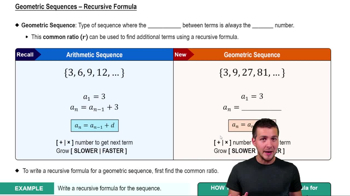
A geometric sequence is a list of numbers where each term after the first is found by multiplying the previous term by a constant called the common ratio. For example, in the sequence 3, 9, 27, 81, each term is multiplied by 3. Understanding this pattern is essential to identify the terms and apply the sum formula.
Recommended video:
Guided course
Geometric Sequences - Recursive Formula
Sum of the First n Terms of a Geometric Sequence
The sum of the first n terms of a geometric sequence can be calculated using the formula S_n = a(1 - r^n) / (1 - r), where a is the first term and r is the common ratio. This formula simplifies adding many terms without computing each individually, which is crucial for efficiently solving the problem.
Recommended video:
Guided course
Geometric Sequences - Recursive Formula
Exponents and Powers
Exponents represent repeated multiplication of a base number. In this problem, terms are expressed as powers of 3 (3^i), where i is the term index. Understanding how to work with exponents is necessary to correctly interpret the terms and apply the sum formula.
Recommended video:
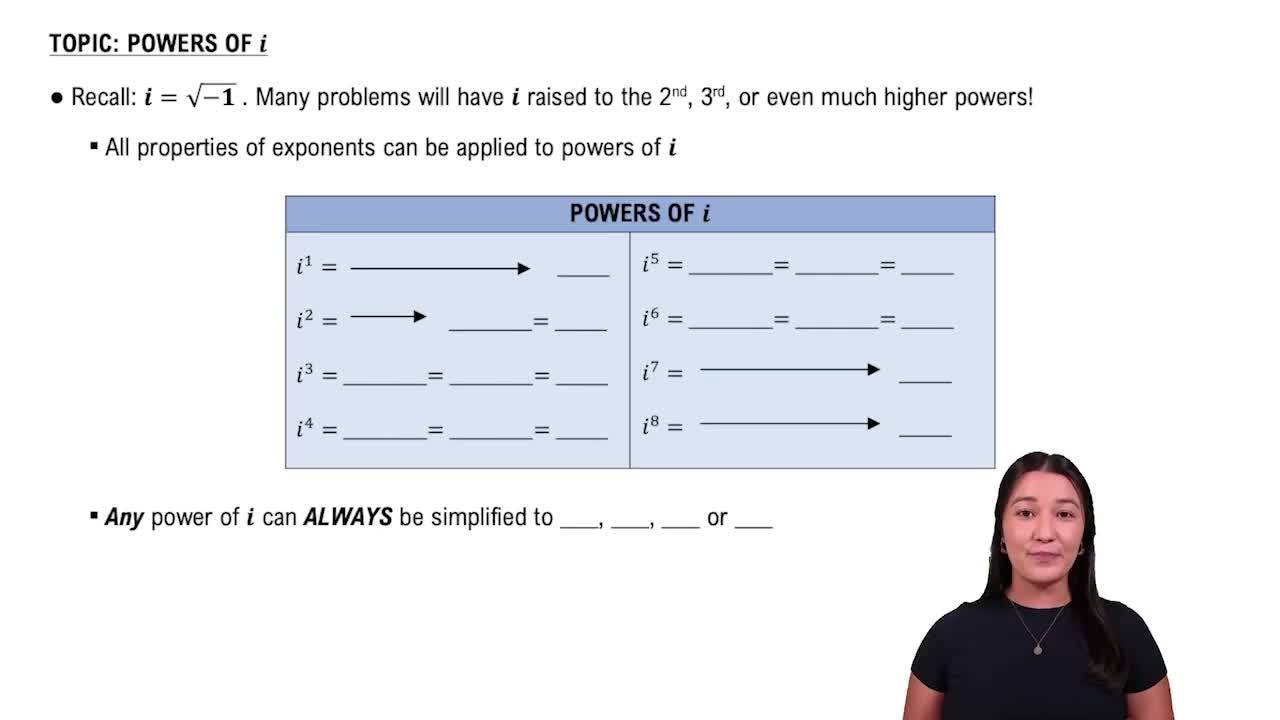
Powers of i
Related Practice
Textbook Question
Textbook Question
Use the Fundamental Counting Principle to solve Exercises 29–40. A popular brand of pen is available in three colors (red, green, or blue) and four writing tips (bold, medium, fine, or micro). How many different choices of pens do you have with this brand?
4
views
Textbook Question
Use mathematical induction to prove that each statement is true for every positive integer n. n + 2 > n
Textbook Question
Write a formula for the general term (the nth term) of each arithmetic sequence. Do not use a recursion formula. Then use the formula for an to find a20, the 20th term of the sequence. an = an-1 +3, a1 = 4
4
views
Textbook Question
Write the first three terms in each binomial expansion, expressing the result in simplified form. (x+2)8
Textbook Question
Write the first five terms of each geometric sequence. a1 = 3, r = 2
2
views
