Ch. 5 - Systems of Equations and Inequalities
Blitzer - College Algebra 8th Edition
Blitzer8th EditionCollege AlgebraISBN: 9780136970514Not the one you use?Change textbook
Chapter 6, Problem 39

In Exercises 31–42, solve by the method of your choice. Identify systems with no solution and systems with infinitely many solutions, using set notation to express their solution sets. x/4 - y/4 = −1 x + 4y = -9

Verified step by step guidance
1
Start by writing the system of equations clearly: x4 - y4 = -1 and x + 4y = -9.
Multiply the first equation by 4 to eliminate the denominators: 4 \(\times\) \(\left\)( \(\frac{x}{4}\) - \(\frac{y}{4}\) \(\right\)) = 4 \(\times\) (-1), which simplifies to x - y = -4.
Now you have the system: x - y = -4 and x + 4y = -9. Use either substitution or elimination to solve this system. For elimination, subtract the first equation from the second to eliminate x: (x + 4y) - (x - y) = -9 - (-4).
Simplify the subtraction: x + 4y - x + y = -9 + 4, which reduces to 5y = -5. Solve for y by dividing both sides by 5.
Substitute the value of y back into one of the original equations (for example, x - y = -4) to solve for x. After finding both x and y, express the solution as an ordered pair (x, y). If you find contradictory statements or infinite solutions during the process, identify and express those accordingly using set notation.

Verified video answer for a similar problem:

This video solution was recommended by our tutors as helpful for the problem above.
Video duration:
3m
Was this helpful?

Key Concepts

Here are the essential concepts you must grasp in order to answer the question correctly.

Solving Systems of Linear Equations

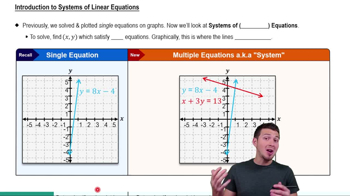
A system of linear equations consists of two or more linear equations with the same variables. Solving the system means finding all variable values that satisfy all equations simultaneously. Common methods include substitution, elimination, and graphing.
Recommended video:
Guided course
4:27
Introduction to Systems of Linear Equations

Types of Solutions for Systems

Systems of linear equations can have one solution (consistent and independent), no solution (inconsistent), or infinitely many solutions (dependent). Identifying the type depends on the relationships between the equations, such as parallel lines or coincident lines.
Recommended video:
Guided course
6:19
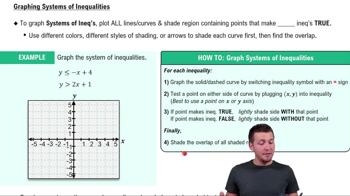
Systems of Inequalities

Expressing Solution Sets Using Set Notation

Set notation is a concise way to represent all solutions of a system. For example, a single solution is written as {(x, y)}, no solution as the empty set ∅, and infinitely many solutions as a set describing the relationship between variables, like {(x, y) | y = 2x + 3}.
Recommended video:
07:07
Introduction to Exponents