Ch. 5 - Systems of Equations and Inequalities
Blitzer - College Algebra 8th Edition
Blitzer8th EditionCollege AlgebraISBN: 9780136970514Not the one you use?Change textbook
Chapter 6, Problem 37

Graph the solution set of each system of inequalities or indicate that the system has no solution. −2≤x<5

Verified step by step guidance
1
Identify the inequality given: \(-2 \leq x < 5\). This describes the range of \(x\) values that satisfy the inequality.
Understand that this inequality represents all \(x\) values starting from \(-2\) (inclusive) up to but not including \(5\) (exclusive).
On a number line, mark the point \(-2\) with a closed circle to indicate that \(x\) can be equal to \(-2\).
Mark the point \(5\) with an open circle to indicate that \(x\) cannot be equal to \(5\), but values less than \(5\) are included.
Shade the region on the number line between \(-2\) and \(5\) to represent all \(x\) values that satisfy the inequality \(-2 \leq x < 5\).

Verified video answer for a similar problem:

This video solution was recommended by our tutors as helpful for the problem above.
Video duration:
1m
Was this helpful?

Key Concepts

Here are the essential concepts you must grasp in order to answer the question correctly.

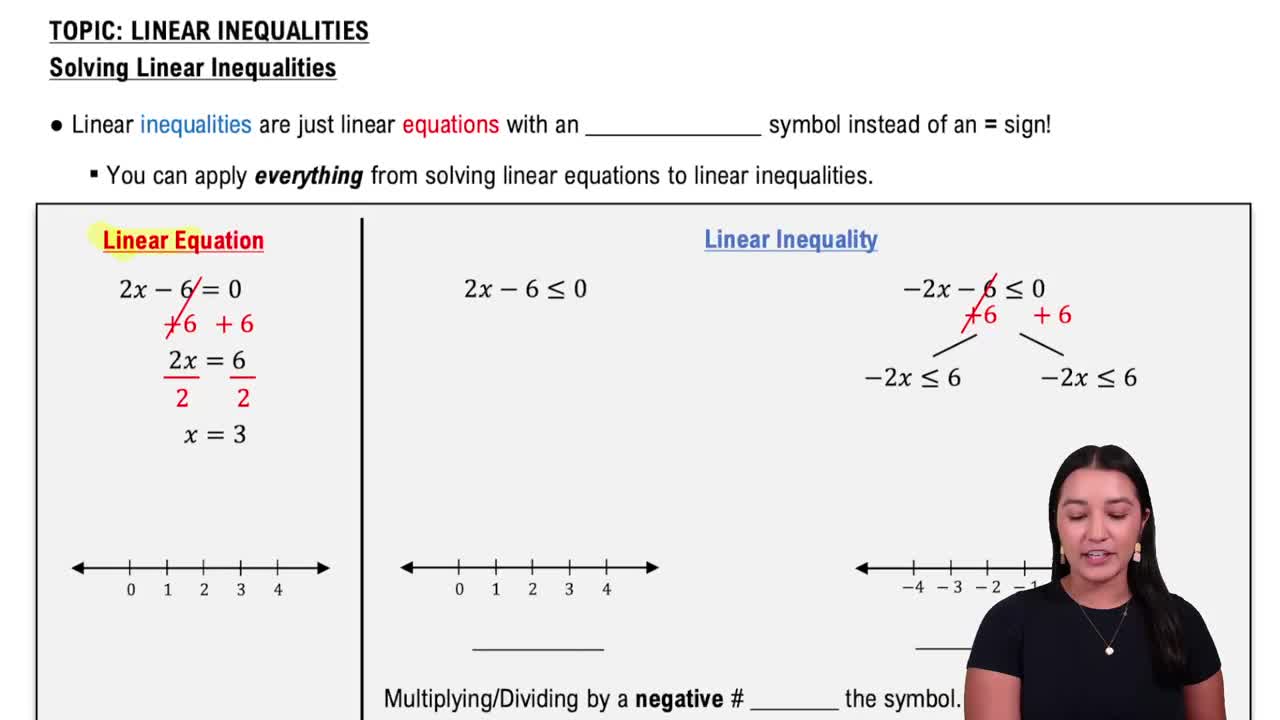
Inequalities and Their Solution Sets

An inequality expresses a range of values that a variable can take. The solution set includes all values that satisfy the inequality. For example, −2 ≤ x < 5 means x can be any number from −2 up to but not including 5.
Recommended video:
06:07
Linear Inequalities

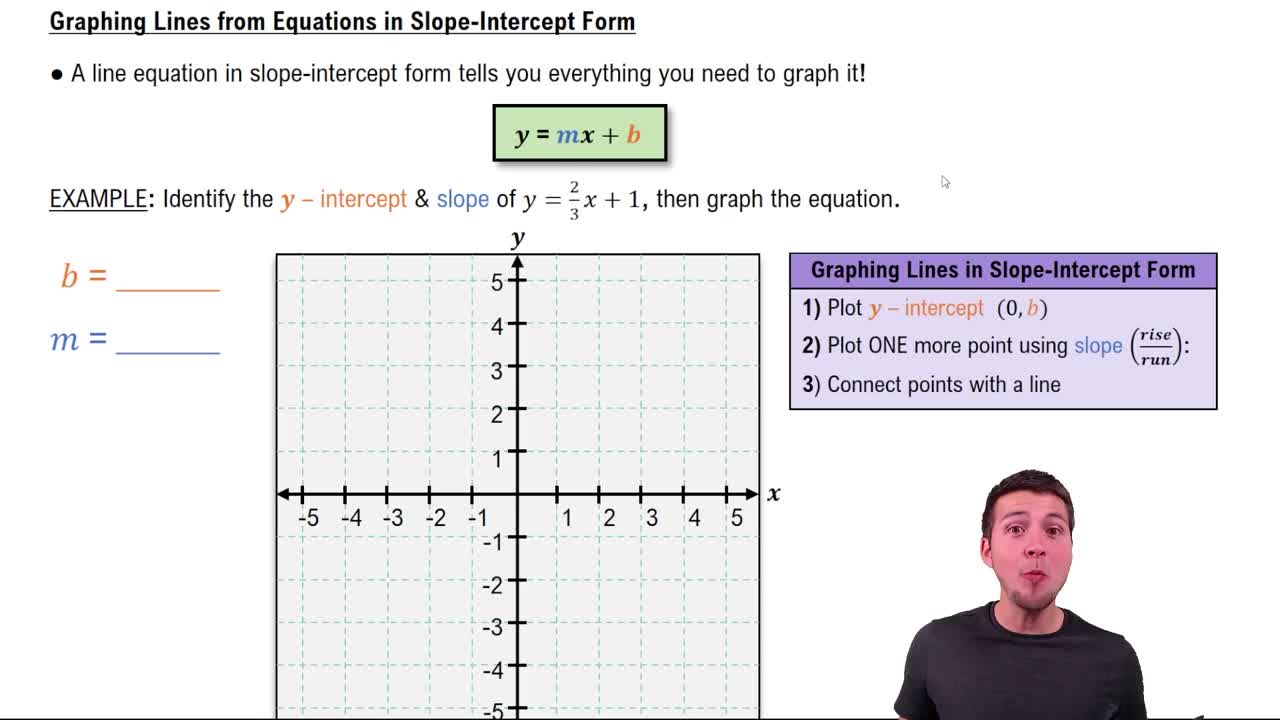
Graphing Inequalities on a Number Line

Graphing inequalities involves shading the portion of the number line that represents all solutions. Closed circles indicate inclusive boundaries (≤ or ≥), while open circles indicate exclusive boundaries (< or >). For −2 ≤ x < 5, use a closed circle at −2 and an open circle at 5.
Recommended video:
Guided course
02:35
Graphing Lines in Slope-Intercept Form

Systems of Inequalities

A system of inequalities consists of two or more inequalities considered together. The solution set is the intersection of all individual solution sets. If no values satisfy all inequalities simultaneously, the system has no solution.
Recommended video:
Guided course
6:19
Systems of Inequalities