Ch. 5 - Systems of Equations and Inequalities
Blitzer - College Algebra 8th Edition
Blitzer8th EditionCollege AlgebraISBN: 9780136970514Not the one you use?Change textbook
Chapter 6, Problem 39

In Exercises 29–42, solve each system by the method of your choice. {y=(x+3)2x+2y=2\(\begin{cases}\)y = (x + 3)^2 \(\x\) + 2y = -2\(\end{cases}\)

Verified step by step guidance
1
Start with the given system of equations: \(y = (x+3)^2\) and \(x + 2y = -2\).
Since \(y\) is already expressed in terms of \(x\) in the first equation, substitute \(y = (x+3)^2\) into the second equation to eliminate \(y\).
After substitution, the second equation becomes \(x + 2(x+3)^2 = -2\). Expand the squared term \((x+3)^2\) to get \(x + 2(x^2 + 6x + 9) = -2\).
Distribute the 2 across the terms inside the parentheses: \(x + 2x^2 + 12x + 18 = -2\).
Combine like terms and rearrange the equation to standard quadratic form: \(2x^2 + 13x + 18 + 2 = 0\), which simplifies to \(2x^2 + 13x + 20 = 0\). Then solve this quadratic equation for \(x\) using factoring, completing the square, or the quadratic formula.

Verified video answer for a similar problem:

This video solution was recommended by our tutors as helpful for the problem above.
Video duration:
4m
Was this helpful?

Key Concepts

Here are the essential concepts you must grasp in order to answer the question correctly.

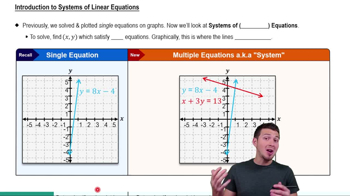
Systems of Equations

A system of equations consists of two or more equations with the same variables. The goal is to find values for the variables that satisfy all equations simultaneously. Solutions can be points where the graphs of the equations intersect.
Recommended video:
Guided course
4:27
Introduction to Systems of Linear Equations

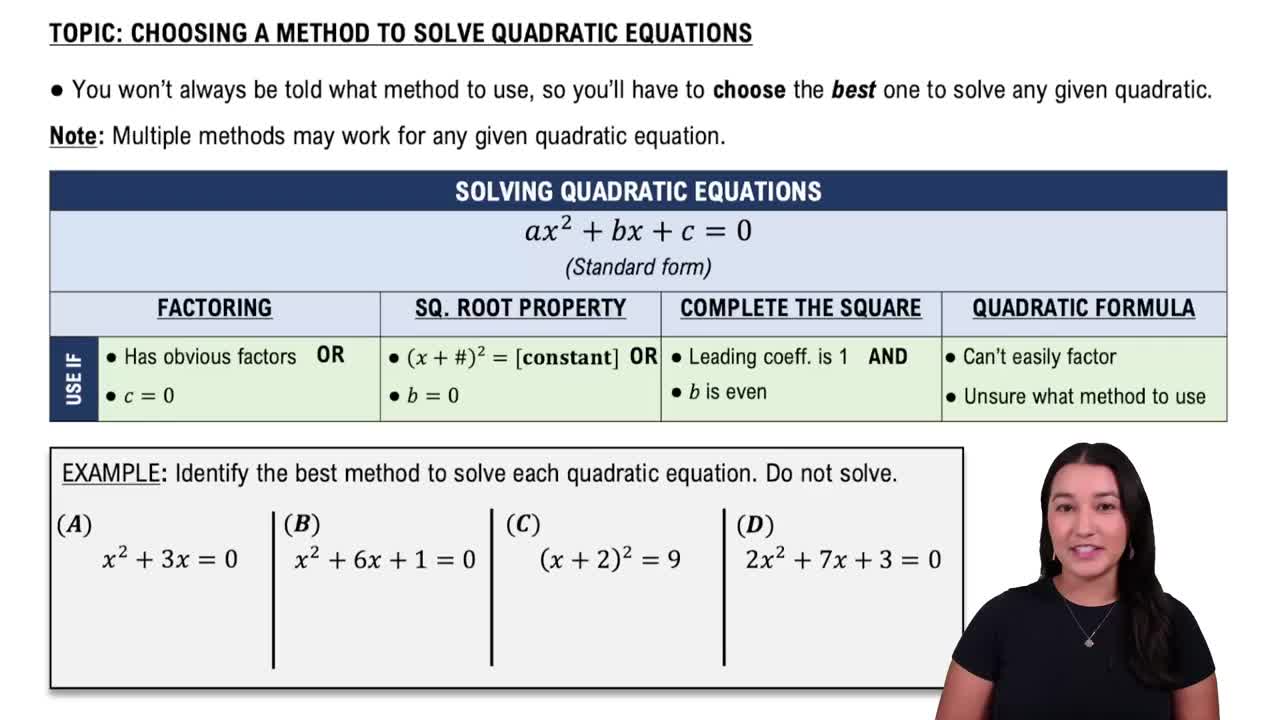
Substitution Method

The substitution method involves solving one equation for one variable and then substituting that expression into the other equation. This reduces the system to a single equation with one variable, making it easier to solve.
Recommended video:
04:03
Choosing a Method to Solve Quadratics

Quadratic Functions and Their Graphs

A quadratic function, like y = (x + 3)^2, graphs as a parabola. Understanding its shape and properties helps in visualizing solutions to systems involving quadratics and linear equations, as their intersections represent the system's solutions.
Recommended video:
5:26
Graphs of Logarithmic Functions