Exercises 57–59 will help you prepare for the material covered in the next section. Subtract:
Ch. 5 - Systems of Equations and Inequalities

Chapter 6, Problem 59
Graph the solution set of each system of inequalities or indicate that the system has no solution.
Verified step by step guidance1
Identify the inequalities in the system: \(x \geq 1\), \(y \geq -1\), \(x + 6y < 15\), and \(2x + y \leq 5\).
Graph the boundary lines for each inequality by converting inequalities to equations: \(x = 1\), \(y = -1\), \(x + 6y = 15\), and \(2x + y = 5\).
Determine the shading direction for each inequality: For \(x \geq 1\), shade to the right of the vertical line \(x=1\); for \(y \geq -1\), shade above the horizontal line \(y=-1\); for \(x + 6y < 15\), shade below the line \(x + 6y = 15\); for \(2x + y \leq 5\), shade below or on the line \(2x + y = 5\).
Find the intersection region where all shaded areas overlap. This region represents the solution set to the system of inequalities.
Check if the intersection region is non-empty. If it exists, the solution set is the overlapping shaded area; if not, the system has no solution.

Verified video answer for a similar problem:
This video solution was recommended by our tutors as helpful for the problem above.
Video duration:
9mWas this helpful?
Key Concepts
Here are the essential concepts you must grasp in order to answer the question correctly.
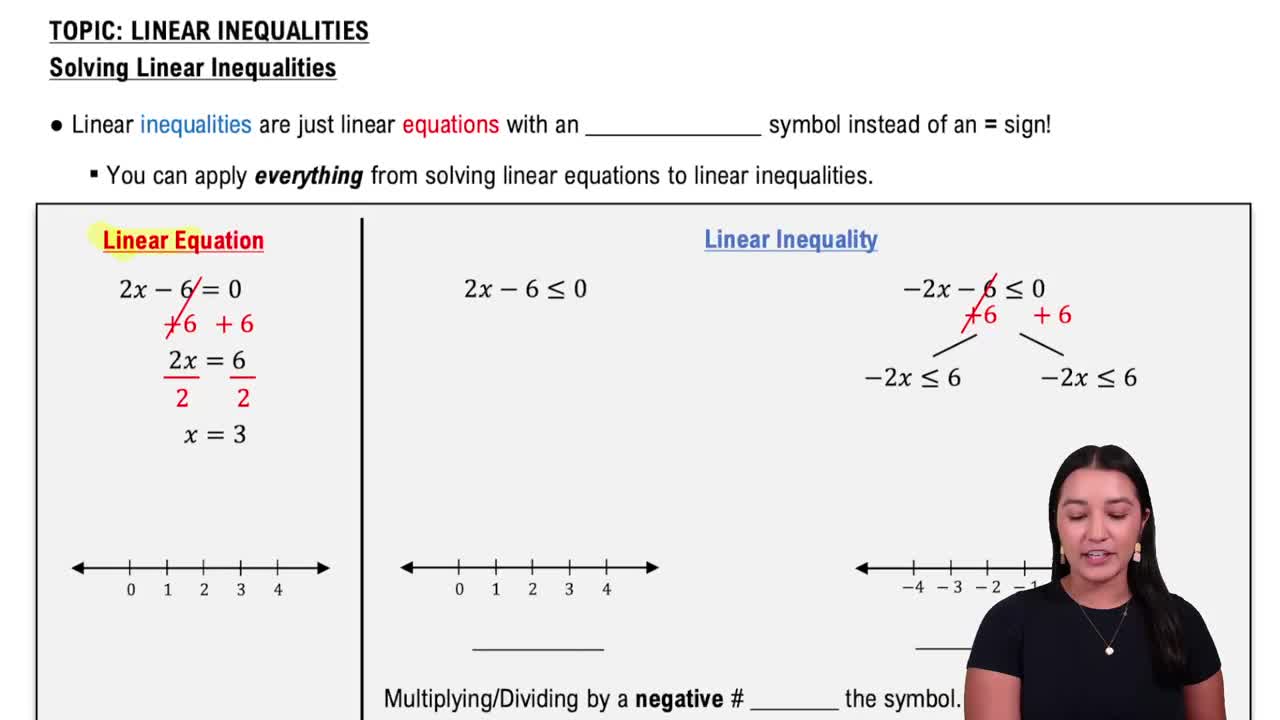
Graphing Linear Inequalities
Graphing linear inequalities involves plotting the boundary line of the inequality and shading the region that satisfies the inequality. For strict inequalities (< or >), the boundary is dashed, while for inclusive inequalities (≤ or ≥), the boundary is solid. This visual representation helps identify all possible solutions.
Recommended video:
Linear Inequalities
System of Inequalities
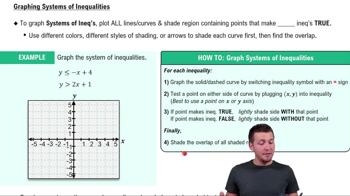
A system of inequalities consists of multiple inequalities that must be satisfied simultaneously. The solution set is the intersection of the individual solution regions of each inequality. Understanding how to find this common region is essential for solving such systems.
Recommended video:
Guided course
Systems of Inequalities
Boundary Conditions and Feasible Region
Boundary conditions like x ≥ 1 and y ≥ -1 restrict the solution to specific quadrants or areas on the coordinate plane. The feasible region is the overlapping area that meets all inequalities, representing all possible solutions. Identifying this region is key to solving and interpreting the system.
Recommended video:
Categorizing Linear Equations
Related Practice
Textbook Question
Textbook Question
In Exercises 27–62, graph the solution set of each system of inequalities or indicate that the system has no solution. 3x+y≤6, 2x−y≤−1, x>−2, y<4
5
views
Textbook Question
In Exercises 57–59, graph the region determined by the constraints. Then find the maximum value of the given objective function, subject to the constraints. This is a piecewise function. Refer to the textbook.
1
views
Textbook Question
Exercises 57–59 will help you prepare for the material covered in the next section. Add: (5x−3)/(x2+1) + 2x/(x2+1)2.
1
views
Textbook Question
Exercises 57–59 will help you prepare for the material covered in the next section. Solve:
Textbook Question
Find the length and width of a rectangle whose perimeter is 40 feet and whose area is 96 square feet.