Find the partial fraction decomposition of 4x²+5x-9/(x³- 6x-9)
Ch. 5 - Systems of Equations and Inequalities

Chapter 6, Problem 59
Exercises 57–59 will help you prepare for the material covered in the next section. Solve:
Verified step by step guidance1
Identify the system of equations given:
\(A + B = 3\),
\(2A - 2B + C = 17\),
\(4A - 2C = 14\).
From the first equation, express one variable in terms of the other. For example, solve for \(B\):
\(B = 3 - A\).
Substitute the expression for \(B\) into the second equation to eliminate \(B\):
\(2A - 2(3 - A) + C = 17\).
Simplify the second equation after substitution to get an equation in terms of \(A\) and \(C\) only.
Use the third equation \(4A - 2C = 14\) along with the simplified second equation to solve the system of two equations with two variables (\(A\) and \(C\)). Then back-substitute to find \(B\).

Verified video answer for a similar problem:
This video solution was recommended by our tutors as helpful for the problem above.
Video duration:
5mWas this helpful?
Key Concepts
Here are the essential concepts you must grasp in order to answer the question correctly.
Systems of Linear Equations
A system of linear equations consists of two or more linear equations with the same variables. The goal is to find values for the variables that satisfy all equations simultaneously. Methods such as substitution, elimination, or matrix operations are commonly used to solve these systems.
Recommended video:
Guided course
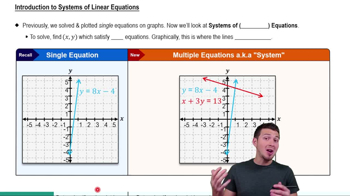
Introduction to Systems of Linear Equations
Substitution and Elimination Methods
Substitution involves solving one equation for a variable and substituting that expression into other equations. Elimination involves adding or subtracting equations to eliminate one variable, simplifying the system. Both methods help reduce the system to fewer variables for easier solving.
Recommended video:
Guided course
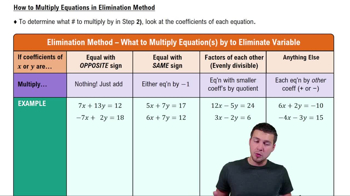
How to Multiply Equations in Elimination Method
Manipulating and Combining Equations
Solving systems often requires multiplying or dividing entire equations to align coefficients, enabling elimination of variables. Careful manipulation preserves equality and simplifies the system step-by-step. This skill is essential for efficiently solving multi-variable linear systems.
Recommended video:
Combinations
Related Practice
Textbook Question
2
views
Textbook Question
In Exercises 27–62, graph the solution set of each system of inequalities or indicate that the system has no solution. 3x+y≤6, 2x−y≤−1, x>−2, y<4
5
views
Textbook Question
In Exercises 63–64, write each sentence as an inequality in two variables. Then graph the inequality. The y-variable is at least 4 more than the product of -2 and the x-variable.
Textbook Question
Graph the solution set of each system of inequalities or indicate that the system has no solution.
Textbook Question
In Exercises 57–59, graph the region determined by the constraints. Then find the maximum value of the given objective function, subject to the constraints. This is a piecewise function. Refer to the textbook.
1
views
Textbook Question
Find the length and width of a rectangle whose perimeter is 40 feet and whose area is 96 square feet.