Find the value of the objective function z = 2x + 3y at each corner of the graphed region shown. What is the maximum value of the objective function? What is the minimum value of the objective function?
Ch. 5 - Systems of Equations and Inequalities

Chapter 6, Problem 57
Exercises 57–59 will help you prepare for the material covered in the next section. Subtract:
Verified step by step guidance1
Identify the two rational expressions to subtract: \(\frac{3}{x-4}\) and \(\frac{2}{x+2}\).
Find the least common denominator (LCD) of the two fractions. Since the denominators are \((x-4)\) and \((x+2)\), the LCD is the product of these two distinct factors: \((x-4)(x+2)\).
Rewrite each fraction with the LCD as the new denominator by multiplying numerator and denominator appropriately:
- For \(\frac{3}{x-4}\), multiply numerator and denominator by \((x+2)\) to get \(\frac{3(x+2)}{(x-4)(x+2)}\).
- For \(\frac{2}{x+2}\), multiply numerator and denominator by \((x-4)\) to get \(\frac{2(x-4)}{(x-4)(x+2)}\).
Now that both fractions have the same denominator, subtract the numerators:
\(\frac{3(x+2) - 2(x-4)}{(x-4)(x+2)}\).
Simplify the numerator by distributing and combining like terms, then write the final expression as a single simplified rational expression.

Verified video answer for a similar problem:
This video solution was recommended by our tutors as helpful for the problem above.
Video duration:
3mWas this helpful?
Key Concepts
Here are the essential concepts you must grasp in order to answer the question correctly.
Finding a Common Denominator
When subtracting rational expressions, you must first find a common denominator. This involves identifying the least common denominator (LCD) that both denominators share, which allows you to rewrite each fraction with the same denominator for easy subtraction.
Recommended video:
Guided course
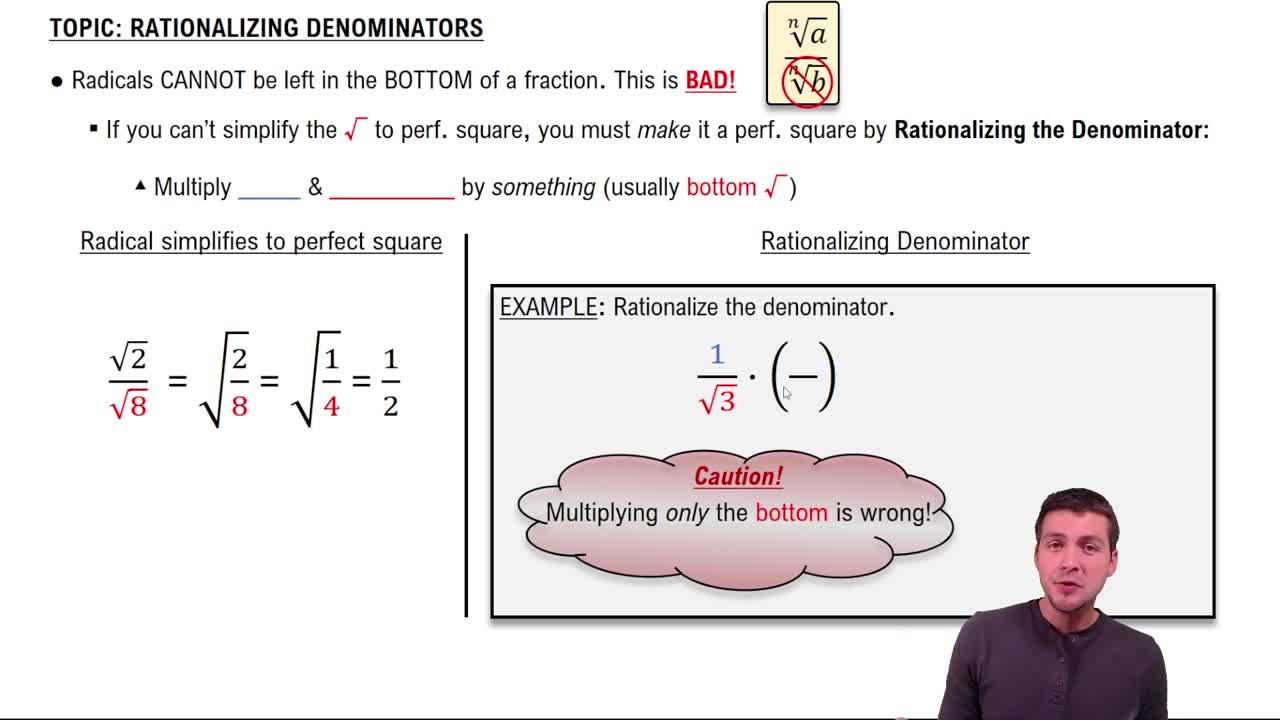
Rationalizing Denominators
Subtracting Rational Expressions
After expressing both fractions with a common denominator, subtract the numerators while keeping the denominator the same. This step combines the expressions into a single rational expression, simplifying the subtraction process.
Recommended video:
Guided course
Rationalizing Denominators
Simplifying the Resulting Expression
Once the subtraction is performed, simplify the resulting rational expression by factoring and reducing common factors in the numerator and denominator. This ensures the expression is in its simplest form for clarity and further use.
Recommended video:
Guided course
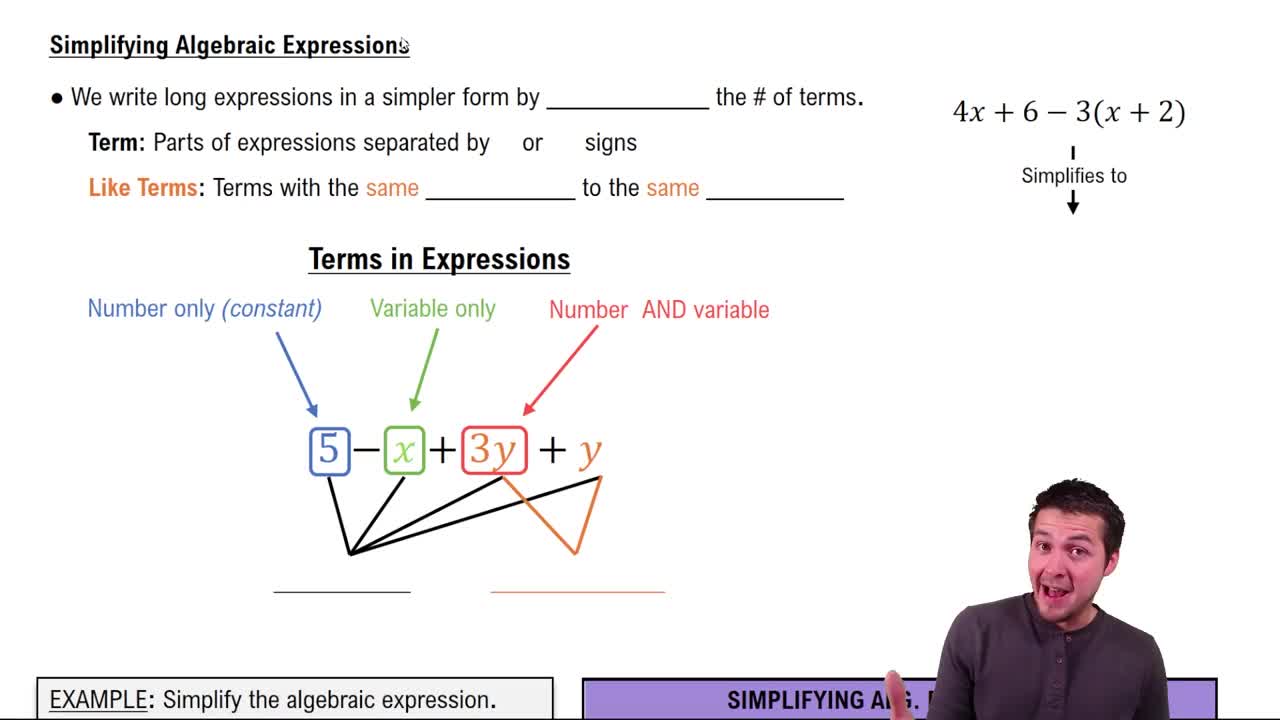
Simplifying Algebraic Expressions
Related Practice
Textbook Question
Textbook Question
In Exercises 57–59, graph the region determined by the constraints. Then find the maximum value of the given objective function, subject to the constraints. This is a piecewise function. Refer to the textbook.
5
views
Textbook Question
Graph the solution set of each system of inequalities or indicate that the system has no solution.
Textbook Question
Find the length and width of a rectangle whose perimeter is 36 feet and whose area is 77 square feet.
Textbook Question
Exercises 57–59 will help you prepare for the material covered in the next section. Add: (5x−3)/(x2+1) + 2x/(x2+1)2.
1
views
Textbook Question
Find the length and width of a rectangle whose perimeter is 40 feet and whose area is 96 square feet.