The graph of an exponential function is given. Select the function for each graph from the following options:
Ch. 4 - Exponential and Logarithmic Functions

Chapter 5, Problem 20
In Exercises 19–29, evaluate each expression without using a calculator. If evaluation is not possible, state the reason. log5 (1/5)
Verified step by step guidance1
Step 1: Recall the definition of a logarithm. The logarithmic expression logb(a) asks the question: 'To what power must the base b be raised to produce the number a?' In this case, the base is 5, and the number is 1/5.
Step 2: Rewrite the logarithmic equation log5(1/5) = x in its equivalent exponential form. Using the property of logarithms, this becomes 5x = 1/5.
Step 3: Recognize that 1/5 can be written as 5-1. This means the equation 5x = 1/5 can be rewritten as 5x = 5-1.
Step 4: Since the bases are the same (both are 5), the exponents must be equal. Therefore, x = -1.
Step 5: Conclude that log5(1/5) = -1, as the base 5 raised to the power of -1 equals 1/5.

Verified video answer for a similar problem:
This video solution was recommended by our tutors as helpful for the problem above.
Video duration:
2mWas this helpful?
Key Concepts
Here are the essential concepts you must grasp in order to answer the question correctly.
Logarithms
A logarithm is the inverse operation to exponentiation, representing the power to which a base must be raised to obtain a given number. For example, in the expression log_b(a), b is the base, and a is the number for which we want to find the logarithm. Understanding logarithms is essential for evaluating expressions like log5(1/5).
Recommended video:
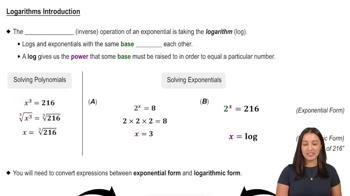
Logarithms Introduction
Change of Base Formula
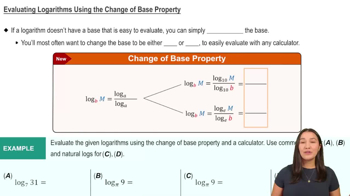
The change of base formula allows us to convert logarithms from one base to another, which can simplify calculations. It states that log_b(a) = log_k(a) / log_k(b) for any positive k. This is particularly useful when the base is not easily computable, enabling us to express log5(1/5) in terms of more familiar bases like 10 or e.
Recommended video:
Change of Base Property
Properties of Logarithms
Logarithms have several key properties that simplify their evaluation. One important property is that log_b(1) = 0 for any base b, since b^0 = 1. Additionally, log_b(1/b) = -1, as b^(-1) = 1/b. These properties can be directly applied to evaluate log5(1/5) without a calculator.
Recommended video:
Change of Base Property
Related Practice
Textbook Question
1
views
Textbook Question
Use properties of logarithms to expand each logarithmic expression as much as possible. Where possible, evaluate logarithmic expressions without using a calculator. logb (x2 y)
Textbook Question
Use properties of logarithms to expand each logarithmic expression as much as possible. Where possible, evaluate logarithmic expressions without using a calculator.
Textbook Question
Solve each exponential equation in Exercises 1–22 by expressing each side as a power of the same base and then equating exponents. e(x+1)=1/e
4
views
Textbook Question
Solve each exponential equation in Exercises 1–22 by expressing each side as a power of the same base and then equating exponents. 8(x+3)=16(x−1)
Textbook Question
Write each equation in its equivalent logarithmic form. 7y = 200