Graph each function by making a table of coordinates. If applicable, use a graphing utility to confirm your hand-drawn graph. f(x) = (0.6)x
Ch. 4 - Exponential and Logarithmic Functions

Chapter 5, Problem 19
Use properties of logarithms to expand each logarithmic expression as much as possible. Where possible, evaluate logarithmic expressions without using a calculator.
Verified step by step guidance1
Recognize that the expression \( \ln 5\sqrt{x} \) can be rewritten using exponent notation. The fifth root of \( x \) is \( x^{\frac{1}{5}} \), so rewrite the expression as \( \ln \left( 5 x^{\frac{1}{5}} \right) \).
Use the logarithm property that \( \ln(ab) = \ln a + \ln b \) to separate the logarithm of the product into a sum: \( \ln 5 + \ln x^{\frac{1}{5}} \).
Apply the power rule of logarithms, which states \( \ln a^{b} = b \ln a \), to the second term: \( \ln x^{\frac{1}{5}} = \frac{1}{5} \ln x \).
Combine the results to express the expanded form as \( \ln 5 + \frac{1}{5} \ln x \).
Since \( \ln 5 \) is a constant, it can be left as is or approximated if needed, but the problem states to expand as much as possible without a calculator, so this is the fully expanded form.

Verified video answer for a similar problem:
This video solution was recommended by our tutors as helpful for the problem above.
Video duration:
1mWas this helpful?
Key Concepts
Here are the essential concepts you must grasp in order to answer the question correctly.
Properties of Logarithms
Properties of logarithms include rules such as the product, quotient, and power rules. These allow us to expand or condense logarithmic expressions by turning multiplication into addition, division into subtraction, and exponents into coefficients. Understanding these properties is essential for simplifying and expanding logarithmic expressions.
Recommended video:
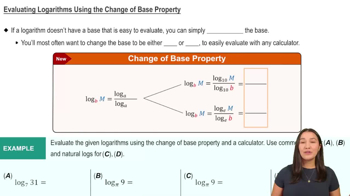
Change of Base Property
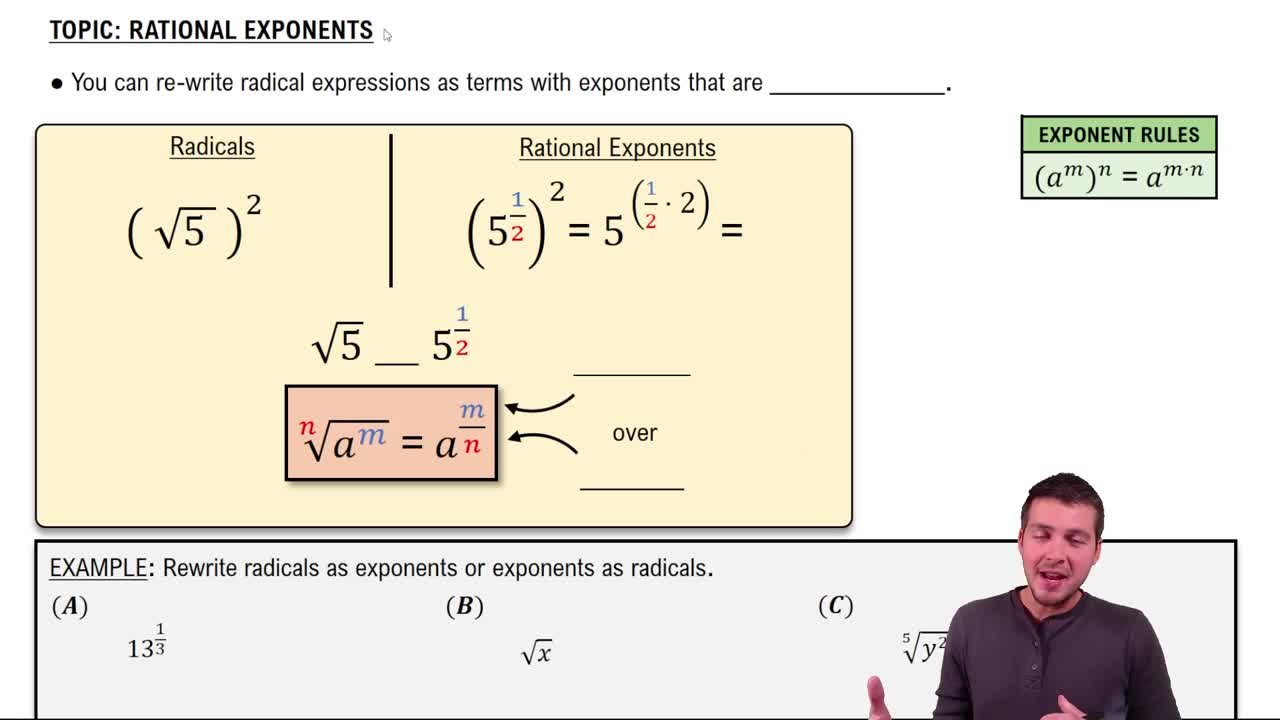
Radicals and Exponents
Radicals like the fifth root can be expressed as fractional exponents (e.g., the fifth root of x is x^(1/5)). Converting radicals to exponents helps apply logarithm power rules effectively, making it easier to expand or simplify logarithmic expressions involving roots.
Recommended video:
Guided course
Rational Exponents
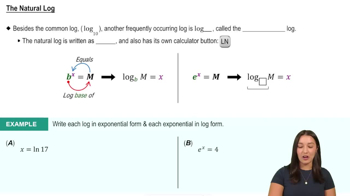
Natural Logarithm (ln)
The natural logarithm, denoted ln, is the logarithm with base e, where e is approximately 2.718. It has the same properties as other logarithms but is commonly used in calculus and algebra. Recognizing ln and its properties helps in correctly expanding and evaluating expressions without a calculator.
Recommended video:
The Natural Log
Related Practice
Textbook Question
1
views
Textbook Question
In Exercises 19–24, the graph of an exponential function is given. Select the function for each graph from the following options:
Textbook Question
Solve each exponential equation in Exercises 1–22 by expressing each side as a power of the same base and then equating exponents. 8(x+3)=16(x−1)
Textbook Question
In Exercises 16–18, write each equation in its equivalent logarithmic form. 13^y = 874
2
views
Textbook Question
Write each equation in its equivalent logarithmic form. 7y = 200
Textbook Question
In Exercises 19–29, evaluate each expression without using a calculator. If evaluation is not possible, state the reason. log5 (1/5)
3
views