Ch. 4 - Exponential and Logarithmic Functions
Blitzer - College Algebra 8th Edition
Blitzer8th EditionCollege AlgebraISBN: 9780136970514Not the one you use?Change textbook
Chapter 5, Problem 21

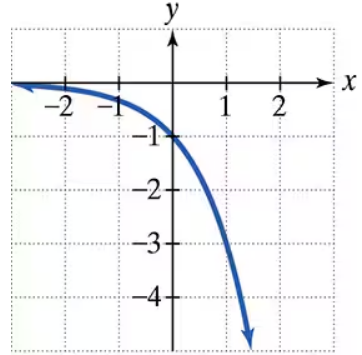
The graph of an exponential function is given. Select the function for each graph from the following options:
f(x)=3x,g(x)=3x1,h(x)=3x1,f(x)=3x,G(x)=3x,H(x)=3x.f(x) = 3^x, \(\quad\) g(x) = 3^{x-1}, \(\quad\) h(x) = 3^x - 1, \\ f(x) = -3^x, \(\quad\) G(x) = 3^{-x}, \(\quad\) H(x) = -3^{-x}.

Verified step by step guidance
1
Step 1: Identify the horizontal asymptote of the graph. The graph shows a horizontal asymptote at \(y = -1\), which means the function approaches \(-1\) as \(x\) goes to negative infinity.
Step 2: Recall that the basic exponential function \$3^x$ has a horizontal asymptote at $y = 0$. To shift this asymptote to $y = -1$, the function must be vertically shifted down by 1 unit. This suggests the function has the form \(3^x - 1\).
Step 3: Check the point given on the graph, which is \((1, 5)\). Substitute \(x = 1\) into the candidate function \(3^x - 1\) to verify: \(3^1 - 1 = 3 - 1 = 2\), which does not match the point \((1, 5)\).
Step 4: Consider the function \(3^{x-1}\), which shifts the graph horizontally to the right by 1 unit. The asymptote remains at \(y = 0\), so this does not match the asymptote at \(y = -1\).
Step 5: Since the asymptote is at \(y = -1\) and the graph passes through \((1, 5)\), the function must be \(f(x) = 3^x - 1\). The discrepancy in step 3 suggests rechecking the point or considering the vertical shift as the key feature to identify the function.

Verified video answer for a similar problem:

This video solution was recommended by our tutors as helpful for the problem above.
Video duration:
2m

Key Concepts

Here are the essential concepts you must grasp in order to answer the question correctly.

Exponential Functions and Their Graphs

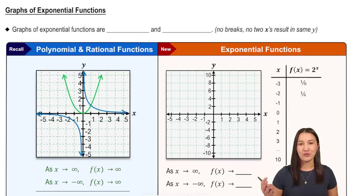
Exponential functions have the form f(x) = a^x, where the base a is positive and not equal to 1. Their graphs show rapid growth or decay, depending on the base and the exponent's sign. Key features include a horizontal asymptote and passing through specific points like (0,1) for f(x) = a^x.
Recommended video:
5:46
Graphs of Exponential Functions

Transformations of Exponential Functions

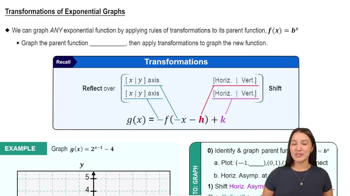
Transformations such as shifts and reflections modify the graph of an exponential function. Horizontal shifts change the input (e.g., f(x) = 3^(x-1) shifts right by 1), vertical shifts add or subtract constants (e.g., f(x) = 3^x - 1 shifts down by 1), and reflections flip the graph across axes.
Recommended video:
6:16
Transformations of Exponential Graphs

Horizontal Asymptotes in Exponential Functions

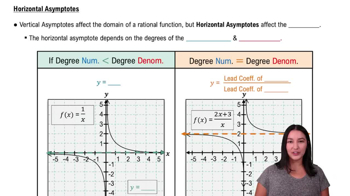
Exponential functions have horizontal asymptotes that the graph approaches but never touches. The asymptote is typically y=0 for basic functions, but vertical shifts move it up or down. In the given graph, the asymptote at y = -1 indicates a vertical shift downward by 1.
Recommended video:
4:48
Determining Horizontal Asymptotes