The graph of an exponential function is given. Select the function for each graph from the following options:
Ch. 4 - Exponential and Logarithmic Functions

Chapter 5, Problem 23
Use properties of logarithms to expand each logarithmic expression as much as possible. Where possible, evaluate logarithmic expressions without using a calculator.
Verified step by step guidance1
Recall the logarithmic property for quotients: \(\log_b \left( \frac{M}{N} \right) = \log_b M - \log_b N\). Apply this to rewrite \(\log_4 \left( \frac{\sqrt{x}}{64} \right)\) as \(\log_4 (\sqrt{x}) - \log_4 (64)\).
Express the square root as an exponent: \(\sqrt{x} = x^{\frac{1}{2}}\). Use the power rule of logarithms: \(\log_b (M^p) = p \log_b M\). So, \(\log_4 (\sqrt{x}) = \log_4 (x^{\frac{1}{2}}) = \frac{1}{2} \log_4 x\).
Rewrite 64 as a power of 4 if possible. Since \(4^3 = 64\), we have \(64 = 4^3\). Use the power rule again: \(\log_4 (64) = \log_4 (4^3) = 3 \log_4 4\).
Recall that \(\log_b b = 1\) for any base \(b\). Therefore, \(\log_4 4 = 1\), so \(\log_4 (64) = 3 \times 1 = 3\).
Combine all parts to write the expanded form: \(\log_4 \left( \frac{\sqrt{x}}{64} \right) = \frac{1}{2} \log_4 x - 3\).

Verified video answer for a similar problem:
This video solution was recommended by our tutors as helpful for the problem above.
Video duration:
4mWas this helpful?
Key Concepts
Here are the essential concepts you must grasp in order to answer the question correctly.
Properties of Logarithms
Properties of logarithms include rules such as the product, quotient, and power rules. These allow us to rewrite logarithmic expressions by expanding or condensing them. For example, log_b(M/N) = log_b(M) - log_b(N) and log_b(M^k) = k * log_b(M). These properties are essential for simplifying and expanding logarithmic expressions.
Recommended video:
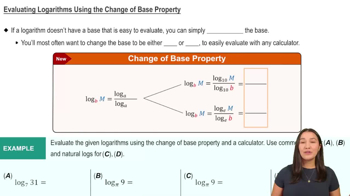
Change of Base Property
Radicals and Exponents
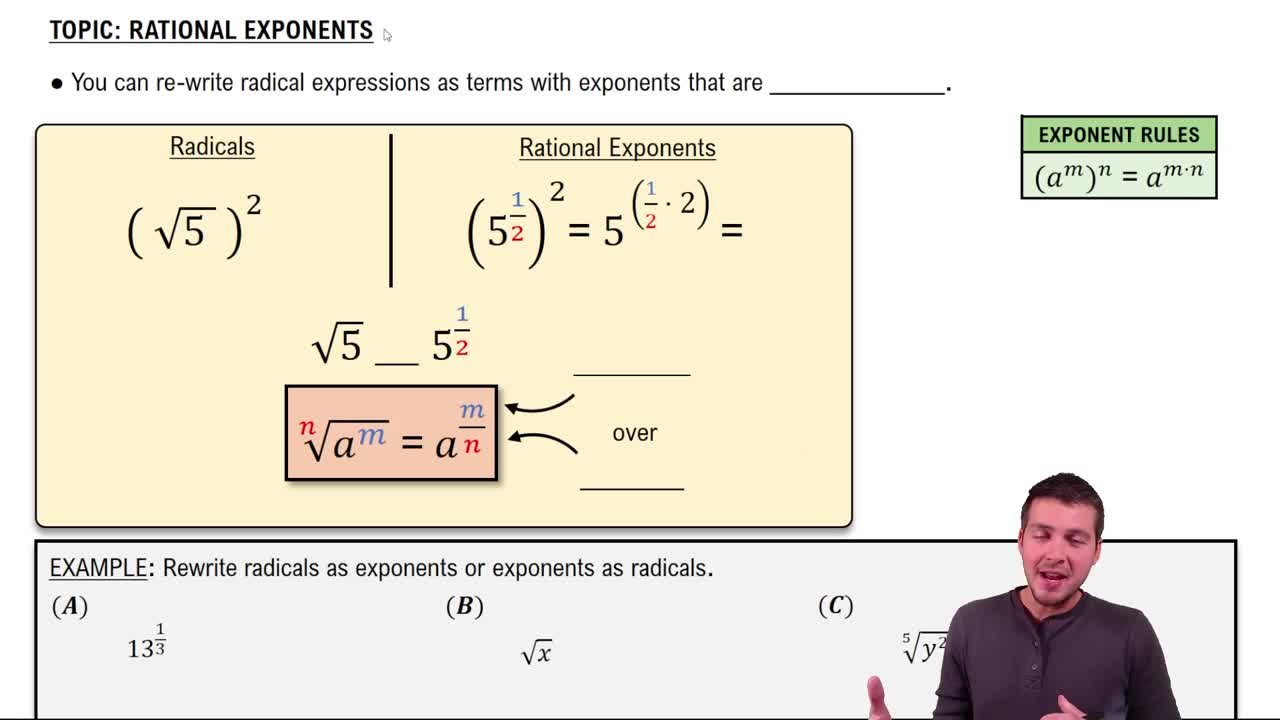
Understanding how to express radicals as fractional exponents is crucial. For instance, the square root of x can be written as x^(1/2). This conversion allows the use of logarithm power rules to simplify expressions involving roots. Recognizing this helps in expanding logarithmic expressions involving radicals.
Recommended video:
Guided course
Rational Exponents
Change of Base and Evaluating Logarithms
Evaluating logarithms without a calculator often involves expressing numbers as powers of the base. For example, 64 can be written as 4^3 since 4^3 = 64. This allows direct simplification of logarithmic terms like log_4(64) = 3. This concept helps in simplifying and evaluating logarithmic expressions exactly.
Recommended video:
Change of Base Property
Related Practice
Textbook Question
1
views
Textbook Question
Solve each exponential equation in Exercises 23–48. Express the solution set in terms of natural logarithms or common logarithms. Then use a calculator to obtain a decimal approximation, correct to two decimal places, for the solution. 10x=3.91
Textbook Question
Evaluate each expression without using a calculator. log2 64
1
views
Textbook Question
In Exercises 19–29, evaluate each expression without using a calculator. If evaluation is not possible, state the reason. log16 4
Textbook Question
Evaluate each expression without using a calculator. log4 16
Textbook Question
The graph of an exponential function is given. Select the function for each graph from the following options:
4
views