Ch. 2 - Functions and Graphs
Blitzer - College Algebra 8th Edition
Blitzer8th EditionCollege AlgebraISBN: 9780136970514Not the one you use?Change textbook
Chapter 3, Problem 96

In Exercises 95–96, let f and g be defined by the following table: Find |ƒ(1) − f(0)| − [g (1)]² +g(1) ÷ ƒ(−1) · g (2) .

Verified step by step guidance
1
Step 1: Identify the values of f(x) and g(x) from the given table for the specific inputs. Look up f(1), f(0), f(-1), g(1), and g(2) in the table provided in the problem.
Step 2: Compute the absolute difference |f(1) - f(0)|. Subtract f(0) from f(1), then take the absolute value of the result.
Step 3: Square the value of g(1). This means calculating [g(1)]² by multiplying g(1) by itself.
Step 4: Divide g(1) by f(-1). Perform the division g(1) ÷ f(-1). Ensure that f(-1) is not zero to avoid division by zero.
Step 5: Substitute all the computed values into the expression |f(1) - f(0)| - [g(1)]² + g(1) ÷ f(-1) · g(2). Simplify the expression step by step to reach the final result.

Verified video answer for a similar problem:

This video solution was recommended by our tutors as helpful for the problem above.
Video duration:
2m
Was this helpful?

Key Concepts

Here are the essential concepts you must grasp in order to answer the question correctly.

Function Evaluation

Function evaluation involves substituting a specific input value into a function to determine its output. For example, if f(x) is a function, then f(1) means to find the output of f when the input is 1. Understanding how to evaluate functions at given points is crucial for solving problems that require calculating specific values from a function.
Recommended video:
4:26
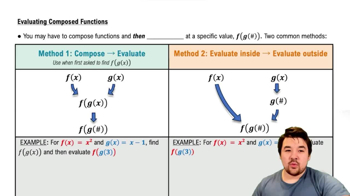
Evaluating Composed Functions

Order of Operations

The order of operations is a set of rules that dictates the sequence in which mathematical operations should be performed to ensure consistent results. Commonly remembered by the acronym PEMDAS (Parentheses, Exponents, Multiplication and Division, Addition and Subtraction), this concept is essential for correctly simplifying expressions and solving equations, especially when multiple operations are involved.
Recommended video:
Guided course
8:38
Performing Row Operations on Matrices

Absolute Value

Absolute value refers to the distance of a number from zero on the number line, regardless of direction. It is denoted by vertical bars, such as |x|, and is always non-negative. Understanding absolute value is important for interpreting expressions that involve differences between function outputs, as it affects the final result by ensuring it is expressed as a positive quantity.
Recommended video:
7:12
Parabolas as Conic Sections Example 1