Ch. 2 - Functions and Graphs
Blitzer - College Algebra 8th Edition
Blitzer8th EditionCollege AlgebraISBN: 9780136970514Not the one you use?Change textbook
Chapter 3, Problem 95

Determine whether each statement is true or false. If the statement is false, make the necessary change(s) to produce a true statement.
If f(x)=3xf(x) = 3x and g(x)=x+5g(x) = x + 5, find (fg)1(x)\(\left\)(f\(\circ\) g\(\right\))^{-1}(x) and (g1f1)(x)(g^{-1} \(\circ\) f^{-1})(x).

Verified step by step guidance
1
First, understand the notation: (ƒ 0 g)(x) means the composition of functions f and g, which is f(g(x)). Similarly, (ƒ 0 g)^{-1}(x) means the inverse of the composition f(g(x)).
Step 1: Find the composition (ƒ 0 g)(x) by substituting g(x) into f. Since f(x) = 3x and g(x) = x + 5, write the expression for f(g(x)) as \(f(g(x)) = 3(x + 5)\).
Step 2: To find the inverse of the composition, set \(y = 3(x + 5)\) and solve for x in terms of y. This involves isolating x on one side of the equation.
Step 3: Next, find the inverse functions individually: find \(f^{-1}(x)\) by solving \(y = 3x\) for x, and find \(g^{-1}(x)\) by solving \(y = x + 5\) for x.
Step 4: Finally, find the composition \((g^{-1} 0 f^{-1})(x)\) by substituting \(f^{-1}(x)\) into \(g^{-1}\). Write the expression for \(g^{-1}(f^{-1}(x))\).

Verified video answer for a similar problem:

This video solution was recommended by our tutors as helpful for the problem above.
Video duration:
5m
Was this helpful?

Key Concepts

Here are the essential concepts you must grasp in order to answer the question correctly.

Function Composition

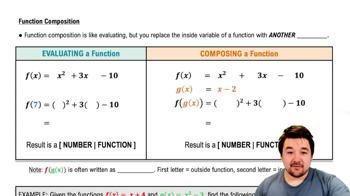
Function composition involves applying one function to the result of another, denoted as (f ∘ g)(x) = f(g(x)). Understanding how to combine functions correctly is essential for evaluating expressions like (f ∘ g)(x) and manipulating them for further operations.
Recommended video:
4:56
Function Composition

Inverse Functions

An inverse function reverses the effect of the original function, such that f(f⁻¹(x)) = x. Finding the inverse requires solving for x in terms of y and swapping variables. Recognizing and computing inverses is crucial for expressions involving f⁻¹ or g⁻¹.
Recommended video:
4:30
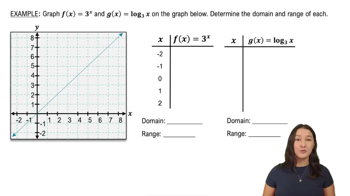
Graphing Logarithmic Functions

Notation and Order of Operations in Compositions and Inverses

Understanding the notation (f ∘ g)⁻¹ and (g⁻¹ ∘ f⁻¹) requires knowing that the inverse of a composition reverses the order: (f ∘ g)⁻¹ = g⁻¹ ∘ f⁻¹. This concept helps correctly interpret and simplify composite inverse functions.
Recommended video:
7:24
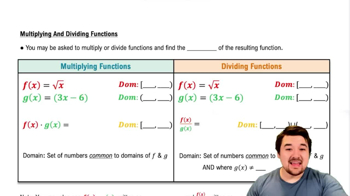
Multiplying & Dividing Functions