The functions in Exercises 93–95 are all one-to-one. For each function, (a) find an equation for f^(-1)x, the inverse function. (b) Verify that your equation is correct by showing that f(f^(-1)(x)) = x and f^(-1)(f(x)) = x. f(x) = (x - 7)/(x + 2)
Ch. 2 - Functions and Graphs

Chapter 3, Problem 95a
Begin by graphing the standard cubic function, f(x) = x³. Then use transformations of this graph to graph the given function. g(x) = x³-3
Verified step by step guidance1
Start by identifying the standard cubic function, f(x) = x³. This is a basic cubic function with a graph that passes through the origin (0, 0) and has a characteristic S-shape, increasing to the right and decreasing to the left.
Understand the transformation applied to f(x) to obtain g(x). The given function is g(x) = x³ - 3. This represents a vertical shift of the graph of f(x) downward by 3 units.
To apply the vertical shift, take each point on the graph of f(x) = x³ and subtract 3 from its y-coordinate. For example, the point (0, 0) on f(x) becomes (0, -3) on g(x). Similarly, the point (1, 1) on f(x) becomes (1, -2) on g(x), and so on.
Sketch the transformed graph. The new graph will have the same S-shape as the original cubic function, but it will be shifted downward by 3 units. Ensure that the key points, such as the origin (now at (0, -3)), are clearly marked.
Verify the transformation by substituting specific x-values into g(x) = x³ - 3 and confirming that the resulting points match the shifted graph. For example, if x = 2, g(2) = 2³ - 3 = 8 - 3 = 5, so the point (2, 5) should lie on the graph.

Verified video answer for a similar problem:
This video solution was recommended by our tutors as helpful for the problem above.
Video duration:
6mWas this helpful?
Key Concepts
Here are the essential concepts you must grasp in order to answer the question correctly.
Cubic Functions
A cubic function is a polynomial function of degree three, typically expressed in the form f(x) = ax³ + bx² + cx + d. The standard cubic function, f(x) = x³, has a characteristic S-shaped curve that passes through the origin and extends infinitely in both directions. Understanding the basic shape and properties of cubic functions is essential for analyzing transformations.
Recommended video:
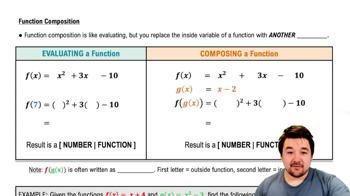
Function Composition
Graph Transformations
Graph transformations involve shifting, reflecting, stretching, or compressing the graph of a function. For the function g(x) = x³ - 3, the transformation is a vertical shift downward by 3 units. Recognizing how these transformations affect the original graph is crucial for accurately sketching the new function.
Recommended video:
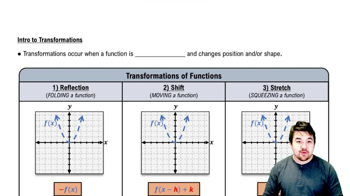
Intro to Transformations
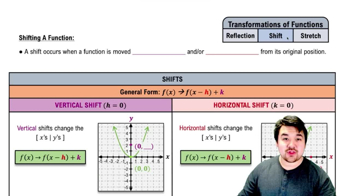
Vertical Shifts
A vertical shift occurs when a constant is added to or subtracted from a function, resulting in the entire graph moving up or down. In the case of g(x) = x³ - 3, the '-3' indicates that every point on the graph of f(x) = x³ is lowered by 3 units. This concept is fundamental for understanding how to manipulate the graph of a function based on its equation.
Recommended video:
Shifts of Functions
Related Practice
Textbook Question
1
views
Textbook Question
In Exercises 95–96, let f and g be defined by the following table: Find |ƒ(1) − f(0)| − [g (1)]² +g(1) ÷ ƒ(−1) · g (2) .
Textbook Question
Which graphs in Exercises 96–99 represent functions that have inverse functions?
Textbook Question
Determine whether each statement is true or false. If the statement is false, make the necessary change(s) to produce a true statement.
If and , find and .
Textbook Question
Find all values of x satisfying the given conditions. f(x) = 2x − 5, g(x) = x² − 3x + 8, and (ƒ o g) (x) = 7.
Textbook Question
Begin by graphing the standard cubic function, f(x) = x3. Then use transformations of this graph to graph the given function. g(x) = (x − 3)3