Graph both equations in the same rectangular coordinate system and find all points of intersection. Then show that these ordered pairs satisfy the equations. x² + y² = 16, x-y = 4
Ch. 2 - Functions and Graphs

Chapter 3, Problem 67
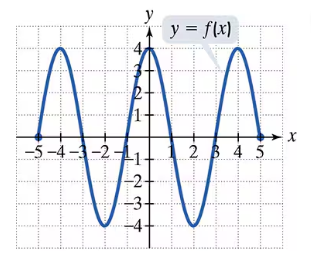
In Exercises 65–70, use the graph of f to find each indicated function value. f(4)

Verified step by step guidance1
Identify the point on the graph where the input value (x) is 4.
Locate the vertical line corresponding to x = 4 on the x-axis.
Find the point on the curve of the function f(x) that intersects this vertical line.
Determine the y-coordinate of this intersection point, which represents the value of f(4).
Read the y-value from the graph at x = 4 without calculating, just noting the position on the y-axis.

Verified video answer for a similar problem:
This video solution was recommended by our tutors as helpful for the problem above.
Video duration:
1mWas this helpful?
Key Concepts
Here are the essential concepts you must grasp in order to answer the question correctly.
Function and Function Notation
A function assigns each input exactly one output. The notation f(x) represents the output value of the function f at the input x. Understanding this notation is essential to interpret and evaluate function values from graphs or equations.
Recommended video:
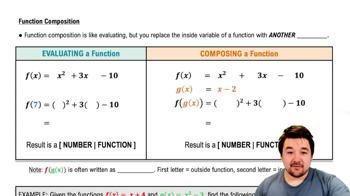
Function Composition
Reading Values from a Graph
To find f(4) from a graph, locate the input value x = 4 on the x-axis, then find the corresponding point on the curve. The y-coordinate of this point is the function value f(4). This skill is crucial for interpreting graphical data.
Recommended video:
Guided course
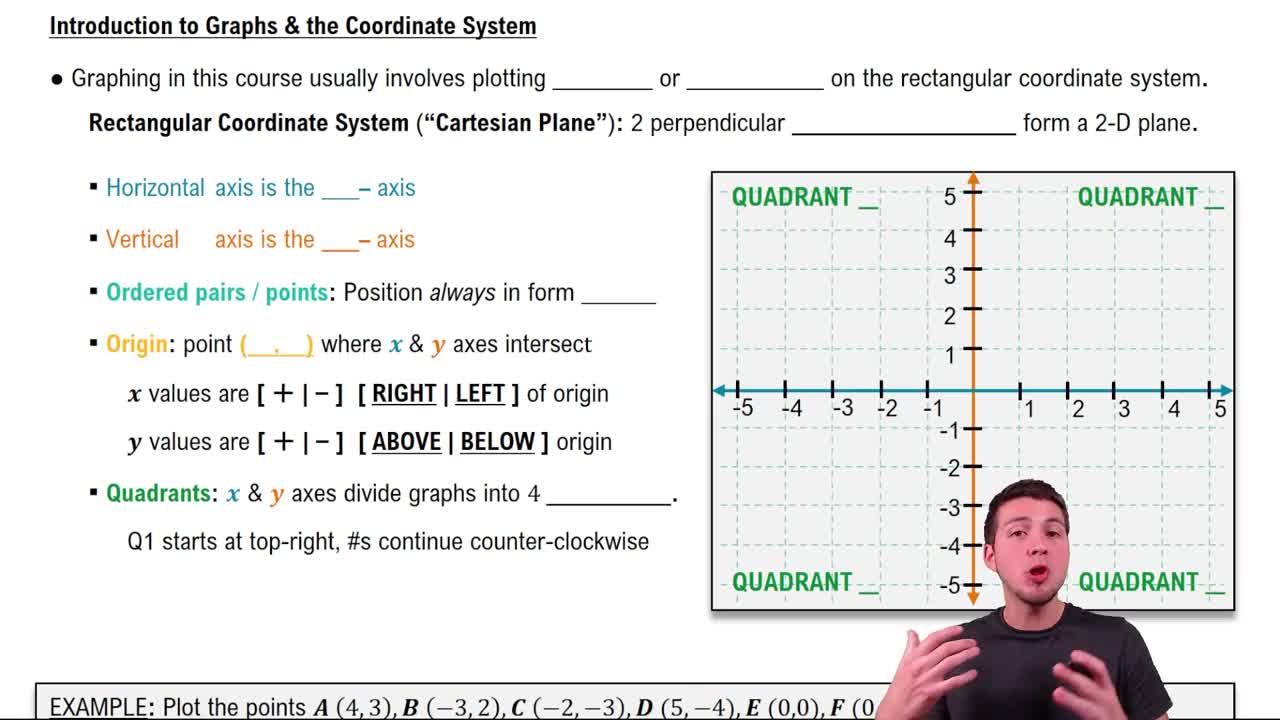
Graphs & the Rectangular Coordinate System
Properties of Sinusoidal Functions
Sinusoidal functions, like sine and cosine, have wave-like patterns with regular peaks and troughs. Recognizing these patterns helps predict function values and understand periodic behavior, which is useful when analyzing graphs of such functions.
Recommended video:
Change of Base Property
Related Practice
Textbook Question
1
views
Textbook Question
In Exercises 59-66, a. Rewrite the given equation in slope-intercept form. b. Give the slope and y-intercept. c. Use the slope and y-intercept to graph the linear function. 4y+ 28 = 0
Textbook Question
Use intercepts to graph each equation. 6x-9y-18 = 0
Textbook Question
Begin by graphing the square root function, f(x) = √x. Then use transformations of this graph to graph the given function. g(x) = √x + 1
Textbook Question
Begin by graphing the standard quadratic function, f(x) = x². Then use transformations of this graph to graph the given function. h(x) = -2(x+2)²+1
7
views
Textbook Question
In Exercises 67-74, find a. (fog) (x) b. the domain of f o g. f(x) = 2/(x+3), g(x) = 1/x
4
views