Graph both equations in the same rectangular coordinate system and find all points of intersection. Then show that these ordered pairs satisfy the equations. x² + y² = 16, x-y = 4
Ch. 2 - Functions and Graphs

Chapter 3, Problem 68
Use intercepts to graph each equation. 6x-9y-18 = 0
Verified step by step guidance1
Rewrite the given equation in standard form: \(6x - 9y - 18 = 0\).
Find the x-intercept by setting \(y = 0\) in the equation and solving for \(x\). This means solving \(6x - 9(0) - 18 = 0\) for \(x\).
Find the y-intercept by setting \(x = 0\) in the equation and solving for \(y\). This means solving \(6(0) - 9y - 18 = 0\) for \(y\).
Plot the intercept points found on the coordinate plane: the x-intercept on the x-axis and the y-intercept on the y-axis.
Draw a straight line through the two intercept points to graph the equation.

Verified video answer for a similar problem:
This video solution was recommended by our tutors as helpful for the problem above.
Video duration:
1mKey Concepts
Here are the essential concepts you must grasp in order to answer the question correctly.
Finding x-intercept
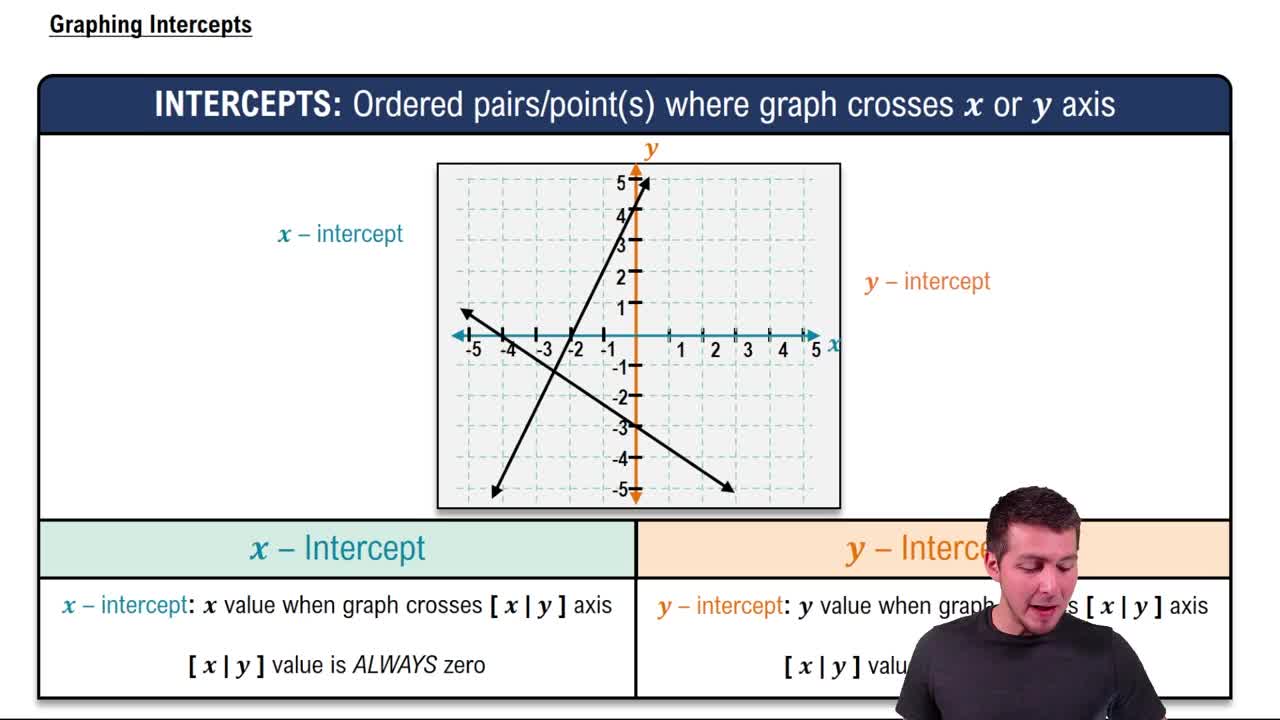
The x-intercept is the point where the graph crosses the x-axis, meaning y = 0. To find it, substitute y = 0 into the equation and solve for x. This gives a coordinate of the form (x, 0), which helps in plotting the graph.
Recommended video:
Graphing Intercepts
Finding y-intercept
The y-intercept is the point where the graph crosses the y-axis, meaning x = 0. To find it, substitute x = 0 into the equation and solve for y. This results in a coordinate of the form (0, y), which is essential for graphing the line.
Recommended video:
Graphing Intercepts
Graphing a linear equation using intercepts
Once the x- and y-intercepts are found, plot these points on the coordinate plane. Drawing a straight line through these two points represents the graph of the linear equation. This method is a straightforward way to graph lines without needing slope.
Recommended video:
Categorizing Linear Equations
Related Practice
Textbook Question
1
views
Textbook Question
Find a. (fog) (x) b. the domain of f o g. f(x) = x/(x+1), g(x) = 4/x
Textbook Question
Begin by graphing the square root function, f(x) = √x. Then use transformations of this graph to graph the given function. g(x) = √x + 1
Textbook Question
Graph both equations in the same rectangular coordinate system and find all points of intersection. Then show that these ordered pairs satisfy the equations. (x − 2)²+(y+3)² = 4, y = x - 3
2
views
Textbook Question
In Exercises 65–70, use the graph of f to find each indicated function value. f(4)
Textbook Question
In Exercises 67–69, begin by graphing the absolute value function, f(x) = |x|. Then use transformations of this graph to graph the given function. r(x) = (1/2) |x + 2|