In Exercises 64–66, begin by graphing the square root function, f(x) = √x. Then use transformations of this graph to graph the given function. r(x) = 2√(x + 2)
Ch. 2 - Functions and Graphs

Chapter 3, Problem 66
Begin by graphing the standard quadratic function, f(x) = x². Then use transformations of this graph to graph the given function. h(x) = -2(x+2)²+1
Verified step by step guidance1
Start by recalling the graph of the standard quadratic function \(f(x) = x^{2}\), which is a parabola opening upwards with its vertex at the origin \((0,0)\).
Identify the transformations applied to \(f(x)\) to get \(h(x) = -2(x+2)^{2} + 1\). Notice the expression inside the squared term is \((x + 2)\), which indicates a horizontal shift.
Apply the horizontal shift by moving the graph of \(f(x)\) left by 2 units, changing the vertex from \((0,0)\) to \((-2,0)\).
Next, observe the coefficient \(-2\) outside the squared term. The negative sign reflects the parabola across the x-axis (it opens downward), and the factor 2 vertically stretches the graph by a factor of 2.
Finally, apply the vertical shift by adding 1, moving the vertex up by 1 unit. The new vertex is at \((-2,1)\). Combine all transformations to sketch the graph of \(h(x)\).

Verified video answer for a similar problem:
This video solution was recommended by our tutors as helpful for the problem above.
Video duration:
2mWas this helpful?
Key Concepts
Here are the essential concepts you must grasp in order to answer the question correctly.
Standard Quadratic Function
The standard quadratic function is f(x) = x², which graphs as a parabola opening upwards with its vertex at the origin (0,0). Understanding this basic shape is essential because transformations are applied relative to this parent graph.
Recommended video:
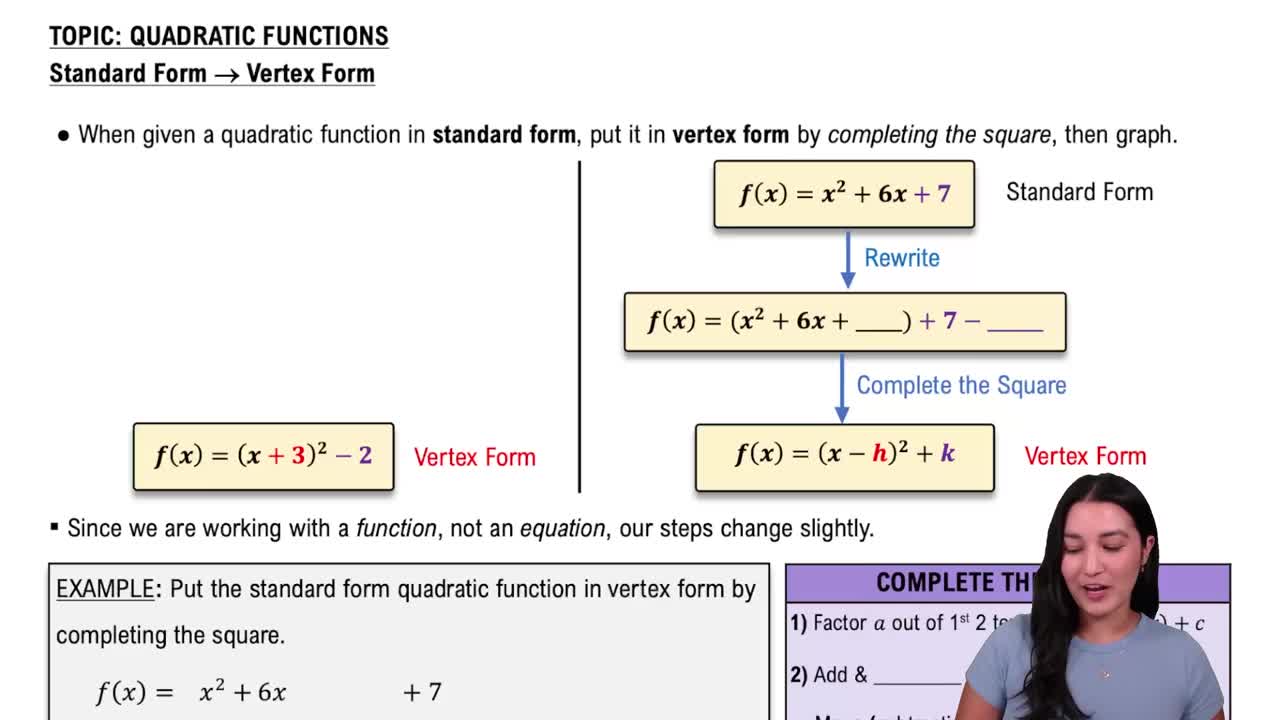
Converting Standard Form to Vertex Form
Transformations of Functions
Transformations include shifts, reflections, stretches, and compressions applied to the parent function. For h(x) = -2(x+2)² + 1, the graph shifts left by 2 units, reflects over the x-axis, vertically stretches by a factor of 2, and shifts up by 1 unit.
Recommended video:
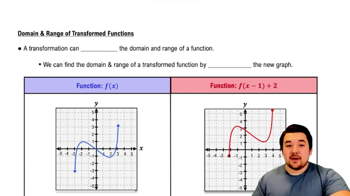
Domain & Range of Transformed Functions
Vertex Form of a Quadratic Function
The vertex form is h(x) = a(x-h)² + k, where (h,k) is the vertex. This form makes it easier to identify transformations and graph the function by locating the vertex and understanding how 'a' affects the parabola's shape and direction.
Recommended video:
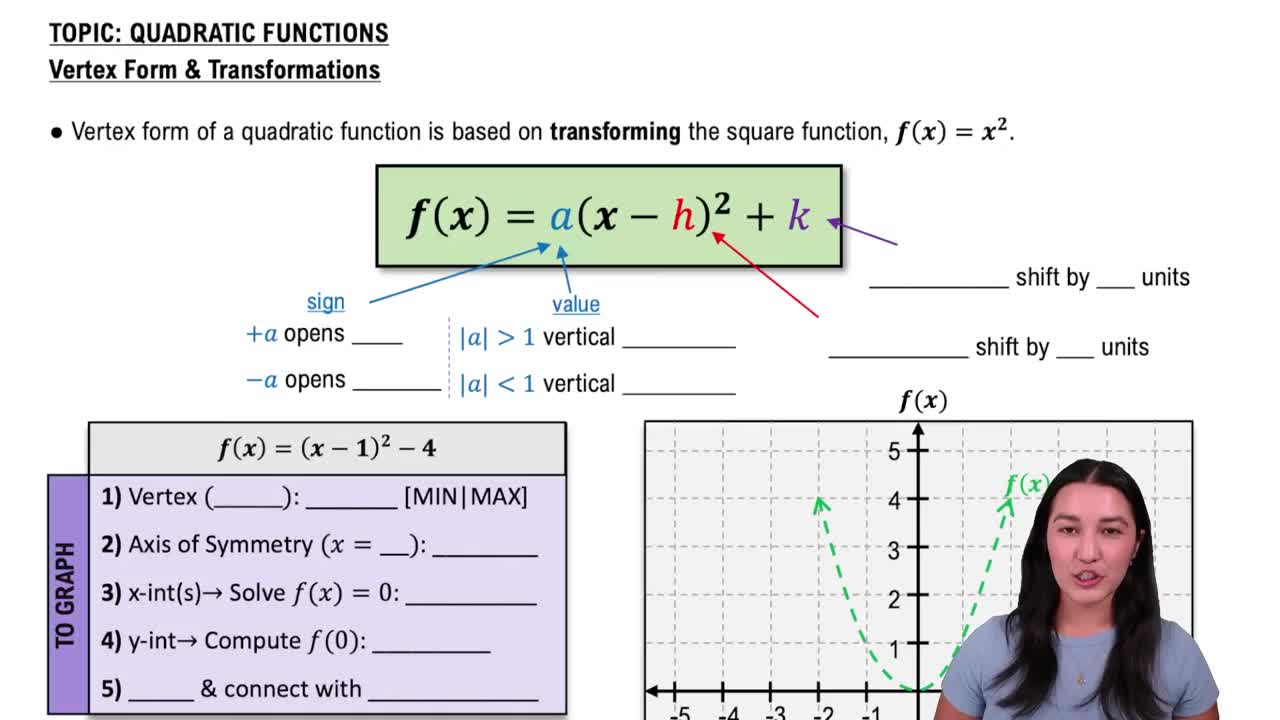
Vertex Form
Related Practice
Textbook Question
Textbook Question
In Exercises 59-66, a. Rewrite the given equation in slope-intercept form. b. Give the slope and y-intercept. c. Use the slope and y-intercept to graph the linear function. 4y+ 28 = 0
Textbook Question
Find a. (fog) (x) b. (go f) (x) c. (fog) (2) d. (go f) (2).
f(x) = 1/x, g(x)= 1/x
Textbook Question
A line segment through the center of each circle intersects the circle at the points shown. a. Find the coordinates of the circle's center. b. Find the radius of the circle. c. Use your answers from parts (a) and (b) to write the standard form of the circle's equation.
1
views
Textbook Question
In Exercises 65–70, use the graph of f to find each indicated function value. f(4)
Textbook Question
In Exercises 67-74, find a. (fog) (x) b. the domain of f o g. f(x) = 2/(x+3), g(x) = 1/x
4
views