Ch. 2 - Functions and Graphs
Blitzer - College Algebra 8th Edition
Blitzer8th EditionCollege AlgebraISBN: 9780136970514Not the one you use?Change textbook
Chapter 3, Problem 65

Find a. (fog) (x) b. (go f) (x) c. (fog) (2) d. (go f) (2).
f(x) = 1/x, g(x)= 1/x

Verified step by step guidance
1
Step 1: Understand the composition of functions. The notation (f ∘ g)(x) means f(g(x)), which involves substituting g(x) into f(x). Similarly, (g ∘ f)(x) means g(f(x)), which involves substituting f(x) into g(x).
Step 2: For part (a), calculate (f ∘ g)(x). Substitute g(x) = 1/x into f(x) = 1/x. This gives f(g(x)) = f(1/x). Replace x in f(x) with 1/x to get the expression for (f ∘ g)(x).
Step 3: For part (b), calculate (g ∘ f)(x). Substitute f(x) = 1/x into g(x) = 1/x. This gives g(f(x)) = g(1/x). Replace x in g(x) with 1/x to get the expression for (g ∘ f)(x).
Step 4: For part (c), evaluate (f ∘ g)(2). Use the expression for (f ∘ g)(x) derived in part (a) and substitute x = 2. Simplify the resulting expression.
Step 5: For part (d), evaluate (g ∘ f)(2). Use the expression for (g ∘ f)(x) derived in part (b) and substitute x = 2. Simplify the resulting expression.

Verified video answer for a similar problem:

This video solution was recommended by our tutors as helpful for the problem above.
Video duration:
2m
Was this helpful?

Key Concepts

Here are the essential concepts you must grasp in order to answer the question correctly.

Function Composition

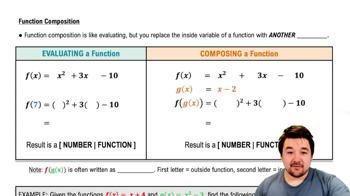
Function composition involves combining two functions to create a new function. If f(x) and g(x) are two functions, the composition (fog)(x) means applying g first and then f to the result, expressed as f(g(x)). This concept is essential for solving the given exercises, as it requires understanding how to manipulate and evaluate the functions in sequence.
Recommended video:
4:56
Function Composition

Evaluating Functions

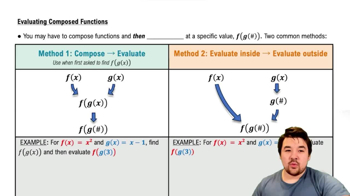
Evaluating functions means substituting a specific value into the function to find the output. For example, if f(x) = 1/x, evaluating f(2) involves substituting 2 for x, resulting in f(2) = 1/2. This skill is crucial for calculating the values of (fog)(2) and (go f)(2) in the exercises.
Recommended video:
4:26
Evaluating Composed Functions

Reciprocal Functions

Reciprocal functions are functions of the form f(x) = 1/x, which are defined for all x except zero. They exhibit unique properties, such as having vertical asymptotes at x = 0 and being symmetric about the line y = x. Understanding the behavior of reciprocal functions is important for accurately performing the compositions and evaluations in the problem.
Recommended video:
4:56
Function Composition