Complete the square and write the equation in standard form. Then give the center and radius of each circle and graph the equation. x² + y² - 6y -7=0
Ch. 2 - Functions and Graphs

Chapter 3, Problem 61
Let f(x) = 2x - 5 g(x) = 4x - 1 h(x) = x² + x + 2. Evaluate the indicated function without finding an equation for the function. ƒ-1 (1)
Verified step by step guidance1
Identify that the notation ƒ¹(1) represents the value of the inverse function of ƒ at 1, meaning we want to find the input x such that ƒ(x) = 1.
Write the equation based on the function ƒ(x) = 2x - 5, setting it equal to 1: 2x - 5 = 1.
Solve the equation for x by first adding 5 to both sides: 2x = 1 + 5.
Then divide both sides by 2 to isolate x: x = \(\frac{1 + 5}{2}\).
The value of x found is ƒ¹(1), which is the output of the inverse function at 1.

Verified video answer for a similar problem:
This video solution was recommended by our tutors as helpful for the problem above.
Video duration:
1mWas this helpful?
Key Concepts
Here are the essential concepts you must grasp in order to answer the question correctly.
Function Notation and Evaluation
Function notation, such as f(x), represents a rule that assigns each input x to an output. Evaluating a function at a specific value means substituting that value into the function's expression and simplifying to find the output.
Recommended video:
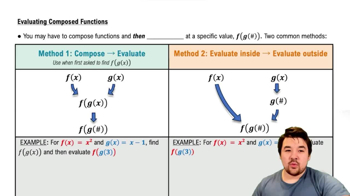
Evaluating Composed Functions
Composite Functions and Inverse Notation
The notation ƒ¹(1) often represents the inverse function evaluated at 1, not the reciprocal. Understanding inverse functions involves finding an input that maps to a given output under the original function.
Recommended video:
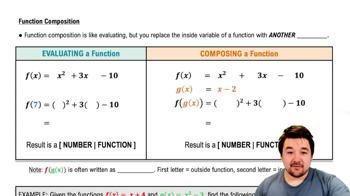
Function Composition
Solving Linear Equations
To find ƒ¹(1), you solve the equation f(x) = 1 for x. This requires isolating x by performing algebraic operations, such as addition, subtraction, multiplication, or division, to find the input that produces the output 1.
Recommended video:
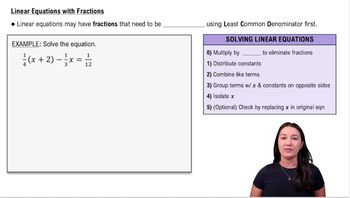
Solving Linear Equations with Fractions
Related Practice
Textbook Question
2
views
Textbook Question
In Exercises 60–63, begin by graphing the standard quadratic function, f(x) = x^2. Then use transformations of this graph to graph the given function. g(x) = x^2 + 2
Textbook Question
Find a. (fog) (x) b. (go f) (x). f(x) = √x, g(x) = x − 1
Textbook Question
Use the vertical line test to identify graphs in which y is a function of x.
Textbook Question
Complete the square and write the equation in standard form. Then give the center and radius of each circle and graph the equation. x² + y² − x + 2y + 1 = 0
1
views
Textbook Question
In Exercises 59-66, a. Rewrite the given equation in slope-intercept form. b. Give the slope and y-intercept. c. Use the slope and y-intercept to graph the linear function. 4x+y-6=0
4
views