Ch. 2 - Functions and Graphs
Blitzer - College Algebra 8th Edition
Blitzer8th EditionCollege AlgebraISBN: 9780136970514Not the one you use?Change textbook
Chapter 3, Problem 53

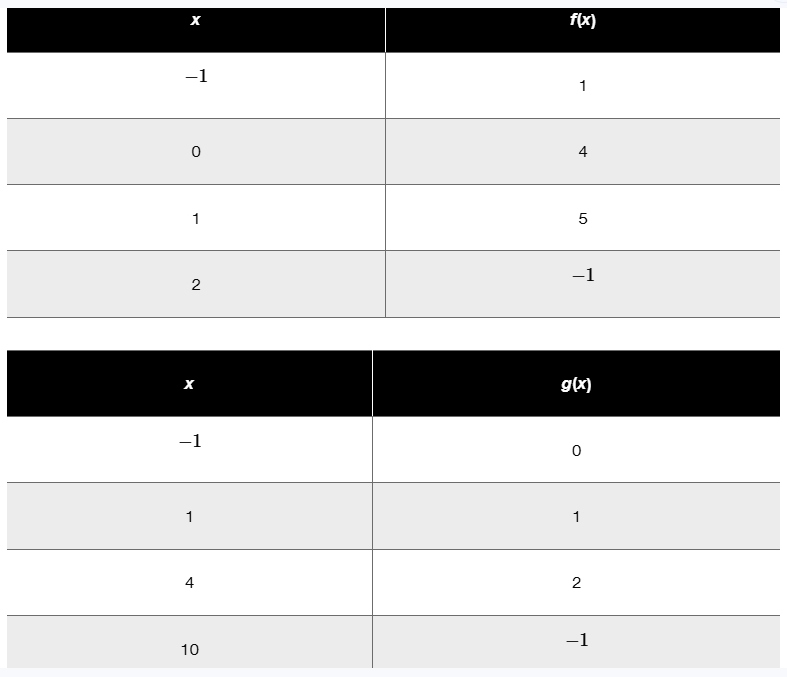
In Exercises 53–58, f and g are defined by the following tables. Use the tables to evaluate each composite function. f(g(1))
Tables showing values of functions f and g for given x inputs, used to evaluate composite functions.

Verified step by step guidance
1
Identify the composite function to evaluate: \(f(g(1))\). This means you first find \(g(1)\), then use that result as the input for \(f\).
Look up the value of \(g(1)\) in the \(g(x)\) table. According to the table, when \(x = 1\), \(g(1) = 1\).
Now, use the value \(g(1) = 1\) as the input for the function \(f\). So, you need to find \(f(1)\).
Look up the value of \(f(1)\) in the \(f(x)\) table. According to the table, when \(x = 1\), \(f(1) = 5\).
Therefore, the value of the composite function \(f(g(1))\) is \(f(1)\), which corresponds to the value found in the previous step.

Key Concepts

Here are the essential concepts you must grasp in order to answer the question correctly.

Function Evaluation

Function evaluation involves finding the output value of a function for a given input. Using the tables, you locate the input value in the x-column and read the corresponding function value from the f(x) or g(x) column. This is essential for determining values like g(1) or f(g(1)).
Recommended video:
4:26
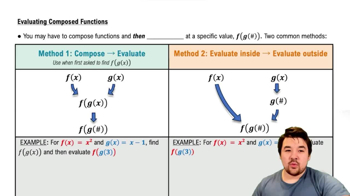
Evaluating Composed Functions

Composite Functions

A composite function, denoted as f(g(x)), means applying one function to the result of another. First, evaluate the inner function g at x, then use that output as the input for f. Understanding this process is key to correctly evaluating expressions like f(g(1)).
Recommended video:
4:56
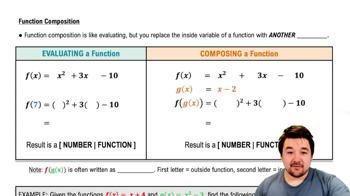
Function Composition

Using Tables to Represent Functions

Tables provide discrete values of functions for specific inputs, allowing evaluation without explicit formulas. By matching input values to outputs in the tables, you can perform operations like composition. This method is useful when functions are defined only by data points.
Recommended video:
5:31
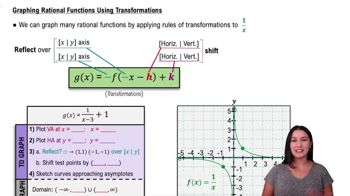
Graphing Rational Functions Using Transformations