
Textbook Question
Use the graph of y = f(x) to graph each function g. g(x)=2f(x-1)

 Verified step by step guidance
 4:30
4:30
 5:26
5:26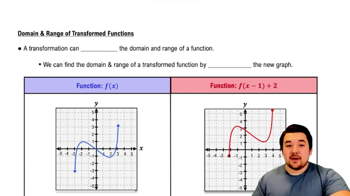 4:22
4:22Use the graph of y = f(x) to graph each function g. g(x)=2f(x-1)
In Exercises 53–58, f and g are defined by the following tables. Use the tables to evaluate each composite function. f(g(1))
In Exercises 51–54, graph the given square root functions, f and g, in the same rectangular coordinate system. Use the integer values of x given to the right of each function to obtain ordered pairs. Because only nonnegative numbers have square roots that are real numbers, be sure that each graph appears only for values of x that cause the expression under the radical sign to be greater than or equal to zero. Once you have obtained your graphs, describe how the graph of g is related to the graph of f. f(x) = √x (x = 0, 1, 4, 9) and g(x) = √x −1 (x = 0, 1, 4, 9)
Give the center and radius of the circle described by the equation and graph each equation. Use the graph to identify the relation's domain and range. (x + 1)² + y² = 25
Find
a. (fog) (x)
b. (go f) (x)
c. (fog) (2)
d. (go f) (2).
f(x) = 2x, g(x) = x+7
Complete the square and write the equation in standard form. Then give the center and radius of each circle and graph the equation. x² + y²+6x+2y+6 = 0