Ch. 2 - Functions and Graphs
Blitzer - College Algebra 8th Edition
Blitzer8th EditionCollege AlgebraISBN: 9780136970514Not the one you use?Change textbook
Chapter 3, Problem 51a

In Exercises 51–54, graph the given square root functions, f and g, in the same rectangular coordinate system. Use the integer values of x given to the right of each function to obtain ordered pairs. Because only nonnegative numbers have square roots that are real numbers, be sure that each graph appears only for values of x that cause the expression under the radical sign to be greater than or equal to zero. Once you have obtained your graphs, describe how the graph of g is related to the graph of f. f(x) = √x (x = 0, 1, 4, 9) and g(x) = √x −1 (x = 0, 1, 4, 9)

Verified step by step guidance
1
Step 1: Understand the domain of the square root functions. The square root function is only defined for values of x where the expression under the radical is greater than or equal to zero. For both f(x) = √x and g(x) = √x - 1, the domain is x ≥ 0.
Step 2: Calculate the corresponding y-values for f(x) = √x using the given x-values (0, 1, 4, 9). For each x-value, substitute it into the function f(x) and compute the square root. This will give you the ordered pairs (x, f(x)).
Step 3: Calculate the corresponding y-values for g(x) = √x - 1 using the same x-values (0, 1, 4, 9). For each x-value, substitute it into the function g(x), compute the square root of x, and then subtract 1. This will give you the ordered pairs (x, g(x)).
Step 4: Plot the ordered pairs for both functions f(x) and g(x) on the same rectangular coordinate system. Use the points calculated in Steps 2 and 3 to draw the graphs of f(x) and g(x). Ensure that the graph of each function starts at x = 0 and only includes nonnegative y-values.
Step 5: Compare the graphs of f(x) and g(x). Notice that the graph of g(x) = √x - 1 is a vertical shift of the graph of f(x) = √x. Specifically, the graph of g(x) is shifted downward by 1 unit compared to the graph of f(x).

Verified video answer for a similar problem:

This video solution was recommended by our tutors as helpful for the problem above.
Video duration:
5m
Was this helpful?

Key Concepts

Here are the essential concepts you must grasp in order to answer the question correctly.

Square Root Function

A square root function is defined as f(x) = √x, where the output is the nonnegative value that, when squared, gives x. This function is only defined for x ≥ 0, as negative numbers do not have real square roots. The graph of f(x) is a curve that starts at the origin (0,0) and increases gradually, reflecting the increasing nature of the square root.
Recommended video:
02:20
Imaginary Roots with the Square Root Property

Graphing Functions

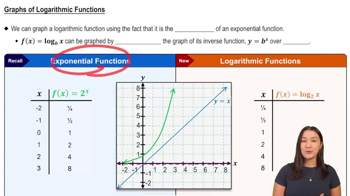
Graphing functions involves plotting points on a coordinate system based on the function's output for given input values. For the square root functions f and g, we will calculate the output for specified integer values of x (0, 1, 4, 9) and plot these points. Understanding how to represent these points visually helps in analyzing the behavior and relationship between different functions.
Recommended video:
5:26
Graphs of Logarithmic Functions

Vertical Shifts

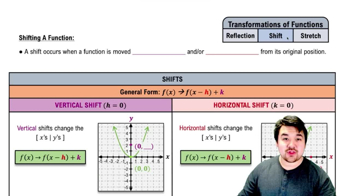
Vertical shifts occur when a constant is added to or subtracted from a function, affecting its position on the y-axis. In the case of g(x) = √x - 1, the graph of f(x) = √x is shifted downward by 1 unit. This transformation alters the y-values of the function without changing the x-values, allowing for a comparison of how the two graphs relate to each other.
Recommended video:
5:34
Shifts of Functions