Ch. 2 - Functions and Graphs
Blitzer - College Algebra 8th Edition
Blitzer8th EditionCollege AlgebraISBN: 9780136970514Not the one you use?Change textbook
Chapter 3, Problem 47

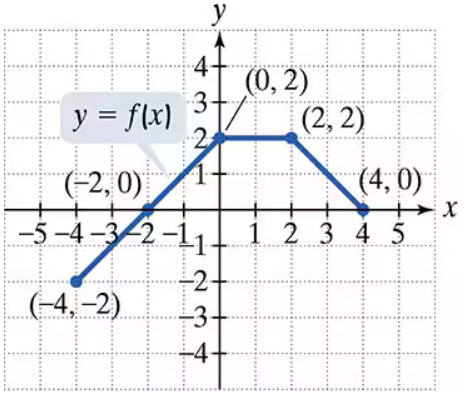
Use the graph of y = f(x) to graph each function g. g(x) = -f(x-1) + 1

Verified step by step guidance
1
Start with the original function \( y = f(x) \). The goal is to graph \( g(x) = -f(x-1) + 1 \) by applying transformations to \( f(x) \).
First, consider the inside of the function argument: \( f(x-1) \). This represents a horizontal shift of the graph of \( f(x) \) to the right by 1 unit.
Next, apply the negative sign in front of \( f(x-1) \), which means reflecting the graph of \( f(x-1) \) across the x-axis (flip it upside down).
Finally, add 1 to the entire function: \( -f(x-1) + 1 \). This shifts the graph vertically upward by 1 unit.
To summarize, start with the graph of \( f(x) \), shift it right by 1 unit, reflect it over the x-axis, then shift it up by 1 unit to obtain the graph of \( g(x) \).

Verified video answer for a similar problem:

This video solution was recommended by our tutors as helpful for the problem above.
Video duration:
3m
Was this helpful?

Key Concepts

Here are the essential concepts you must grasp in order to answer the question correctly.

Function Transformations

Function transformations involve shifting, reflecting, stretching, or compressing the graph of a function. In this problem, the function g(x) is derived from f(x) by applying horizontal shifts, reflections, and vertical shifts, which change the graph's position and orientation without altering its shape.
Recommended video:
4:22
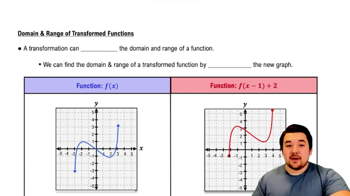
Domain & Range of Transformed Functions

Horizontal Shifts

A horizontal shift moves the graph left or right. For g(x) = -f(x-1) + 1, the term (x-1) inside the function indicates a shift of the graph of f(x) one unit to the right. This means every point on f(x) moves right by 1 unit before other transformations are applied.
Recommended video:
5:34
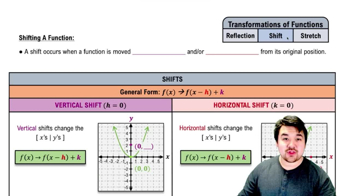
Shifts of Functions

Reflections and Vertical Shifts

The negative sign before f(x-1) reflects the graph across the x-axis, flipping it upside down. The +1 outside the function shifts the entire graph up by one unit. Together, these transformations modify the graph's orientation and vertical position.
Recommended video:
4:25
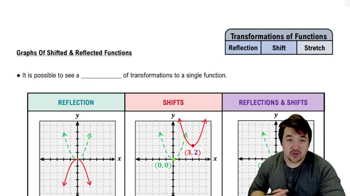
Graphs of Shifted & Reflected Functions