Ch. 2 - Functions and Graphs
Blitzer - College Algebra 8th Edition
Blitzer8th EditionCollege AlgebraISBN: 9780136970514Not the one you use?Change textbook
Chapter 3, Problem 47a

In Exercises 39–50, graph the given functions, f and g, in the same rectangular coordinate system. Select integers for x, starting with -2 and ending with 2. Once you have obtained your graphs, describe how the graph of g is related to the graph of f. f(x) = x³, g(x) = x³ +2

Verified step by step guidance
1
Step 1: Understand the given functions. The first function is f(x) = x³, which is a cubic function. The second function is g(x) = x³ + 2, which is a transformation of the first function. Specifically, g(x) is obtained by adding 2 to f(x), which represents a vertical shift of the graph of f(x) upward by 2 units.
Step 2: Create a table of values for f(x) = x³. Select integer values for x from -2 to 2. For each x, calculate f(x) by cubing the value of x. For example, when x = -2, f(x) = (-2)³ = -8. Repeat this for x = -1, 0, 1, and 2.
Step 3: Create a table of values for g(x) = x³ + 2. Use the same x-values from -2 to 2. For each x, calculate g(x) by first cubing the value of x (as in f(x)) and then adding 2. For example, when x = -2, g(x) = (-2)³ + 2 = -8 + 2 = -6. Repeat this for x = -1, 0, 1, and 2.
Step 4: Plot the points for both functions on the same rectangular coordinate system. Use the (x, f(x)) pairs to plot the graph of f(x) = x³ and the (x, g(x)) pairs to plot the graph of g(x) = x³ + 2. Ensure that the points are accurately plotted and connected smoothly to reflect the cubic nature of the functions.
Step 5: Analyze the relationship between the graphs. Observe that the graph of g(x) = x³ + 2 is identical in shape to the graph of f(x) = x³, but it is shifted vertically upward by 2 units. This confirms that adding a constant to a function results in a vertical translation of the graph.

Verified video answer for a similar problem:

This video solution was recommended by our tutors as helpful for the problem above.
Video duration:
5m
Was this helpful?

Key Concepts

Here are the essential concepts you must grasp in order to answer the question correctly.

Graphing Functions

Graphing functions involves plotting points on a coordinate system based on the function's output for given input values. For the functions f(x) = x³ and g(x) = x³ + 2, you will calculate the output for selected integer values of x, which helps visualize the shape and behavior of the functions. Understanding how to plot these points accurately is essential for comparing the two graphs.
Recommended video:
5:26
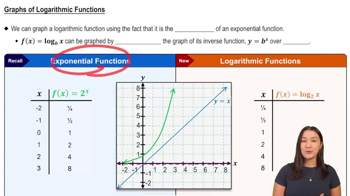
Graphs of Logarithmic Functions

Transformation of Functions

Transformation of functions refers to the changes made to the graph of a function based on modifications to its equation. In this case, g(x) = x³ + 2 represents a vertical shift of the graph of f(x) = x³ upwards by 2 units. Recognizing how transformations affect the position and shape of graphs is crucial for understanding the relationship between f and g.
Recommended video:
4:22
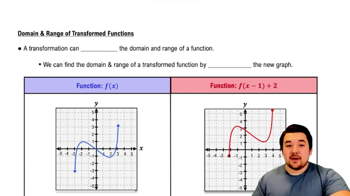
Domain & Range of Transformed Functions

Coordinate System

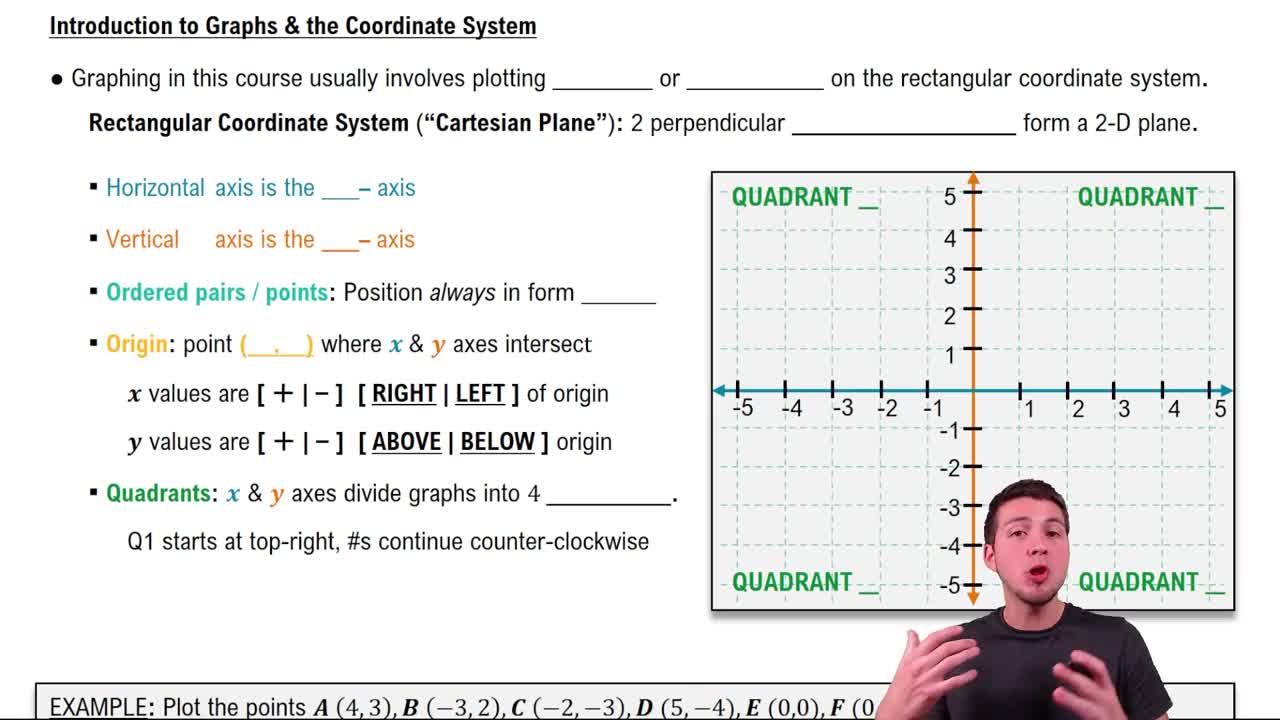
A coordinate system is a two-dimensional plane defined by an x-axis (horizontal) and a y-axis (vertical), where each point is represented by an ordered pair (x, y). Understanding how to navigate this system is vital for accurately plotting the graphs of functions and analyzing their relationships. The rectangular coordinate system is the standard framework used in algebra to visualize functions and their transformations.
Recommended video:
Guided course
05:10
Graphs & the Rectangular Coordinate System