Use the vertical line test to identify graphs in which y is a function of x.
Ch. 2 - Functions and Graphs

Chapter 3, Problem 13
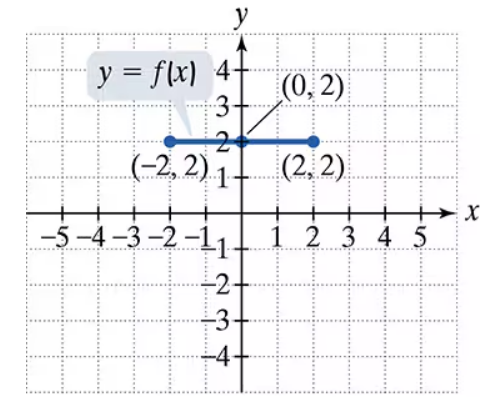
Use the graph of y = f(x) to graph each function g.

g(x) = f(x/2)
Verified step by step guidance1
Step 1: Understand the transformation g(x) = f(x/2). This transformation involves a horizontal stretch of the graph of f(x) by a factor of 2. Each x-coordinate of the points on the graph of f(x) will be multiplied by 2, while the y-coordinates remain unchanged.
Step 2: Identify the key points on the graph of f(x). From the graph, the points are (1, -3) and (4, -3). These points will be transformed according to the horizontal stretch.
Step 3: Apply the transformation to the x-coordinates of the points. Multiply each x-coordinate by 2: For (1, -3), the new x-coordinate is 1 * 2 = 2, so the transformed point is (2, -3). For (4, -3), the new x-coordinate is 4 * 2 = 8, so the transformed point is (8, -3).
Step 4: Plot the transformed points (2, -3) and (8, -3) on the graph. These points represent the new positions of the graph after the horizontal stretch.
Step 5: Draw the graph of g(x) = f(x/2) by connecting the transformed points with a horizontal line, maintaining the same y-value (-3) across the stretch.

Verified video answer for a similar problem:
This video solution was recommended by our tutors as helpful for the problem above.
Video duration:
1mWas this helpful?
Key Concepts
Here are the essential concepts you must grasp in order to answer the question correctly.
Function Transformation
Function transformation refers to the process of altering the graph of a function through various operations, such as shifting, stretching, or compressing. In this case, the function g(x) = f(x/2) represents a horizontal stretch of the original function f(x) by a factor of 2, meaning that every x-coordinate in the graph of f(x) is doubled in g(x).
Recommended video:
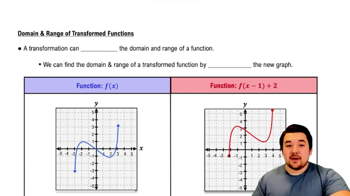
Domain & Range of Transformed Functions
Horizontal Stretch
A horizontal stretch occurs when the x-values of a function are multiplied by a factor less than 1. For g(x) = f(x/2), the x-values are effectively halved, which stretches the graph horizontally. This transformation results in the graph of g(x) appearing wider than that of f(x), as points that were originally close together on f(x) will be spaced further apart on g(x).
Recommended video:
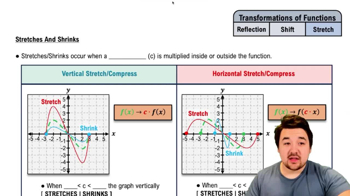
Stretches & Shrinks of Functions
Graph Interpretation
Graph interpretation involves analyzing the visual representation of a function to extract information about its behavior, such as intercepts, maxima, minima, and overall shape. In this exercise, understanding the graph of f(x) is crucial to accurately sketching g(x), as it allows one to see how the transformation affects the positions of key points and the overall structure of the graph.
Recommended video:
Guided course
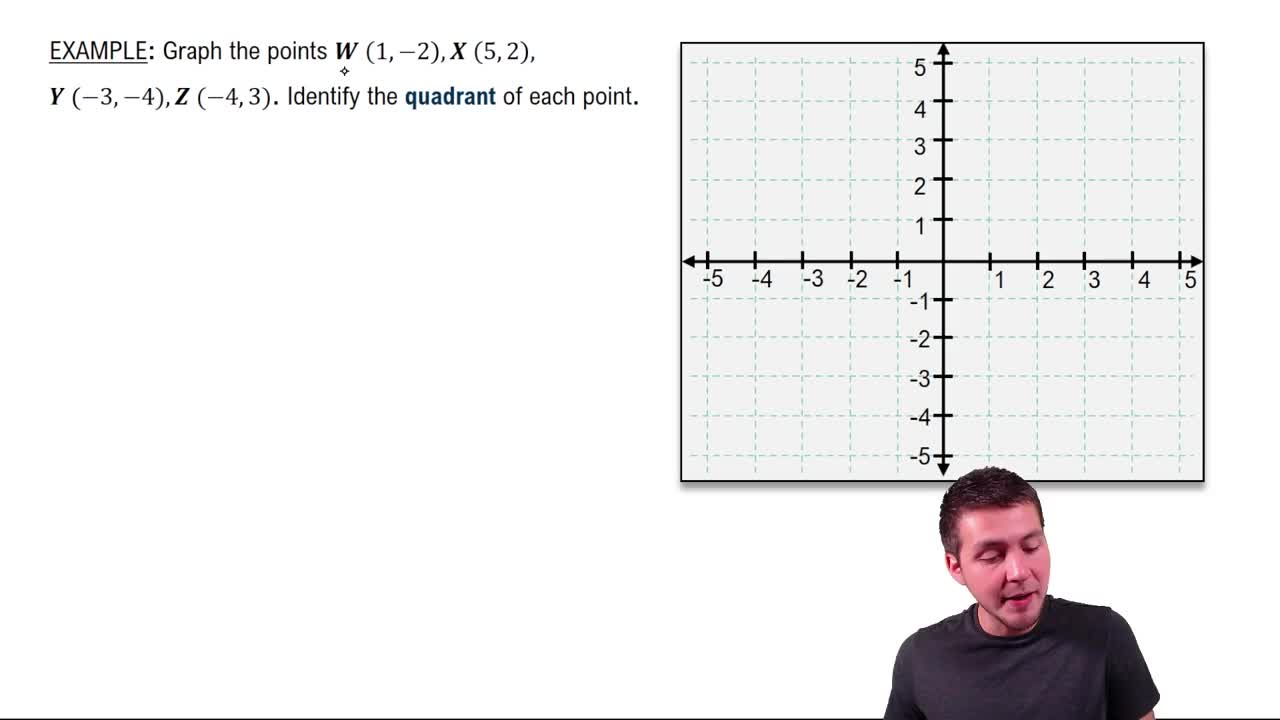
Graphs and Coordinates - Example
Related Practice
Textbook Question
Textbook Question
Find the average rate of change of the function from x1 to x2. f(x) = 3x from x1 = 0 to x2 = 5
Textbook Question
Find the domain of each function. h(x) = 4/(3/x - 1)
Textbook Question
Use the given conditions to write an equation for each line in point-slope form and general form. Passing through (5, −9) and perpendicular to the line whose equation is x + 7y - 12= 0
Textbook Question
Find the distance between each pair of points. If necessary, express answers in simplified radical form and then round to two decimal places. (0, −√3) and (√5, 0)
1
views
Textbook Question
The functions in Exercises 11-28 are all one-to-one. For each function, a. Find an equation for f-1(x), the inverse function. b. Verify that your equation is correct by showing that f(ƒ-1 (x)) = = x and ƒ-1 (f(x)) = x. f(x) = 2x