Find the average rate of change of the function from x1 to x2. f(x) = 3x from x1 = 0 to x2 = 5
Ch. 2 - Functions and Graphs

Chapter 3, Problem 13a
Find the domain of each function. h(x) = 4/(3/x - 1)
Verified step by step guidance1
Step 1: Recall that the domain of a function consists of all input values (x) for which the function is defined. For rational functions, the denominator cannot be zero because division by zero is undefined.
Step 2: Analyze the given function h(x) = 4/(3/x - 1). Notice that the denominator is (3/x - 1). To ensure the function is defined, set the denominator not equal to zero: 3/x - 1 ≠ 0.
Step 3: Solve the inequality 3/x - 1 ≠ 0. First, isolate the term 3/x by adding 1 to both sides: 3/x ≠ 1.
Step 4: Eliminate the fraction by multiplying both sides of the inequality by x (assuming x ≠ 0): 3 ≠ x. Additionally, x ≠ 0 must be considered because division by zero is undefined.
Step 5: Combine the restrictions: x ≠ 0 and x ≠ 3. The domain of h(x) is all real numbers except x = 0 and x = 3.

Verified video answer for a similar problem:
This video solution was recommended by our tutors as helpful for the problem above.
Video duration:
2mWas this helpful?
Key Concepts
Here are the essential concepts you must grasp in order to answer the question correctly.
Domain of a Function
The domain of a function refers to the set of all possible input values (x-values) for which the function is defined. For rational functions, the domain is typically restricted by values that would make the denominator zero, as division by zero is undefined.
Recommended video:
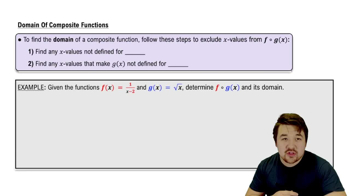
Domain Restrictions of Composed Functions
Rational Functions
A rational function is a function that can be expressed as the ratio of two polynomials. In the case of h(x) = 4/(3/x - 1), the denominator is a polynomial expression, and identifying its zeros is crucial for determining the domain.
Recommended video:
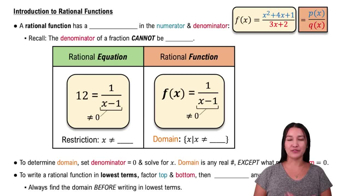
Intro to Rational Functions
Finding Restrictions
To find the domain of a function, one must identify any restrictions on the variable. For the function h(x), we need to solve the equation in the denominator, 3/x - 1 = 0, to find values of x that would make the function undefined, thus determining the valid domain.
Recommended video:
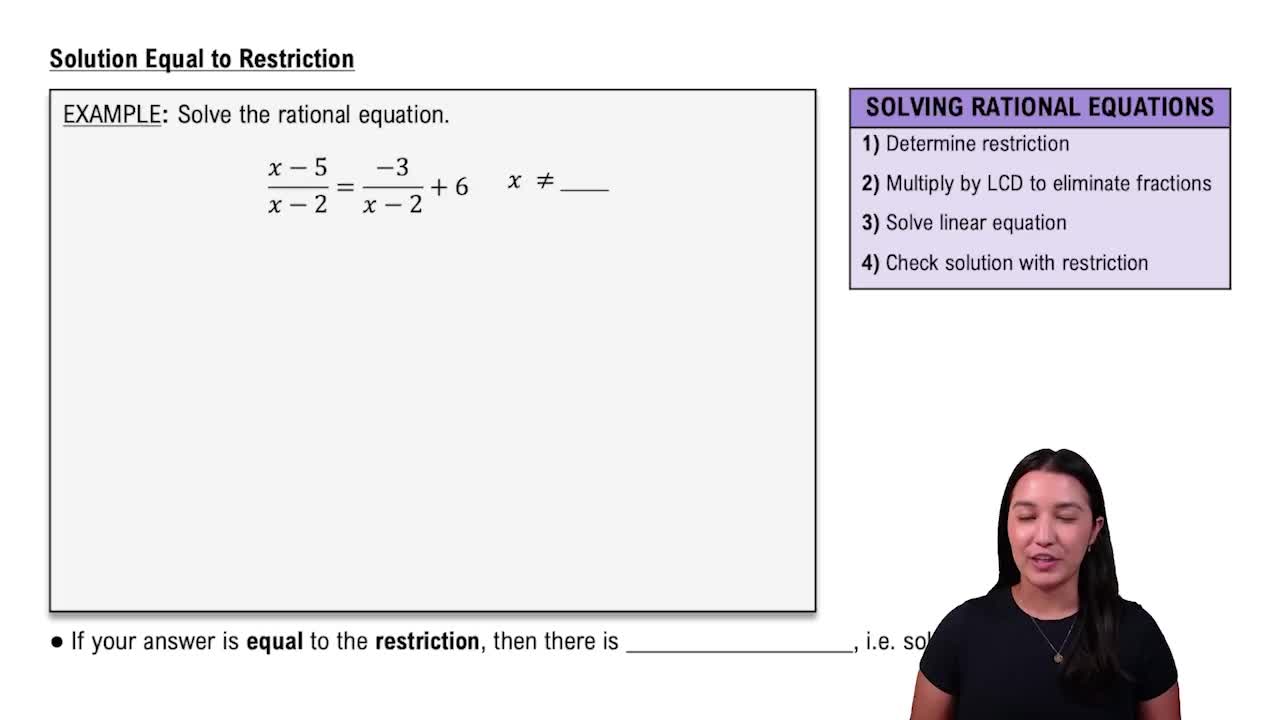
Restrictions on Rational Equations
Related Practice
Textbook Question
Textbook Question
Use the given conditions to write an equation for each line in point-slope form and slope-intercept form. Slope = 8, passing through (4, −1)
1
views
Textbook Question
Use the graph of y = f(x) to graph each function g.
g(x) = f(x/2)
1
views
Textbook Question
The functions in Exercises 11-28 are all one-to-one. For each function, a. Find an equation for f-1(x), the inverse function. b. Verify that your equation is correct by showing that f(ƒ-1 (x)) = = x and ƒ-1 (f(x)) = x. f(x) = 2x
Textbook Question
Find the distance between each pair of points. If necessary, express answers in simplified radical form and then round to two decimal places. (0, -√2) and (√7,0)
1
views
Textbook Question
In Exercises 11–26, determine whether each equation defines y as a function of x. x² + y = 25