Ch. 1 - Equations and Inequalities
Blitzer - College Algebra 8th Edition
Blitzer8th EditionCollege AlgebraISBN: 9780136970514Not the one you use?Change textbook
Chapter 2, Problem 107

When 3 times a number is subtracted from 4, the absolute value of the difference is at least 5. Use interval notation to express the set of all numbers that satisfy this condition.

Verified step by step guidance
1
Let the number be represented by the variable \(x\). The expression "3 times a number" is \$3x$, and "4 minus 3 times a number" is written as \(4 - 3x\).
The problem states that the absolute value of this difference is at least 5. This can be written as the inequality \(|4 - 3x| \geq 5\).
Recall that the absolute value inequality \(|A| \geq B\) (where \(B > 0\)) can be rewritten as two separate inequalities: \(A \leq -B\) or \(A \geq B\). Applying this, we get two inequalities: \(4 - 3x \leq -5\) or \(4 - 3x \geq 5\).
Solve each inequality separately for \(x\). For \(4 - 3x \leq -5\), subtract 4 from both sides and then divide by -3, remembering to reverse the inequality sign when dividing by a negative number. For \(4 - 3x \geq 5\), do the same steps but keep the inequality direction the same.
Express the solutions from both inequalities in interval notation and combine them using the union symbol \(\cup\) to represent all values of \(x\) that satisfy the original absolute value inequality.

Verified video answer for a similar problem:

This video solution was recommended by our tutors as helpful for the problem above.
Video duration:
4m
Was this helpful?

Key Concepts

Here are the essential concepts you must grasp in order to answer the question correctly.

Absolute Value Inequalities

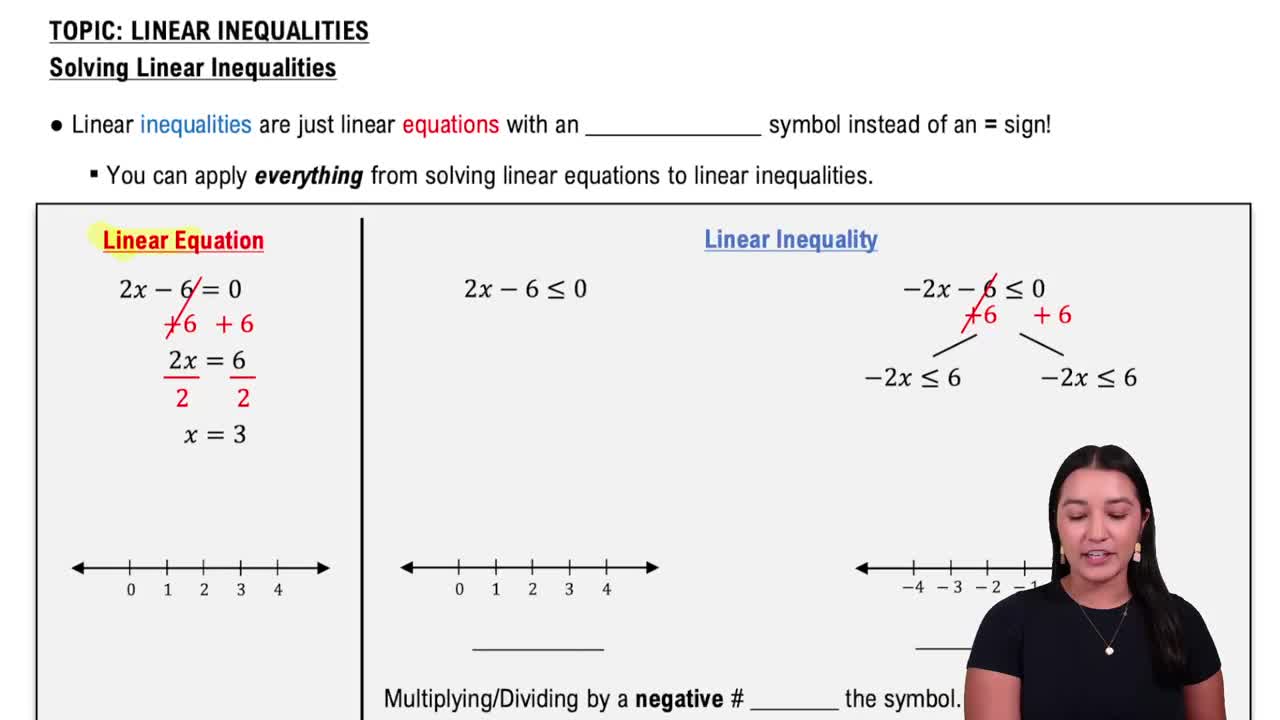
Absolute value inequalities involve expressions where the absolute value of an algebraic expression is compared to a number. The inequality |A| ≥ B means that the expression A is either greater than or equal to B or less than or equal to -B. This concept helps in splitting the problem into two separate inequalities to solve.
Recommended video:
06:07
Linear Inequalities

Translating Word Problems into Algebraic Expressions

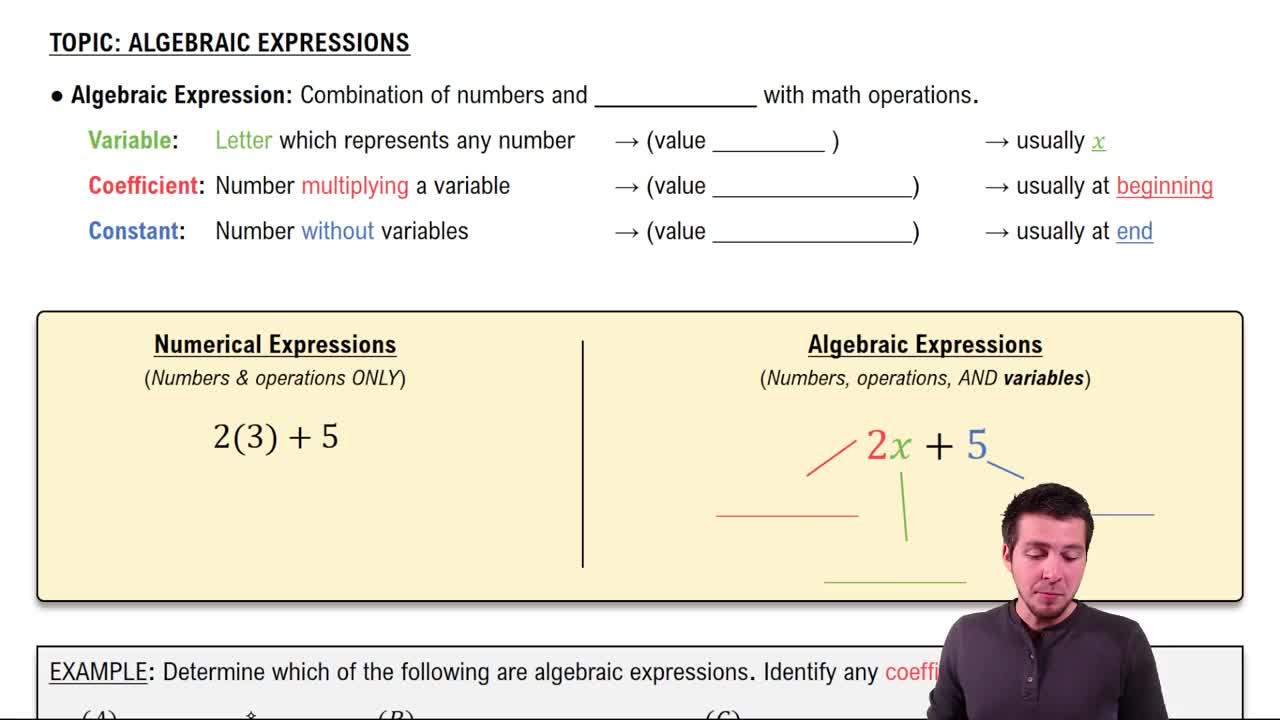
This involves converting verbal statements into mathematical expressions or equations. For example, '3 times a number' translates to 3x, and 'subtracted from 4' means 4 - 3x. Understanding this translation is crucial to formulating the correct inequality to solve.
Recommended video:
Guided course
05:09
Introduction to Algebraic Expressions

Interval Notation

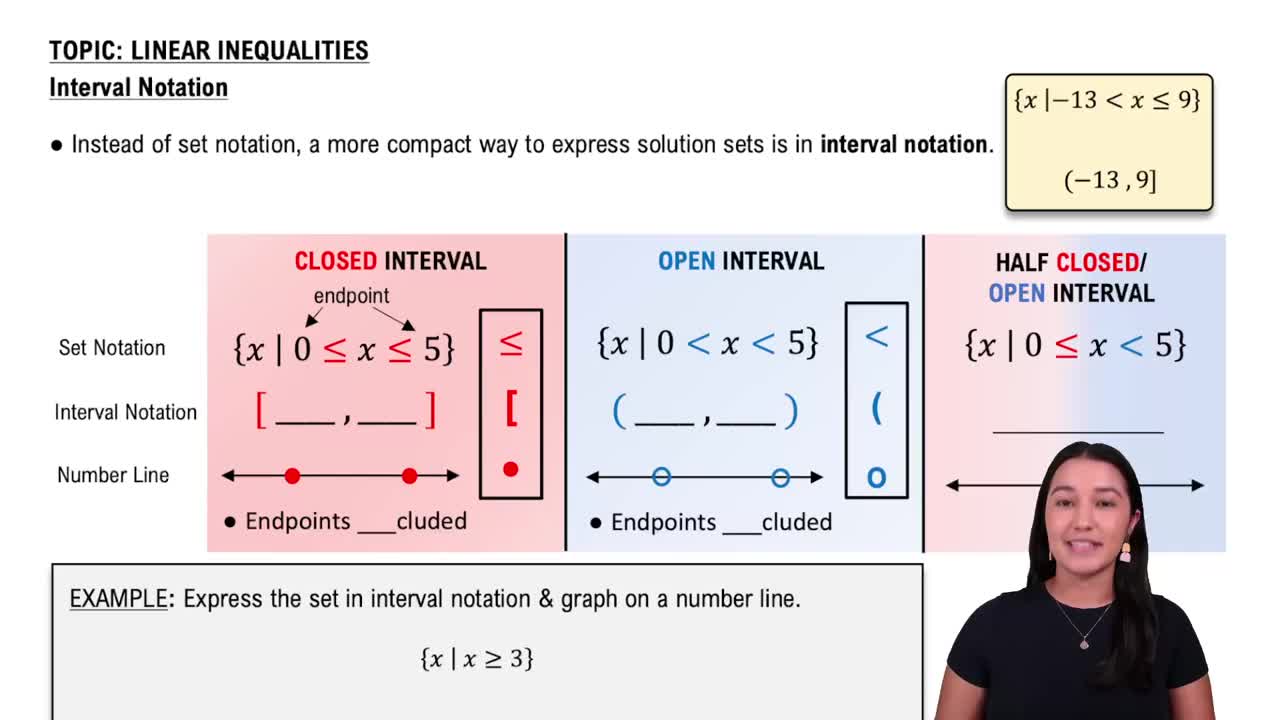
Interval notation is a way to represent sets of numbers on the number line. It uses parentheses and brackets to denote open or closed intervals, respectively. After solving inequalities, interval notation succinctly expresses the solution set, such as (-∞, a] ∪ [b, ∞).
Recommended video:
05:18
Interval Notation