Ch. 1 - Equations and Inequalities
Blitzer - College Algebra 8th Edition
Blitzer8th EditionCollege AlgebraISBN: 9780136970514Not the one you use?Change textbook
Chapter 2, Problem 106

Solve each equation in Exercises 83–108 by the method of your choice. 1/x + 1/(x + 3) = 1/4

Verified step by step guidance
1
Identify the equation: \(\frac{1}{x} + \frac{1}{x + 3} = \frac{1}{4}\).
Find the least common denominator (LCD) for the fractions, which is \(4x(x + 3)\).
Multiply both sides of the equation by the LCD to eliminate the denominators: \(4x(x + 3) \times \left( \frac{1}{x} + \frac{1}{x + 3} \right) = 4x(x + 3) \times \frac{1}{4}\).
Simplify each term after multiplication: \(4(x + 3) + 4x = x(x + 3)\).
Rewrite the equation and expand all terms to form a quadratic equation: \(4x + 12 + 4x = x^2 + 3x\), then combine like terms and set the equation to zero.

Verified video answer for a similar problem:

This video solution was recommended by our tutors as helpful for the problem above.
Video duration:
4m
Was this helpful?

Key Concepts

Here are the essential concepts you must grasp in order to answer the question correctly.

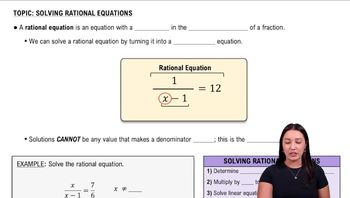
Solving Rational Equations

Rational equations involve expressions with variables in the denominator. To solve them, find a common denominator to combine terms or clear denominators by multiplying both sides, ensuring to check for excluded values that make denominators zero.
Recommended video:
05:56
Introduction to Rational Equations

Finding the Least Common Denominator (LCD)

The LCD is the smallest expression that all denominators divide into evenly. Identifying the LCD allows you to combine fractions or eliminate denominators by multiplying through, simplifying the equation to a polynomial or linear form.
Recommended video:
Guided course
03:42
Rationalizing Denominators Using Conjugates

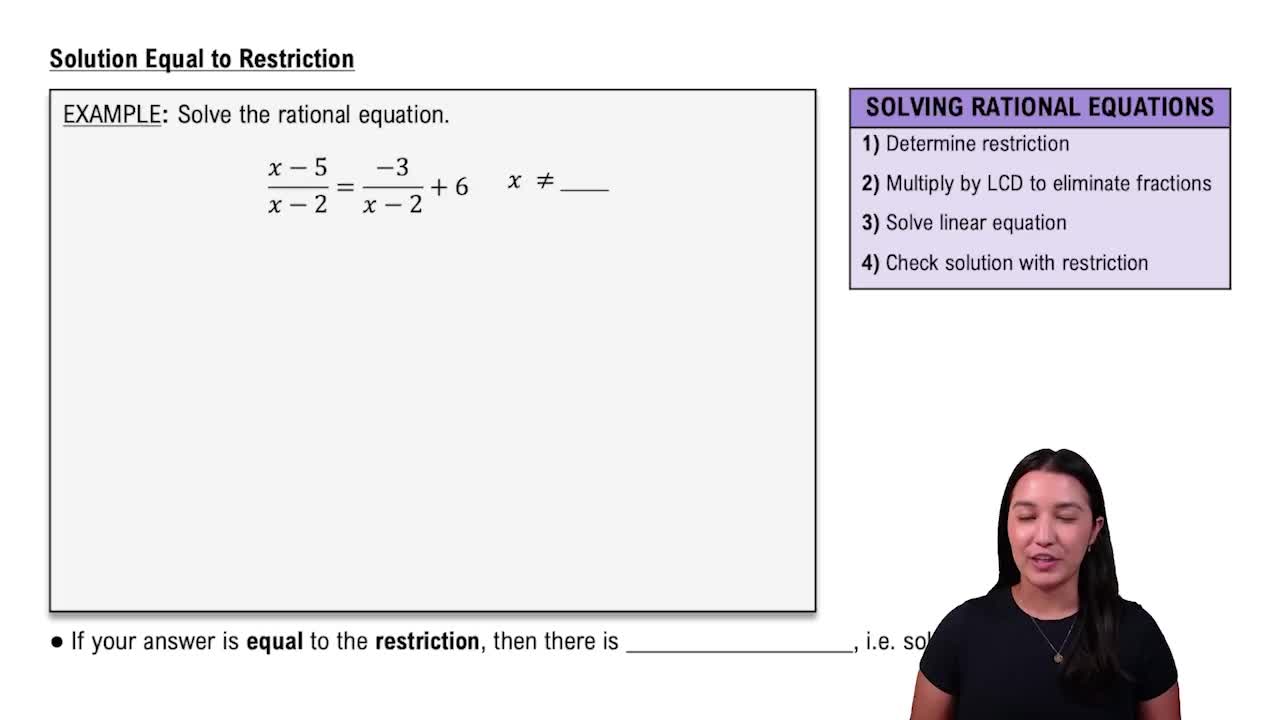
Checking for Extraneous Solutions

When solving rational equations, some solutions may make denominators zero, which are invalid. After finding potential solutions, substitute them back into the original equation to ensure they do not cause division by zero.
Recommended video:
05:21
Restrictions on Rational Equations