Ch. 1 - Equations and Inequalities
Blitzer - College Algebra 8th Edition
Blitzer8th EditionCollege AlgebraISBN: 9780136970514Not the one you use?Change textbook
Chapter 2, Problem 106

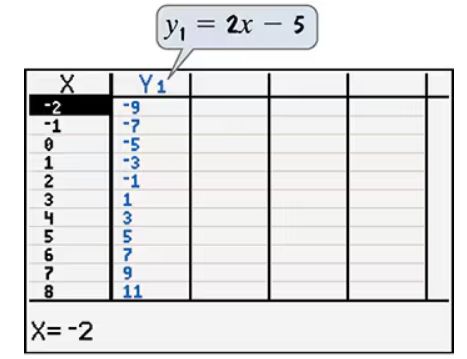
Use the table to solve each inequality. - 3 < 2x - 5 ≤ 3

Verified step by step guidance
1
Start with the compound inequality: \(3 < 2x - 5 \leq 3\).
Break the compound inequality into two separate inequalities: 1) \(3 < 2x - 5\) 2) \(2x - 5 \leq 3\).
Solve the first inequality \(3 < 2x - 5\) by adding 5 to both sides: \(3 + 5 < 2x\), which simplifies to \(8 < 2x\). Then divide both sides by 2 to isolate \(x\): \(4 < x\).
Solve the second inequality \(2x - 5 \leq 3\) by adding 5 to both sides: \(2x \leq 8\). Then divide both sides by 2: \(x \leq 4\).
Combine the two results to find the solution to the compound inequality: \(4 < x \leq 4\). Since this is a contradiction (no number is both greater than 4 and less than or equal to 4), check the table values for \(x\) and \(y = 2x - 13\) to verify if any \(x\) satisfies the original inequality.

Verified video answer for a similar problem:

This video solution was recommended by our tutors as helpful for the problem above.
Video duration:
3m
Was this helpful?

Key Concepts

Here are the essential concepts you must grasp in order to answer the question correctly.

Solving Compound Inequalities

A compound inequality involves two inequalities joined by 'and' or 'or'. To solve, treat each inequality separately and find the intersection (for 'and') or union (for 'or') of their solution sets. For example, solving 3 < 2x - 5 ≤ 3 requires isolating x in both inequalities and combining the results.
Recommended video:
06:07
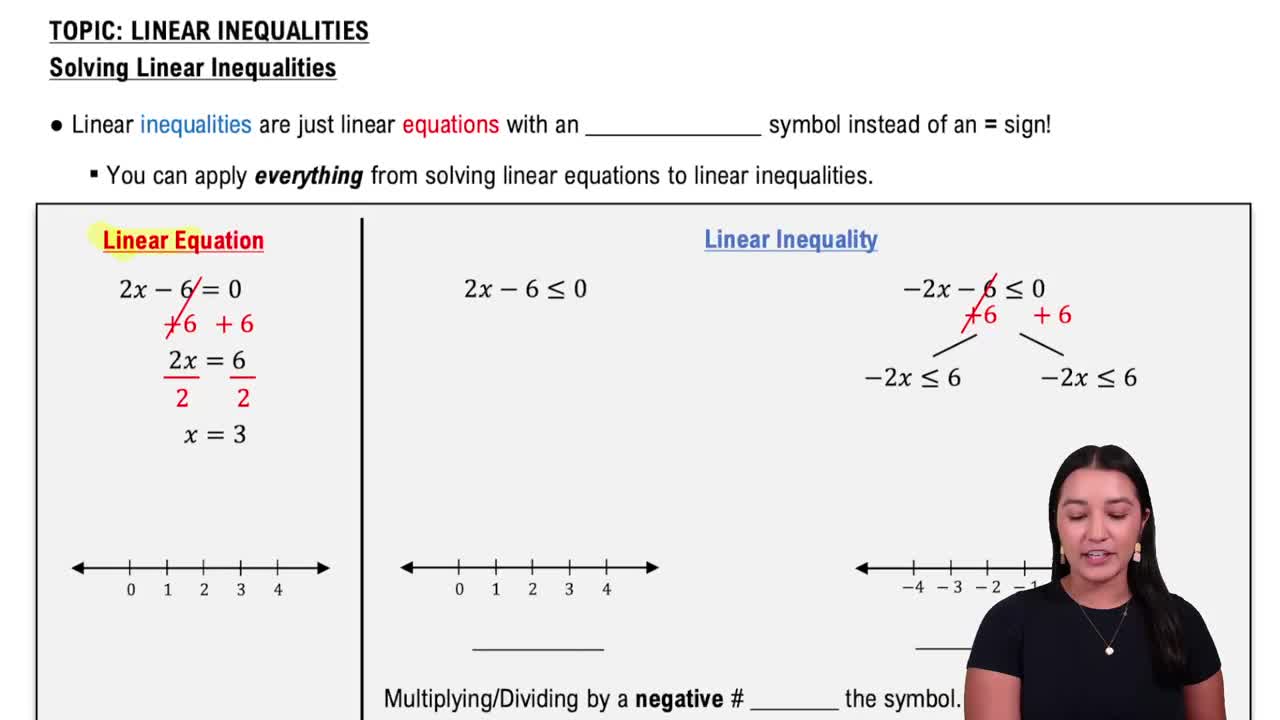
Linear Inequalities

Using Tables to Solve Inequalities

Tables can help solve inequalities by providing values of expressions for specific x-values. By comparing the expression values to the inequality bounds, you can identify which x-values satisfy the inequality. This method is useful when direct algebraic manipulation is complex or when verifying solutions.
Recommended video:
06:07
Linear Inequalities

Linear Functions and Their Graphs

A linear function like y = 2x - 13 produces a straight line when graphed. Understanding how changes in x affect y helps solve inequalities involving linear expressions. The table shows corresponding y-values for given x-values, illustrating the function's behavior and aiding in solving inequalities.
Recommended video:
5:26
Graphs of Logarithmic Functions