In Exercises 71–78, solve each equation. Then determine whether the equation is an identity, a conditional equation, or an inconsistent equation. 5x + 7 = 2x + 7
Ch. 1 - Equations and Inequalities

Chapter 2, Problem 77
Solve each equation by the method of your choice.
Verified step by step guidance1
Start with the given equation: \( (x-3)^2 - 25 = 0 \).
Isolate the squared term by adding 25 to both sides: \( (x-3)^2 = 25 \).
Take the square root of both sides, remembering to consider both the positive and negative roots: \( x - 3 = \pm \sqrt{25} \).
Simplify the square root: \( x - 3 = \pm 5 \).
Solve for \(x\) by adding 3 to both sides for each case: \( x = 3 + 5 \) and \( x = 3 - 5 \).

Verified video answer for a similar problem:
This video solution was recommended by our tutors as helpful for the problem above.
Video duration:
2mWas this helpful?
Key Concepts
Here are the essential concepts you must grasp in order to answer the question correctly.
Solving Quadratic Equations
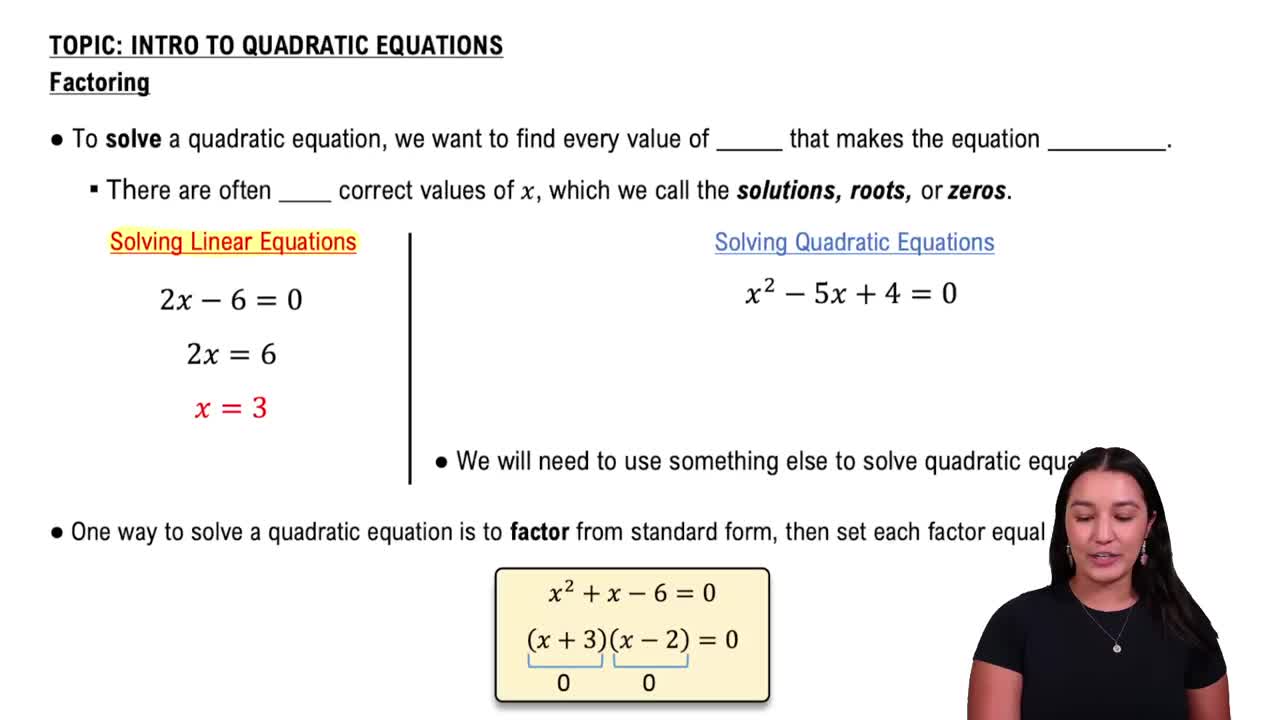
Quadratic equations are polynomial equations of degree two, typically in the form ax² + bx + c = 0. Solving them involves finding values of x that satisfy the equation. Common methods include factoring, completing the square, and using the quadratic formula.
Recommended video:
Solving Quadratic Equations by Factoring
Difference of Squares
The difference of squares is a special factoring technique where an expression of the form a² - b² can be factored into (a - b)(a + b). Recognizing this pattern simplifies solving equations like (x - 3)² - 25 = 0 by rewriting 25 as 5².
Recommended video:
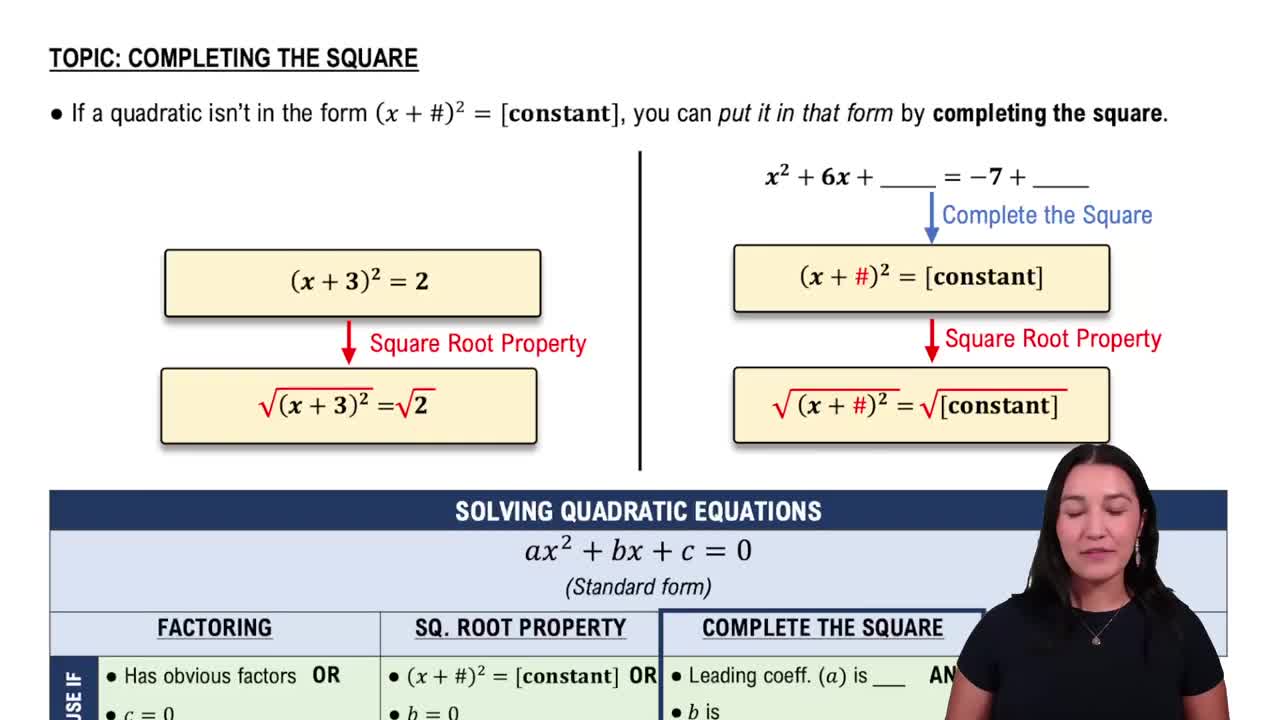
Solving Quadratic Equations by Completing the Square
Isolating the Variable
Isolating the variable means manipulating the equation to get x alone on one side. This often involves adding, subtracting, multiplying, dividing, or taking roots. It is a fundamental step in solving equations to find the exact values of the unknown.
Recommended video:
Guided course
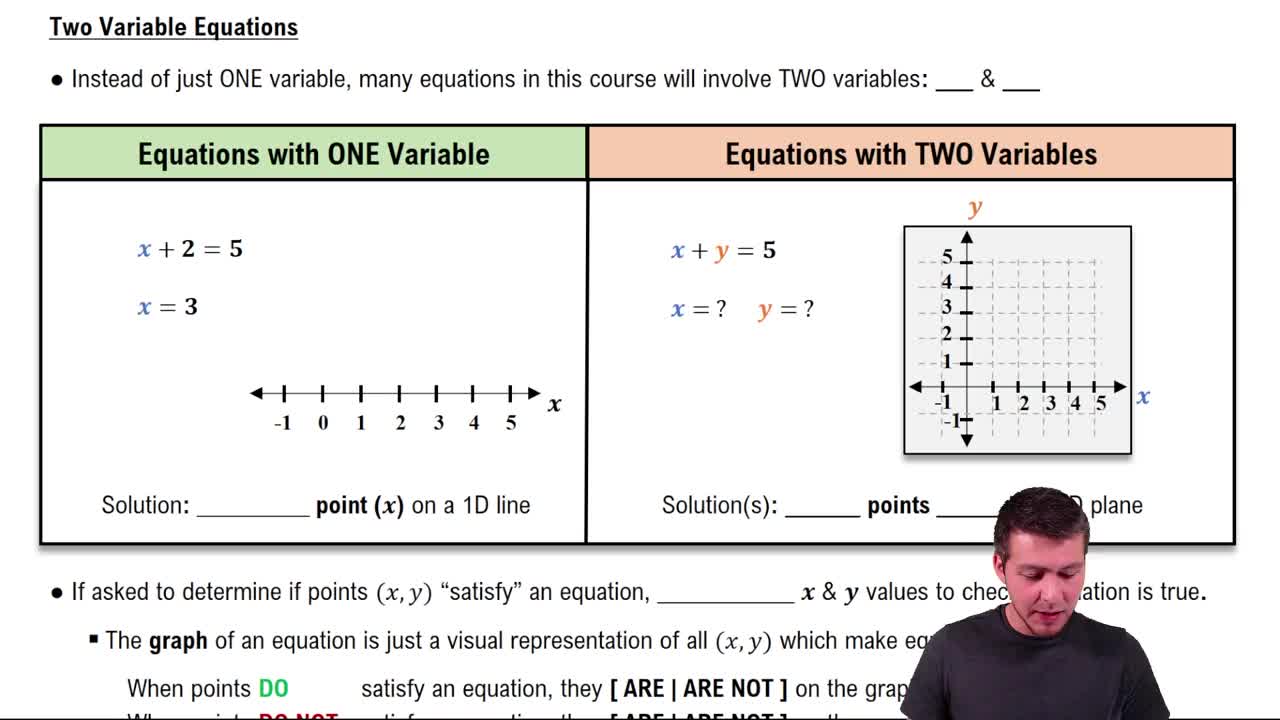
Equations with Two Variables
Related Practice
Textbook Question
Textbook Question
In Exercises 59–94, solve each absolute value inequality. |3 - (2/3)x| > 5
Textbook Question
In Exercises 75–82, compute the discriminant. Then determine the number and type of solutions for the given equation.
3
views
Textbook Question
The rule for rewriting an absolute value equation without absolute value bars can be extended to equations with two sets of absolute value bars: If u and v represent algebraic expressions, then |u| = |v| is equivalent to u = v or u = - v. Use this to solve the equations in Exercises 77–84. |3x - 1| = |x + 5|
1
views
Textbook Question
In Exercises 59–94, solve each absolute value inequality. 3|x - 1| + 2 ≥ 8
Textbook Question
List the quadrant or quadrants satisfying each condition. x3 > 0 and y3 <0
7
views