In Exercises 71–78, solve each equation. Then determine whether the equation is an identity, a conditional equation, or an inconsistent equation. 5x + 7 = 2x + 7
Ch. 1 - Equations and Inequalities

Chapter 2, Problem 77
In Exercises 75–82, compute the discriminant. Then determine the number and type of solutions for the given equation.
Verified step by step guidance1
Identify the coefficients in the quadratic equation \(2x^2 - 11x + 3 = 0\). Here, \(a = 2\), \(b = -11\), and \(c = 3\).
Recall the formula for the discriminant: \(\Delta = b^2 - 4ac\).
Substitute the values of \(a\), \(b\), and \(c\) into the discriminant formula: \(\Delta = (-11)^2 - 4 \times 2 \times 3\).
Simplify the expression to find the value of the discriminant (do not calculate the final number yet).
Use the value of the discriminant to determine the number and type of solutions: if \(\Delta > 0\), there are two distinct real solutions; if \(\Delta = 0\), there is one real solution; if \(\Delta < 0\), there are two complex solutions.

Verified video answer for a similar problem:
This video solution was recommended by our tutors as helpful for the problem above.
Video duration:
2mWas this helpful?
Key Concepts
Here are the essential concepts you must grasp in order to answer the question correctly.
Quadratic Equation
A quadratic equation is a second-degree polynomial equation in the form ax² + bx + c = 0, where a, b, and c are constants and a ≠ 0. It represents a parabola when graphed and can have zero, one, or two real solutions depending on its coefficients.
Recommended video:
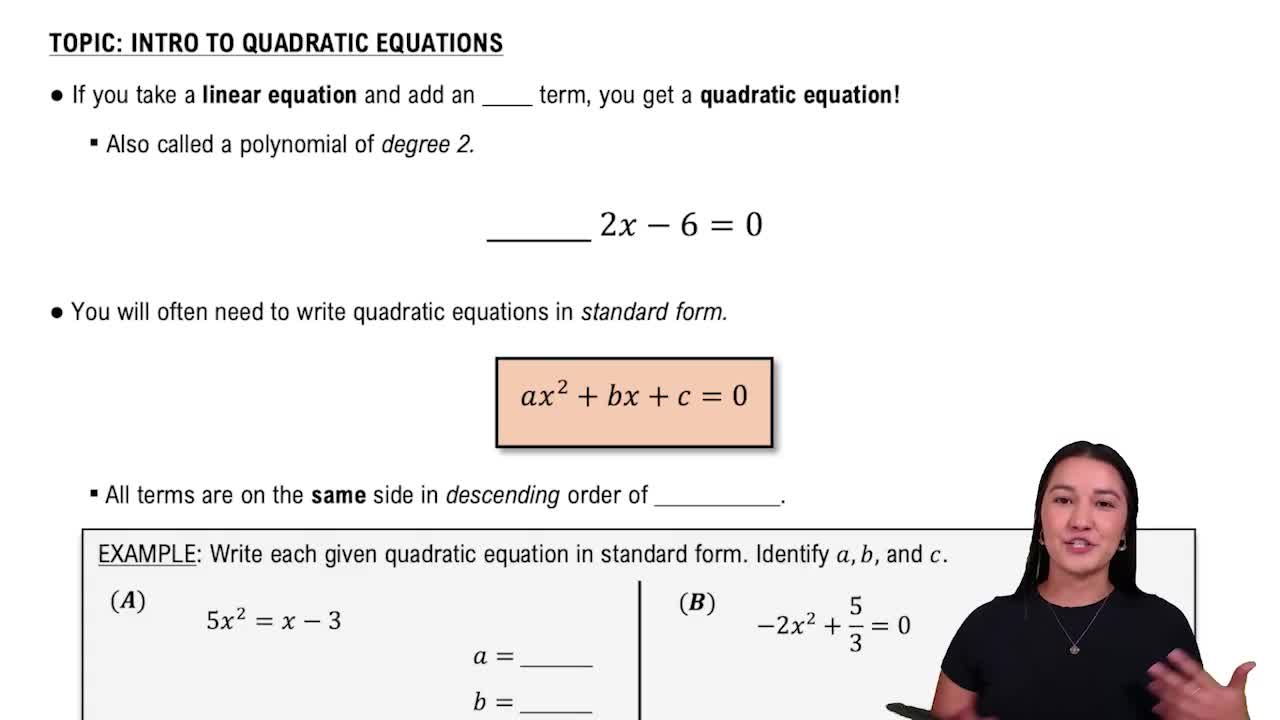
Introduction to Quadratic Equations
Discriminant
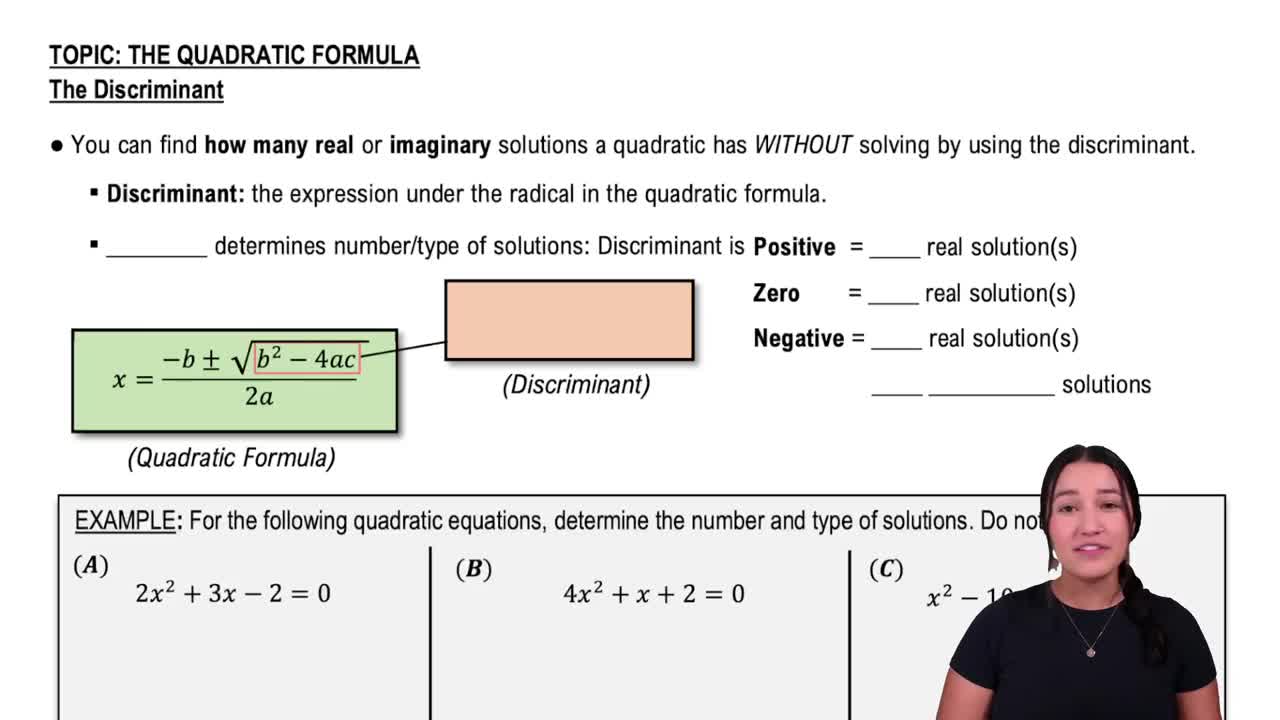
The discriminant is the part of the quadratic formula under the square root, given by b² - 4ac. It determines the nature and number of solutions of a quadratic equation: if positive, two distinct real solutions; if zero, one real repeated solution; if negative, two complex solutions.
Recommended video:
The Discriminant
Types of Solutions of Quadratic Equations
The solutions of a quadratic equation can be real or complex. Based on the discriminant, the equation may have two distinct real roots, one repeated real root, or two complex conjugate roots. Understanding these types helps in interpreting the behavior of the quadratic function.
Recommended video:
Introduction to Quadratic Equations
Related Practice
Textbook Question
Textbook Question
In Exercises 59–94, solve each absolute value inequality. |3 - (2/3)x| > 5
Textbook Question
Exercises 73–75 will help you prepare for the material covered in the next section. Rationalize the denominator: (7 + 4√2)/(2 - 5√2).
1
views
Textbook Question
The rule for rewriting an absolute value equation without absolute value bars can be extended to equations with two sets of absolute value bars: If u and v represent algebraic expressions, then |u| = |v| is equivalent to u = v or u = - v. Use this to solve the equations in Exercises 77–84. |3x - 1| = |x + 5|
1
views
Textbook Question
In Exercises 61–76, solve each absolute value equation or indicate that the equation has no solution. |2x - 1| + 3 = 3
1
views
Textbook Question
Solve each equation by the method of your choice.