Ch. 1 - Equations and Inequalities
Blitzer - College Algebra 8th Edition
Blitzer8th EditionCollege AlgebraISBN: 9780136970514Not the one you use?Change textbook
Chapter 2, Problem 77a

List the quadrant or quadrants satisfying each condition. x3 > 0 and y3 <0

Verified step by step guidance
1
Understand the problem: We are tasked with identifying the quadrant(s) where the conditions x^3 > 0 and y^3 < 0 are satisfied. Recall that the Cartesian plane is divided into four quadrants, and the signs of x and y in each quadrant determine the conditions.
Analyze the condition x^3 > 0: The cube of x is positive when x itself is positive. This means x > 0. On the Cartesian plane, x > 0 corresponds to Quadrants I and IV.
Analyze the condition y^3 < 0: The cube of y is negative when y itself is negative. This means y < 0. On the Cartesian plane, y < 0 corresponds to Quadrants III and IV.
Combine the conditions: For both conditions to be true simultaneously, we need a quadrant where x > 0 and y < 0. From the analysis, this occurs in Quadrant IV.
Conclude the solution: The quadrant that satisfies the conditions x^3 > 0 and y^3 < 0 is Quadrant IV.

Verified video answer for a similar problem:

This video solution was recommended by our tutors as helpful for the problem above.
Video duration:
5m
Was this helpful?

Key Concepts

Here are the essential concepts you must grasp in order to answer the question correctly.

Quadrants of the Cartesian Plane

The Cartesian plane is divided into four quadrants based on the signs of the x and y coordinates. Quadrant I has both x and y positive, Quadrant II has x negative and y positive, Quadrant III has both x and y negative, and Quadrant IV has x positive and y negative. Understanding these quadrants is essential for determining where specific conditions hold true.
Recommended video:
06:36
Solving Quadratic Equations Using The Quadratic Formula

Inequalities and Their Solutions

Inequalities express a relationship where one side is not equal to the other, often involving greater than (>) or less than (<) symbols. In this case, x^3 > 0 indicates that x must be positive, while y^3 < 0 indicates that y must be negative. Solving these inequalities helps identify the values of x and y that satisfy the given conditions.
Recommended video:
06:07
Linear Inequalities

Cubic Functions and Their Behavior

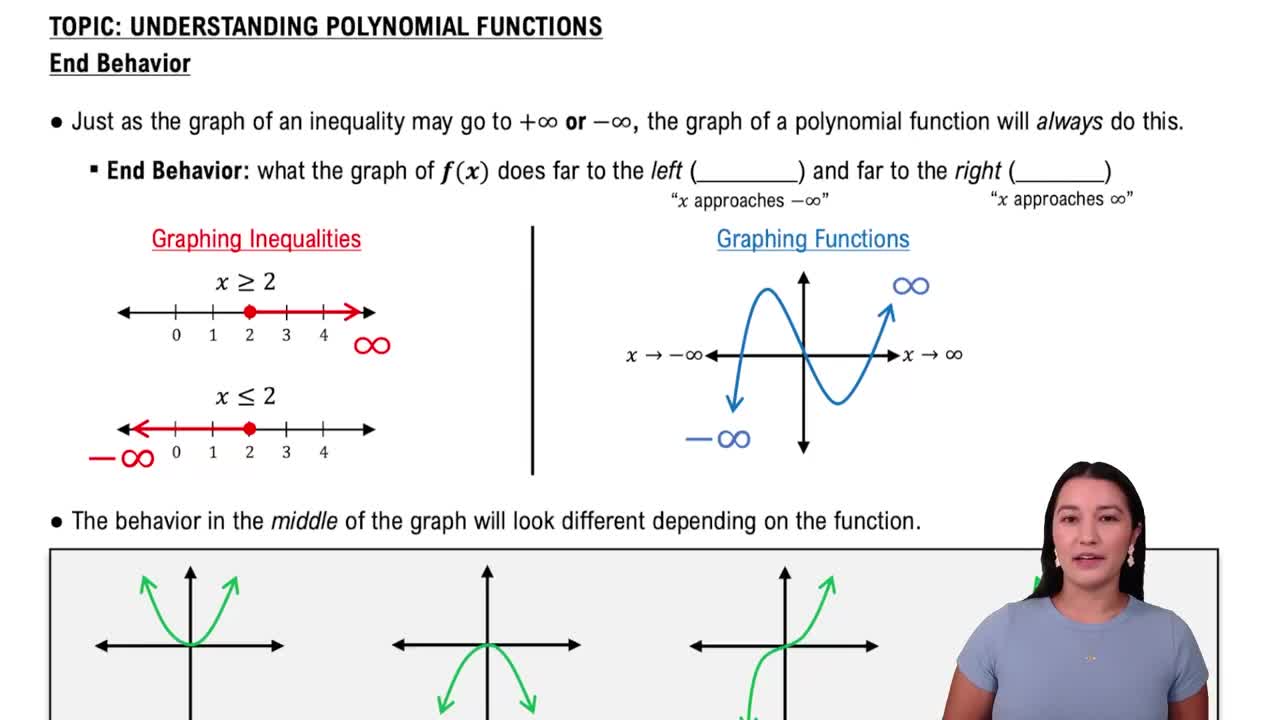
Cubic functions, such as f(x) = x^3, exhibit specific behaviors based on the sign of x. For positive x, the output is positive, and for negative x, the output is negative. This characteristic is crucial for understanding the conditions x^3 > 0 and y^3 < 0, as it directly influences the signs of x and y in the context of the quadrants.
Recommended video:
06:08
End Behavior of Polynomial Functions