Ch. 9 - First-Order Differential Equations
Hass - Thomas' Calculus 15th Edition
Hass15th EditionThomas' CalculusISBN: 9780137616077Not the one you use?Change textbook
Chapter 9, Problem 9.2.16

Solving Initial Value Problems
Solve the initial value problems in Exercises 15–20.


t dy/dt + 2y = t³, t > 0, y(2) = 1

Verified step by step guidance
1
Rewrite the given differential equation in standard linear form by dividing both sides by \(t\) (since \(t > 0\)): \[\frac{dy}{dt} + \frac{2}{t} y = t^2\]
Identify the integrating factor \(\mu(t)\), which is given by: \[\mu(t) = e^{\int P(t) \, dt} = e^{\int \frac{2}{t} \, dt}\]
Calculate the integrating factor \(\mu(t)\) explicitly by evaluating the integral: \[\mu(t) = e^{2 \ln |t|} = e^{\ln |t|^2} = t^2\] (since \(t > 0\), absolute value can be dropped)
Multiply both sides of the differential equation by the integrating factor \(t^2\) to write the left side as a derivative of a product: \[t^2 \frac{dy}{dt} + 2t y = t^4\] which can be expressed as: \[\frac{d}{dt} (t^2 y) = t^4\]
Integrate both sides with respect to \(t\): \[\int \frac{d}{dt} (t^2 y) \, dt = \int t^4 \, dt\] This gives: \[t^2 y = \frac{t^5}{5} + C\] where \(C\) is the constant of integration. Use the initial condition \(y(2) = 1\) to solve for \(C\).

Verified video answer for a similar problem:

This video solution was recommended by our tutors as helpful for the problem above.
Video duration:
3m
Was this helpful?

Key Concepts

Here are the essential concepts you must grasp in order to answer the question correctly.

First-Order Linear Differential Equations

These are differential equations of the form dy/dt + P(t)y = Q(t). They can be solved using an integrating factor, which simplifies the equation into an exact derivative, allowing integration on both sides to find the general solution.
Recommended video:
07:39
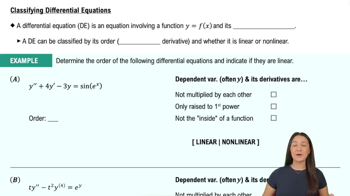
Classifying Differential Equations

Integrating Factor Method

The integrating factor is a function, usually denoted μ(t) = e^(∫P(t) dt), used to multiply both sides of a linear differential equation. This transforms the left side into the derivative of (μ(t)y), making it easier to integrate and solve for y.
Recommended video:
07:33
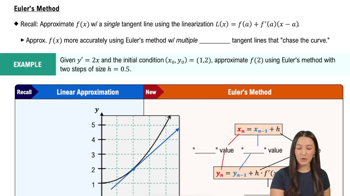
Euler's Method

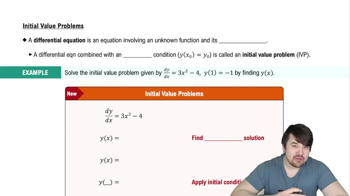
Initial Value Problems (IVP)

An IVP specifies the value of the unknown function at a particular point, such as y(2) = 1. After finding the general solution, the initial condition is used to determine the specific constant, yielding a unique solution to the differential equation.
Recommended video:
05:03
Initial Value Problems